

253
15.4.4 Augusta Sundial (1870)
On the facade of the Palazzo Municipale of Augusta (in the province of Syracuse,
Sicily), on the first floor and opposite the emblem of the city, two large inscriptions
in the wall recall a very significant event for the territory: the observation of the
solar eclipse of December 22, 1870 and the related scientific expedition of which
Secchi was a participant. Engraved on one of them are the hour lines of a local solar
time sundial,
26
with the insertion of an analemma on the noon line for the calculation of mean time. The project was the work of Giovanni Battista Donati and Angelo
Secchi (Fig. 15.2).
As already noted, in 1866 Sicily had no intention of adopting Roman mean time,
given that the only railway in the territory was the Palermo-Bagheria line, which did
not connect up with the national network. In the second inscription, we read the following: “The year MDCCCLXX/22 December/obscured by a total eclipse/the light
of the sun/distinguished stargazers/came here/from various regions of Europe/to
study the phenomenon/they requested this meridian line/designed by/G. B. Donati
and P. A. Secchi/entrusting its memory/to the future.”
26 Chinnici Ileana (ed.), The total eclipse of the Sun of 1870 in Sicily, Letters of Pietro Tacchini to
Gaetano Hunter. INAF- Astronomical Observatory of Palermo, 2008
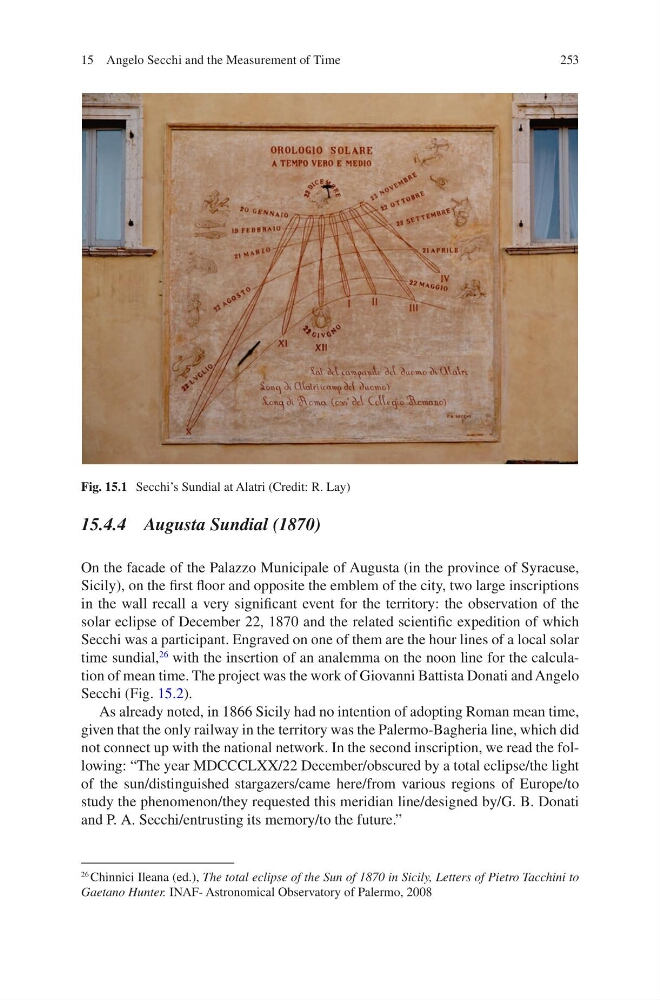
Fig. 15.1 Secchi’s Sundial at Alatri (Credit: R. Lay)
15 Angelo Secchi and the Measurement of Time
15.4.4 Augusta Sundial (1870)
On the facade of the Palazzo Municipale of Augusta (in the province of Syracuse,
Sicily), on the first floor and opposite the emblem of the city, two large inscriptions
in the wall recall a very significant event for the territory: the observation of the
solar eclipse of December 22, 1870 and the related scientific expedition of which
Secchi was a participant. Engraved on one of them are the hour lines of a local solar
time sundial,
26
with the insertion of an analemma on the noon line for the calculation of mean time. The project was the work of Giovanni Battista Donati and Angelo
Secchi (Fig. 15.2).
As already noted, in 1866 Sicily had no intention of adopting Roman mean time,
given that the only railway in the territory was the Palermo-Bagheria line, which did
not connect up with the national network. In the second inscription, we read the following: “The year MDCCCLXX/22 December/obscured by a total eclipse/the light
of the sun/distinguished stargazers/came here/from various regions of Europe/to
study the phenomenon/they requested this meridian line/designed by/G. B. Donati
and P. A. Secchi/entrusting its memory/to the future.”
26 Chinnici Ileana (ed.), The total eclipse of the Sun of 1870 in Sicily, Letters of Pietro Tacchini to
Gaetano Hunter. INAF- Astronomical Observatory of Palermo, 2008
Fig. 15.1 Secchi’s Sundial at Alatri (Credit: R. Lay)
15 Angelo Secchi and the Measurement of Time