

204
workers and proceeded slowly over the first days to allow for the necessary coordination between the workers. At the beginning they measured about 250 m per day,
while in spring they had reached 400 m per day, thanks to the lengthening of the
hours of light (Fig. 12.2).
Two endpoints, A and B, were inserted into the ground before the measurement
was performed. To avoid the possible disappearance of the endpoints (the initial and
final points) of the baseline, as had happened with the one of Boscovich, large
stones were built to be buried at depth. Endpoint A (41°51′07.4″N; 12°31′14.5″E
datum WGS84/ETRF89) was demarcated by digging into the ground down to the
layer of the lava flow in order to be sure of its stability (Fig. 12.3). At the base of the
excavation, a square masonry frame of 1.25 m on the side was built, within which a
large travertine stone of 0.84 m on the side and 0.33 m thick was embedded. Around
the brass knob, the following was engraved, reading from the direction of the baseline clockwise: TERMIN. / BASE / 1855 / A. A similar process was done for
Endpoint B (41°46′08.2″N; 12°36′49.5″E datum WGS84/ETRF89) at Frattocchie
(Fig. 12.4), with the foresight of using a larger stone and making a deeper excavation. Unlike the Endpoint A, no writing was engraved on the Endpoint B.
The instrument used by Secchi to measure the length of the baseline, called tesa,
was a beam of fir wood 4.22 m long, 6 cm wide, and 3 cm thick. It was buttressed
to prevent bending in any direction: a rectangular recess 1.6 cm wide, 1.5 cm deep,
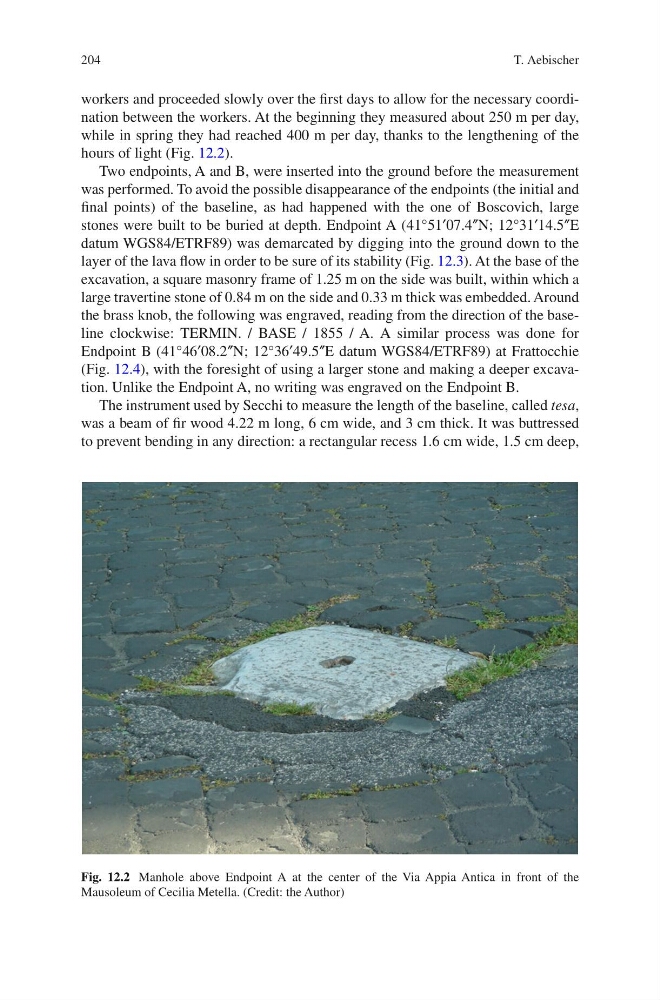
Fig. 12.2 Manhole above Endpoint A at the center of the Via Appia Antica in front of the
Mausoleum of Cecilia Metella. (Credit: the Author)
T. Aebischer
workers and proceeded slowly over the first days to allow for the necessary coordination between the workers. At the beginning they measured about 250 m per day,
while in spring they had reached 400 m per day, thanks to the lengthening of the
hours of light (Fig. 12.2).
Two endpoints, A and B, were inserted into the ground before the measurement
was performed. To avoid the possible disappearance of the endpoints (the initial and
final points) of the baseline, as had happened with the one of Boscovich, large
stones were built to be buried at depth. Endpoint A (41°51′07.4″N; 12°31′14.5″E
datum WGS84/ETRF89) was demarcated by digging into the ground down to the
layer of the lava flow in order to be sure of its stability (Fig. 12.3). At the base of the
excavation, a square masonry frame of 1.25 m on the side was built, within which a
large travertine stone of 0.84 m on the side and 0.33 m thick was embedded. Around
the brass knob, the following was engraved, reading from the direction of the baseline clockwise: TERMIN. / BASE / 1855 / A. A similar process was done for
Endpoint B (41°46′08.2″N; 12°36′49.5″E datum WGS84/ETRF89) at Frattocchie
(Fig. 12.4), with the foresight of using a larger stone and making a deeper excavation. Unlike the Endpoint A, no writing was engraved on the Endpoint B.
The instrument used by Secchi to measure the length of the baseline, called tesa,
was a beam of fir wood 4.22 m long, 6 cm wide, and 3 cm thick. It was buttressed
to prevent bending in any direction: a rectangular recess 1.6 cm wide, 1.5 cm deep,
Fig. 12.2 Manhole above Endpoint A at the center of the Via Appia Antica in front of the
Mausoleum of Cecilia Metella. (Credit: the Author)
T. Aebischer