

203
to Mile XI. During Canina’s excavation works, a large peperino stone was found
that seemed to have been placed there by human hands, but it did not bear any sign
that could identify it as the Boscovich endpoint. Canina concluded that this rock
was, instead, the base of the pillar erected by the French. Unfortunately, this boulder
was torn up and demolished due to the work needed to open the street to the public.
Faced with this task, Secchi decided to remeasure the Boscovich baseline
(Chinnici 2019: 81–85) in order to directly disprove the French criticism. The
results of this immense work were collected, together with the description of the
preparations, in his book Misura della base trigonometrica eseguita sulla via Appia,
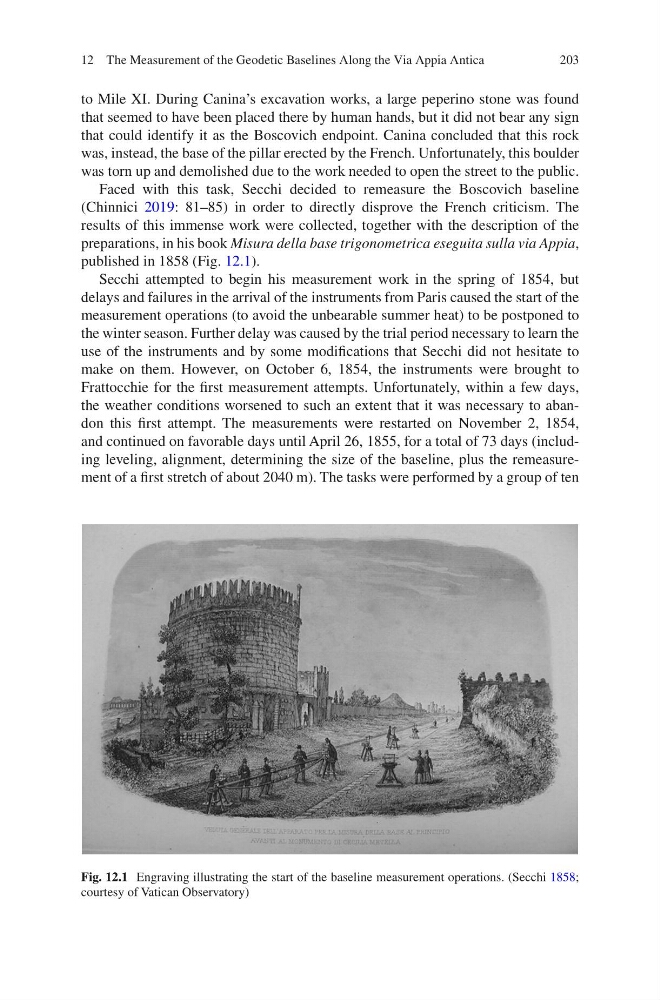
published in 1858 (Fig. 12.1).
Secchi attempted to begin his measurement work in the spring of 1854, but
delays and failures in the arrival of the instruments from Paris caused the start of the
measurement operations (to avoid the unbearable summer heat) to be postponed to
the winter season. Further delay was caused by the trial period necessary to learn the
use of the instruments and by some modifications that Secchi did not hesitate to
make on them. However, on October 6, 1854, the instruments were brought to
Frattocchie for the first measurement attempts. Unfortunately, within a few days,
the weather conditions worsened to such an extent that it was necessary to abandon this first attempt. The measurements were restarted on November 2, 1854,
and continued on favorable days until April 26, 1855, for a total of 73 days (including leveling, alignment, determining the size of the baseline, plus the remeasurement of a first stretch of about 2040 m). The tasks were performed by a group of ten
Fig. 12.1 Engraving illustrating the start of the baseline measurement operations. (Secchi 1858;
courtesy of Vatican Observatory)
12 The Measurement of the Geodetic Baselines Along the Via Appia Antica
to Mile XI. During Canina’s excavation works, a large peperino stone was found
that seemed to have been placed there by human hands, but it did not bear any sign
that could identify it as the Boscovich endpoint. Canina concluded that this rock
was, instead, the base of the pillar erected by the French. Unfortunately, this boulder
was torn up and demolished due to the work needed to open the street to the public.
Faced with this task, Secchi decided to remeasure the Boscovich baseline
(Chinnici 2019: 81–85) in order to directly disprove the French criticism. The
results of this immense work were collected, together with the description of the
preparations, in his book Misura della base trigonometrica eseguita sulla via Appia,
published in 1858 (Fig. 12.1).
Secchi attempted to begin his measurement work in the spring of 1854, but
delays and failures in the arrival of the instruments from Paris caused the start of the
measurement operations (to avoid the unbearable summer heat) to be postponed to
the winter season. Further delay was caused by the trial period necessary to learn the
use of the instruments and by some modifications that Secchi did not hesitate to
make on them. However, on October 6, 1854, the instruments were brought to
Frattocchie for the first measurement attempts. Unfortunately, within a few days,
the weather conditions worsened to such an extent that it was necessary to abandon this first attempt. The measurements were restarted on November 2, 1854,
and continued on favorable days until April 26, 1855, for a total of 73 days (including leveling, alignment, determining the size of the baseline, plus the remeasurement of a first stretch of about 2040 m). The tasks were performed by a group of ten
Fig. 12.1 Engraving illustrating the start of the baseline measurement operations. (Secchi 1858;
courtesy of Vatican Observatory)
12 The Measurement of the Geodetic Baselines Along the Via Appia Antica