

141
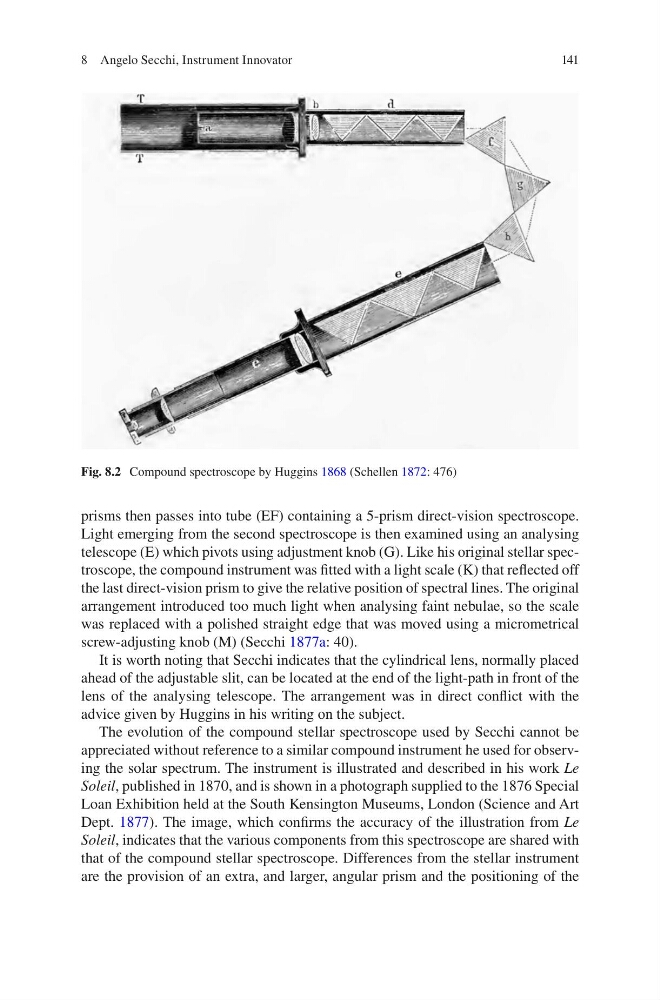
prisms then passes into tube (EF) containing a 5-prism direct-vision spectroscope.
Light emerging from the second spectroscope is then examined using an analysing
telescope (E) which pivots using adjustment knob (G). Like his original stellar spectroscope, the compound instrument was fitted with a light scale (K) that reflected off
the last direct-vision prism to give the relative position of spectral lines. The original
arrangement introduced too much light when analysing faint nebulae, so the scale
was replaced with a polished straight edge that was moved using a micrometrical
screw-adjusting knob (M) (Secchi 1877a: 40).
It is worth noting that Secchi indicates that the cylindrical lens, normally placed
ahead of the adjustable slit, can be located at the end of the light-path in front of the
lens of the analysing telescope. The arrangement was in direct conflict with the
advice given by Huggins in his writing on the subject.
The evolution of the compound stellar spectroscope used by Secchi cannot be
appreciated without reference to a similar compound instrument he used for observing the solar spectrum. The instrument is illustrated and described in his work Le
Soleil, published in 1870, and is shown in a photograph supplied to the 1876 Special
Loan Exhibition held at the South Kensington Museums, London (Science and Art
Dept. 1877). The image, which confirms the accuracy of the illustration from Le
Soleil, indicates that the various components from this spectroscope are shared with
that of the compound stellar spectroscope. Differences from the stellar instrument
are the provision of an extra, and larger, angular prism and the positioning of the
Fig. 8.2 Compound spectroscope by Huggins 1868 (Schellen 1872: 476)
8 Angelo Secchi, Instrument Innovator
prisms then passes into tube (EF) containing a 5-prism direct-vision spectroscope.
Light emerging from the second spectroscope is then examined using an analysing
telescope (E) which pivots using adjustment knob (G). Like his original stellar spectroscope, the compound instrument was fitted with a light scale (K) that reflected off
the last direct-vision prism to give the relative position of spectral lines. The original
arrangement introduced too much light when analysing faint nebulae, so the scale
was replaced with a polished straight edge that was moved using a micrometrical
screw-adjusting knob (M) (Secchi 1877a: 40).
It is worth noting that Secchi indicates that the cylindrical lens, normally placed
ahead of the adjustable slit, can be located at the end of the light-path in front of the
lens of the analysing telescope. The arrangement was in direct conflict with the
advice given by Huggins in his writing on the subject.
The evolution of the compound stellar spectroscope used by Secchi cannot be
appreciated without reference to a similar compound instrument he used for observing the solar spectrum. The instrument is illustrated and described in his work Le
Soleil, published in 1870, and is shown in a photograph supplied to the 1876 Special
Loan Exhibition held at the South Kensington Museums, London (Science and Art
Dept. 1877). The image, which confirms the accuracy of the illustration from Le
Soleil, indicates that the various components from this spectroscope are shared with
that of the compound stellar spectroscope. Differences from the stellar instrument
are the provision of an extra, and larger, angular prism and the positioning of the
Fig. 8.2 Compound spectroscope by Huggins 1868 (Schellen 1872: 476)
8 Angelo Secchi, Instrument Innovator