

78
take part in the meeting, and, anxious about the destiny of his observatory, he willingly accepted. The discussion led to a proposed reform (Poppi et al. 2005) from
which the Collegio Romano was deliberately excluded. However, the reform law,
promulgated in 1876, was never implemented; the Collegio Romano Observatory
remained in an unsettled situation, being neither Italian nor Pontifical.
Secchi found some financial resources in publishing treatises. At that time, he
published one of the most important and beautiful books on solar physics, Le Soleil
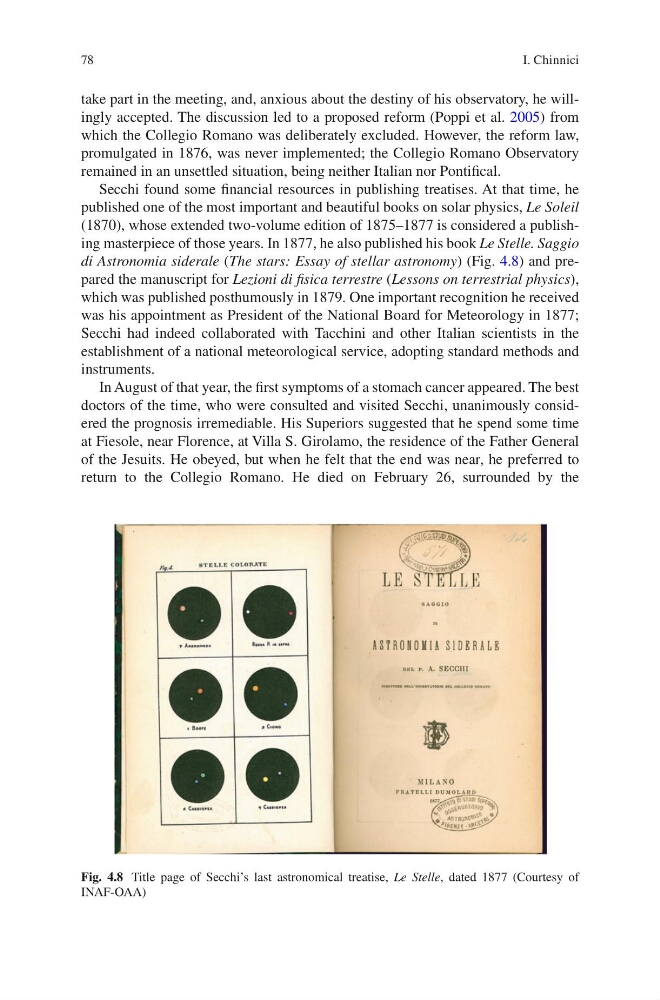
(1870), whose extended two-volume edition of 1875–1877 is considered a publishing masterpiece of those years. In 1877, he also published his book Le Stelle. Saggio
di Astronomia siderale (The stars: Essay of stellar astronomy) (Fig. 4.8) and prepared the manuscript for Lezioni di fisica terrestre (Lessons on terrestrial physics),
which was published posthumously in 1879. One important recognition he received
was his appointment as President of the National Board for Meteorology in 1877;
Secchi had indeed collaborated with Tacchini and other Italian scientists in the
establishment of a national meteorological service, adopting standard methods and
instruments.
In August of that year, the first symptoms of a stomach cancer appeared. The best
doctors of the time, who were consulted and visited Secchi, unanimously considered the prognosis irremediable. His Superiors suggested that he spend some time
at Fiesole, near Florence, at Villa S. Girolamo, the residence of the Father General
of the Jesuits. He obeyed, but when he felt that the end was near, he preferred to
return to the Collegio Romano. He died on February 26, surrounded by the
Fig. 4.8 Title page of Secchi’s last astronomical treatise, Le Stelle, dated 1877 (Courtesy of
INAF-OAA)
I. Chinnici
take part in the meeting, and, anxious about the destiny of his observatory, he willingly accepted. The discussion led to a proposed reform (Poppi et al. 2005) from
which the Collegio Romano was deliberately excluded. However, the reform law,
promulgated in 1876, was never implemented; the Collegio Romano Observatory
remained in an unsettled situation, being neither Italian nor Pontifical.
Secchi found some financial resources in publishing treatises. At that time, he
published one of the most important and beautiful books on solar physics, Le Soleil
(1870), whose extended two-volume edition of 1875–1877 is considered a publishing masterpiece of those years. In 1877, he also published his book Le Stelle. Saggio
di Astronomia siderale (The stars: Essay of stellar astronomy) (Fig. 4.8) and prepared the manuscript for Lezioni di fisica terrestre (Lessons on terrestrial physics),
which was published posthumously in 1879. One important recognition he received
was his appointment as President of the National Board for Meteorology in 1877;
Secchi had indeed collaborated with Tacchini and other Italian scientists in the
establishment of a national meteorological service, adopting standard methods and
instruments.
In August of that year, the first symptoms of a stomach cancer appeared. The best
doctors of the time, who were consulted and visited Secchi, unanimously considered the prognosis irremediable. His Superiors suggested that he spend some time
at Fiesole, near Florence, at Villa S. Girolamo, the residence of the Father General
of the Jesuits. He obeyed, but when he felt that the end was near, he preferred to
return to the Collegio Romano. He died on February 26, surrounded by the
Fig. 4.8 Title page of Secchi’s last astronomical treatise, Le Stelle, dated 1877 (Courtesy of
INAF-OAA)
I. Chinnici