

77
Society of Jesus. One can see how he might “export” communitarian rules into a
scientific milieu. One might say that scheduled prayer times correspond to scheduled observation times, the bell to the telegraph, the breviary to the telescope, the
religious rituals to the observing procedures, the zeal in devotions to the accuracy in
the observations. Secchi perhaps unconsciously replicated this kind of community
when he devised the scientific programme of the new scientific society by fixing
their common rules. Moreover, following his penchant for inclusion, he opened the
society not only to astronomers but also to meteorologists, physicists, chemists, etc.
though in reduced number.
Following the events of 1870, Secchi’s main anxiety was to preserve the Collegio
Romano Observatory from confiscation and to find adequate financial resources.
The role of Pietro Tacchini and Quintino Sella (1827–1884) (who was Minister of
Finance from 1869 to 1873) was crucial in helping him toward both purposes. In
1873, a law of confiscation of all Church properties was passed; Secchi tried to
demonstrate that the observatory was Pontifical and therefore it was protected by
the laws which excluded the Papal properties from confiscation. In fact, he had no
legal proof, but the Italian Government temporized and Secchi was allowed to continue his directorship. The following year, Tacchini proposed a reform of the Italian
observatories and the Minister called a Directors’ meeting to be held in Palermo
during the 12th Congress of the Italian Scientists. Secchi was formally invited to
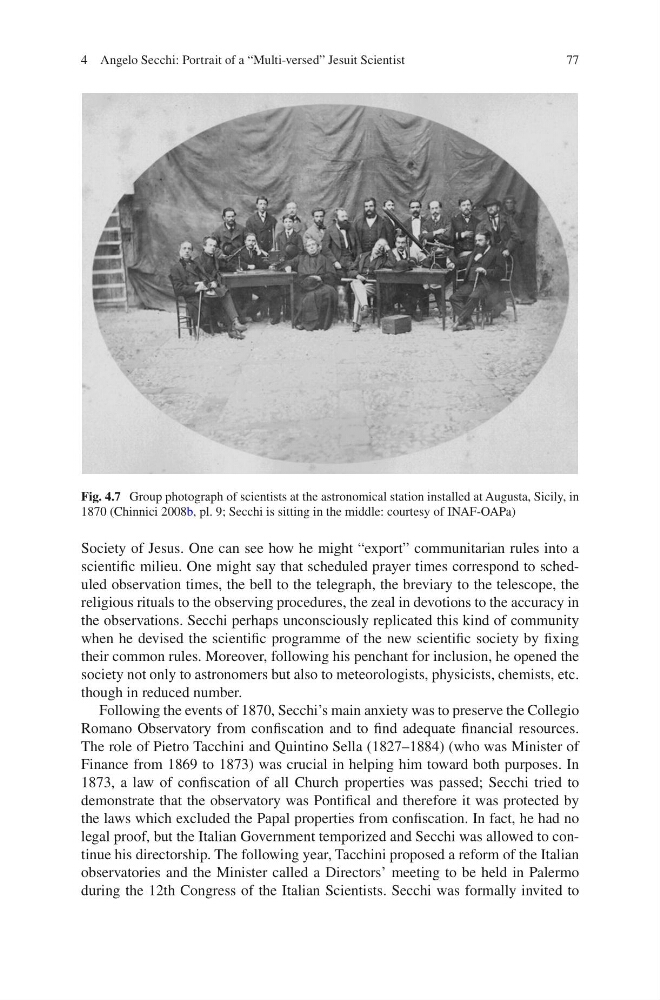
Fig. 4.7 Group photograph of scientists at the astronomical station installed at Augusta, Sicily, in
1870 (Chinnici 2008b, pl. 9; Secchi is sitting in the middle: courtesy of INAF-OAPa)
4 Angelo Secchi: Portrait of a “Multi-versed” Jesuit Scientist
Society of Jesus. One can see how he might “export” communitarian rules into a
scientific milieu. One might say that scheduled prayer times correspond to scheduled observation times, the bell to the telegraph, the breviary to the telescope, the
religious rituals to the observing procedures, the zeal in devotions to the accuracy in
the observations. Secchi perhaps unconsciously replicated this kind of community
when he devised the scientific programme of the new scientific society by fixing
their common rules. Moreover, following his penchant for inclusion, he opened the
society not only to astronomers but also to meteorologists, physicists, chemists, etc.
though in reduced number.
Following the events of 1870, Secchi’s main anxiety was to preserve the Collegio
Romano Observatory from confiscation and to find adequate financial resources.
The role of Pietro Tacchini and Quintino Sella (1827–1884) (who was Minister of
Finance from 1869 to 1873) was crucial in helping him toward both purposes. In
1873, a law of confiscation of all Church properties was passed; Secchi tried to
demonstrate that the observatory was Pontifical and therefore it was protected by
the laws which excluded the Papal properties from confiscation. In fact, he had no
legal proof, but the Italian Government temporized and Secchi was allowed to continue his directorship. The following year, Tacchini proposed a reform of the Italian
observatories and the Minister called a Directors’ meeting to be held in Palermo
during the 12th Congress of the Italian Scientists. Secchi was formally invited to
Fig. 4.7 Group photograph of scientists at the astronomical station installed at Augusta, Sicily, in
1870 (Chinnici 2008b, pl. 9; Secchi is sitting in the middle: courtesy of INAF-OAPa)
4 Angelo Secchi: Portrait of a “Multi-versed” Jesuit Scientist