

80
J. Zhang et al.
Where c 0 and λ are parameters of Gruneisen.
Equation (17) can be obtained by using the Taylor expansion of Eq. (16) at η = 0
and retaining the first three items.
T 2 = T 0 exp(γ 0 η) +
c 2
0
c v
exp(γ 0 η)[
1
3
λη
3
+ (
3
4
λ
2
−
1
4
γ 0 λ)η
4
]
(17)
According to the theory of the shock temperature caused by impact compression, the
seventh step of MPM algorithm mentioned in Sect. 2.3 should be changed as follows.
The shock temperature of material points are computed and the temperatures of
material points are updated.
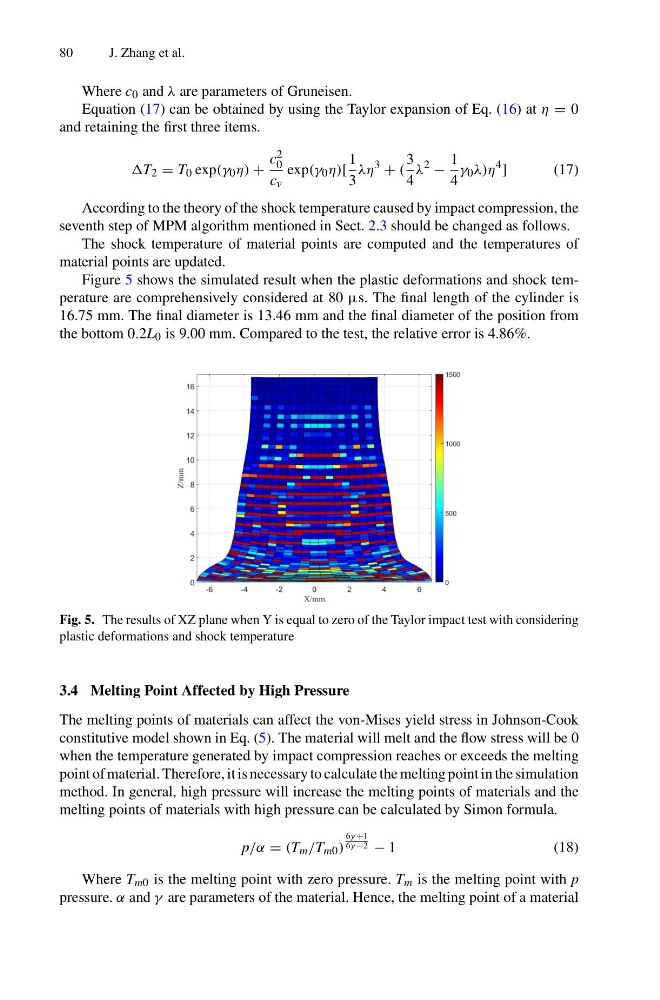
Figure 5 shows the simulated result when the plastic deformations and shock temperature are comprehensively considered at 80 µs. The final length of the cylinder is
16.75 mm. The final diameter is 13.46 mm and the final diameter of the position from
the bottom 0.2L 0 is 9.00 mm. Compared to the test, the relative error is 4.86%.
Fig. 5. The results of XZ plane when Y is equal to zero of the Taylor impact test with considering
plastic deformations and shock temperature
3.4 Melting Point Affected by High Pressure
The melting points of materials can affect the von-Mises yield stress in Johnson-Cook
constitutive model shown in Eq. (5). The material will melt and the flow stress will be 0
when the temperature generated by impact compression reaches or exceeds the melting
point of material. Therefore, it is necessary to calculate the melting point in the simulation
method. In general, high pressure will increase the melting points of materials and the
melting points of materials with high pressure can be calculated by Simon formula.
p/α = (T m /T m0 )
6γ +1
6γ −2 − 1
(18)
Where T m0 is the melting point with zero pressure. T m is the melting point with p
pressure. α and γ are parameters of the material. Hence, the melting point of a material
J. Zhang et al.
Where c 0 and λ are parameters of Gruneisen.
Equation (17) can be obtained by using the Taylor expansion of Eq. (16) at η = 0
and retaining the first three items.
T 2 = T 0 exp(γ 0 η) +
c 2
0
c v
exp(γ 0 η)[
1
3
λη
3
+ (
3
4
λ
2
−
1
4
γ 0 λ)η
4
]
(17)
According to the theory of the shock temperature caused by impact compression, the
seventh step of MPM algorithm mentioned in Sect. 2.3 should be changed as follows.
The shock temperature of material points are computed and the temperatures of
material points are updated.
Figure 5 shows the simulated result when the plastic deformations and shock temperature are comprehensively considered at 80 µs. The final length of the cylinder is
16.75 mm. The final diameter is 13.46 mm and the final diameter of the position from
the bottom 0.2L 0 is 9.00 mm. Compared to the test, the relative error is 4.86%.
Fig. 5. The results of XZ plane when Y is equal to zero of the Taylor impact test with considering
plastic deformations and shock temperature
3.4 Melting Point Affected by High Pressure
The melting points of materials can affect the von-Mises yield stress in Johnson-Cook
constitutive model shown in Eq. (5). The material will melt and the flow stress will be 0
when the temperature generated by impact compression reaches or exceeds the melting
point of material. Therefore, it is necessary to calculate the melting point in the simulation
method. In general, high pressure will increase the melting points of materials and the
melting points of materials with high pressure can be calculated by Simon formula.
p/α = (T m /T m0 )
6γ +1
6γ −2 − 1
(18)
Where T m0 is the melting point with zero pressure. T m is the melting point with p
pressure. α and γ are parameters of the material. Hence, the melting point of a material