

70
T. T. Bui and S. Nakata
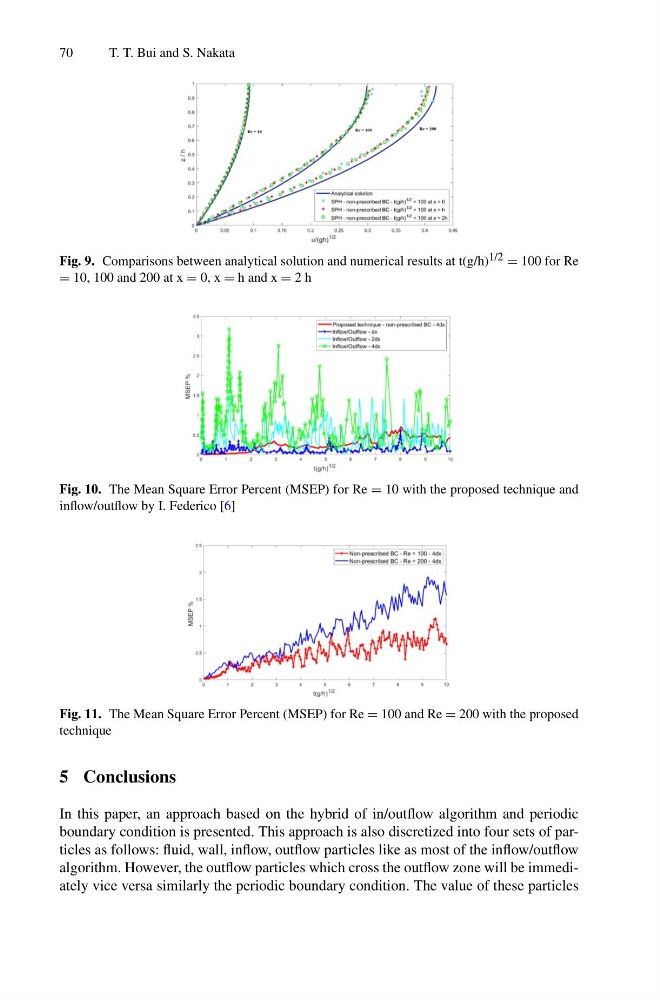
Fig. 9. Comparisons between analytical solution and numerical results at t(g/h) 1/2 = 100 for Re
= 10, 100 and 200 at x = 0, x = h and x = 2 h
Fig. 10. The Mean Square Error Percent (MSEP) for Re = 10 with the proposed technique and
inflow/outflow by I. Federico [6]
Fig. 11. The Mean Square Error Percent (MSEP) for Re = 100 and Re = 200 with the proposed
technique
5 Conclusions
In this paper, an approach based on the hybrid of in/outflow algorithm and periodic
boundary condition is presented. This approach is also discretized into four sets of particles as follows: fluid, wall, inflow, outflow particles like as most of the inflow/outflow
algorithm. However, the outflow particles which cross the outflow zone will be immediately vice versa similarly the periodic boundary condition. The value of these particles
T. T. Bui and S. Nakata
Fig. 9. Comparisons between analytical solution and numerical results at t(g/h) 1/2 = 100 for Re
= 10, 100 and 200 at x = 0, x = h and x = 2 h
Fig. 10. The Mean Square Error Percent (MSEP) for Re = 10 with the proposed technique and
inflow/outflow by I. Federico [6]
Fig. 11. The Mean Square Error Percent (MSEP) for Re = 100 and Re = 200 with the proposed
technique
5 Conclusions
In this paper, an approach based on the hybrid of in/outflow algorithm and periodic
boundary condition is presented. This approach is also discretized into four sets of particles as follows: fluid, wall, inflow, outflow particles like as most of the inflow/outflow
algorithm. However, the outflow particles which cross the outflow zone will be immediately vice versa similarly the periodic boundary condition. The value of these particles