

46
J. Hahn and W. Becker
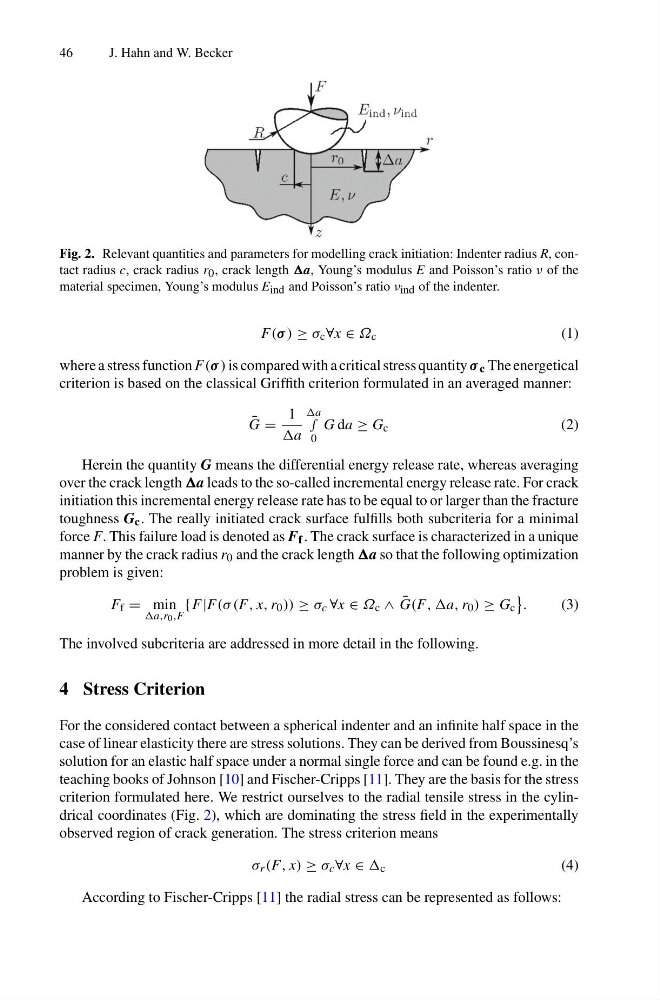
Fig. 2. Relevant quantities and parameters for modelling crack initiation: Indenter radius R, contact radius c, crack radius r 0 , crack length a, Young’s modulus E and Poisson’s ratio ν of the
material specimen, Young’s modulus E ind and Poisson’s ratio ν ind of the indenter.
F(σ ) ≥ σ c ∀x ∈ Ω c
(1)
where a stress function F(σ ) is compared with a critical stress quantity σ c The energetical
criterion is based on the classical Griffith criterion formulated in an averaged manner:
¯
G =
1
a
a
∫
0
G da ≥ G c
(2)
Herein the quantity G means the differential energy release rate, whereas averaging
over the crack length a leads to the so-called incremental energy release rate. For crack
initiation this incremental energy release rate has to be equal to or larger than the fracture
toughness G c . The really initiated crack surface fulfills both subcriteria for a minimal
force F. This failure load is denoted as F f . The crack surface is characterized in a unique
manner by the crack radius r 0 and the crack length a so that the following optimization
problem is given:
F f = min
a,r 0 ,F
{ F|F(σ (F, x, r 0 )) ≥ σ c ∀x ∈ Ω c ∧ ¯
G(F, ,a, r 0 ) ≥ G c
.
(3)
The involved subcriteria are addressed in more detail in the following.
4 Stress Criterion
For the considered contact between a spherical indenter and an infinite half space in the
case of linear elasticity there are stress solutions. They can be derived from Boussinesq’s
solution for an elastic half space under a normal single force and can be found e.g. in the
teaching books of Johnson [10] and Fischer-Cripps [11]. They are the basis for the stress
criterion formulated here. We restrict ourselves to the radial tensile stress in the cylindrical coordinates (Fig. 2), which are dominating the stress field in the experimentally
observed region of crack generation. The stress criterion means
σ r (F, x) ≥ σ c ∀x ∈ c
(4)
According to Fischer-Cripps [11] the radial stress can be represented as follows:
J. Hahn and W. Becker
Fig. 2. Relevant quantities and parameters for modelling crack initiation: Indenter radius R, contact radius c, crack radius r 0 , crack length a, Young’s modulus E and Poisson’s ratio ν of the
material specimen, Young’s modulus E ind and Poisson’s ratio ν ind of the indenter.
F(σ ) ≥ σ c ∀x ∈ Ω c
(1)
where a stress function F(σ ) is compared with a critical stress quantity σ c The energetical
criterion is based on the classical Griffith criterion formulated in an averaged manner:
¯
G =
1
a
a
∫
0
G da ≥ G c
(2)
Herein the quantity G means the differential energy release rate, whereas averaging
over the crack length a leads to the so-called incremental energy release rate. For crack
initiation this incremental energy release rate has to be equal to or larger than the fracture
toughness G c . The really initiated crack surface fulfills both subcriteria for a minimal
force F. This failure load is denoted as F f . The crack surface is characterized in a unique
manner by the crack radius r 0 and the crack length a so that the following optimization
problem is given:
F f = min
a,r 0 ,F
{ F|F(σ (F, x, r 0 )) ≥ σ c ∀x ∈ Ω c ∧ ¯
G(F, ,a, r 0 ) ≥ G c
.
(3)
The involved subcriteria are addressed in more detail in the following.
4 Stress Criterion
For the considered contact between a spherical indenter and an infinite half space in the
case of linear elasticity there are stress solutions. They can be derived from Boussinesq’s
solution for an elastic half space under a normal single force and can be found e.g. in the
teaching books of Johnson [10] and Fischer-Cripps [11]. They are the basis for the stress
criterion formulated here. We restrict ourselves to the radial tensile stress in the cylindrical coordinates (Fig. 2), which are dominating the stress field in the experimentally
observed region of crack generation. The stress criterion means
σ r (F, x) ≥ σ c ∀x ∈ c
(4)
According to Fischer-Cripps [11] the radial stress can be represented as follows: