

Determination of Strength and Fracture Toughness from Indentation Tests
45
of the crack initiation without the need of empirical correction factors. In addition to
the fracture toughness also the strength of the material can be identified at the same
time. A similar approach has been suggested recently by Strobl [4]. We extend the approach to spherical indenters where an analytical modelling is possible. In combination
with a robust parameter identification the approach should allow to identify strength and
toughness at the same time from simple tests.
2 Modelling Approach
For the case of spherical indenters the crack generation process has already been investigated experimentally by a larger number of authors, for instance by Langitan et al.
[5], Warren [6] and Mouginot/Maugis [7]. Typically the spherical indenter is pushed
normally onto the material specimen. The initiation of cracks is recorded acoustically,
optically or by means of the identified force-displacement behavior. Langitan/Lawn did
not observe a simple circular crack but the growth of a conically propagating crack.
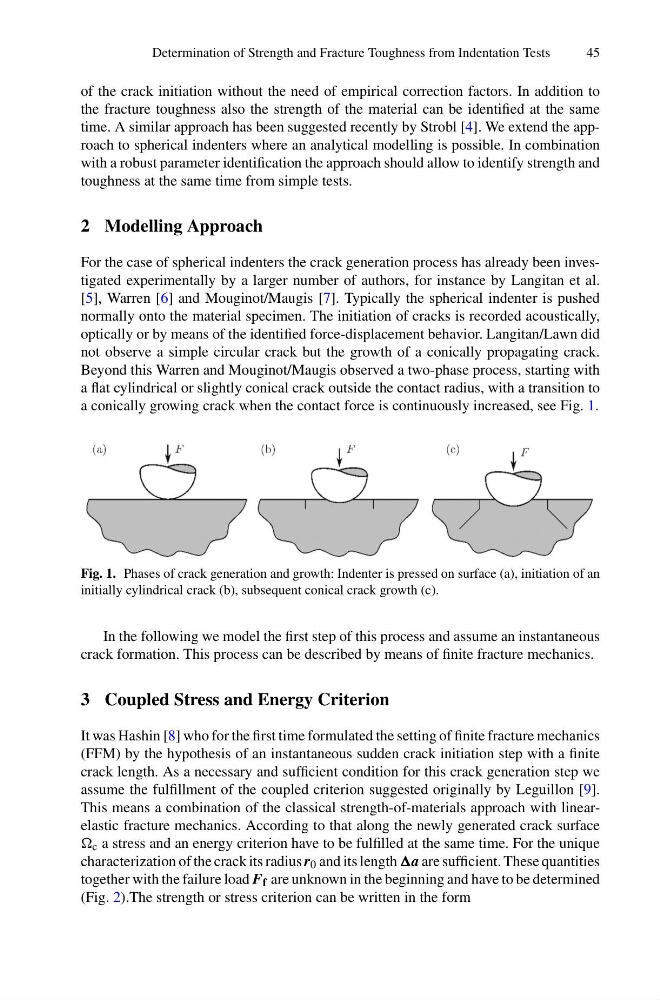
Beyond this Warren and Mouginot/Maugis observed a two-phase process, starting with
a flat cylindrical or slightly conical crack outside the contact radius, with a transition to
a conically growing crack when the contact force is continuously increased, see Fig. 1.
Fig. 1. Phases of crack generation and growth: Indenter is pressed on surface (a), initiation of an
initially cylindrical crack (b), subsequent conical crack growth (c).
In the following we model the first step of this process and assume an instantaneous
crack formation. This process can be described by means of finite fracture mechanics.
3 Coupled Stress and Energy Criterion
It was Hashin [8] who for the first time formulated the setting of finite fracture mechanics
(FFM) by the hypothesis of an instantaneous sudden crack initiation step with a finite
crack length. As a necessary and sufficient condition for this crack generation step we
assume the fulfillment of the coupled criterion suggested originally by Leguillon [9].
This means a combination of the classical strength-of-materials approach with linearelastic fracture mechanics. According to that along the newly generated crack surface
c a stress and an energy criterion have to be fulfilled at the same time. For the unique
characterization of the crack its radius r 0 and its length a are sufficient. These quantities
together with the failure load F f are unknown in the beginning and have to be determined
(Fig. 2).The strength or stress criterion can be written in the form
45
of the crack initiation without the need of empirical correction factors. In addition to
the fracture toughness also the strength of the material can be identified at the same
time. A similar approach has been suggested recently by Strobl [4]. We extend the approach to spherical indenters where an analytical modelling is possible. In combination
with a robust parameter identification the approach should allow to identify strength and
toughness at the same time from simple tests.
2 Modelling Approach
For the case of spherical indenters the crack generation process has already been investigated experimentally by a larger number of authors, for instance by Langitan et al.
[5], Warren [6] and Mouginot/Maugis [7]. Typically the spherical indenter is pushed
normally onto the material specimen. The initiation of cracks is recorded acoustically,
optically or by means of the identified force-displacement behavior. Langitan/Lawn did
not observe a simple circular crack but the growth of a conically propagating crack.
Beyond this Warren and Mouginot/Maugis observed a two-phase process, starting with
a flat cylindrical or slightly conical crack outside the contact radius, with a transition to
a conically growing crack when the contact force is continuously increased, see Fig. 1.
Fig. 1. Phases of crack generation and growth: Indenter is pressed on surface (a), initiation of an
initially cylindrical crack (b), subsequent conical crack growth (c).
In the following we model the first step of this process and assume an instantaneous
crack formation. This process can be described by means of finite fracture mechanics.
3 Coupled Stress and Energy Criterion
It was Hashin [8] who for the first time formulated the setting of finite fracture mechanics
(FFM) by the hypothesis of an instantaneous sudden crack initiation step with a finite
crack length. As a necessary and sufficient condition for this crack generation step we
assume the fulfillment of the coupled criterion suggested originally by Leguillon [9].
This means a combination of the classical strength-of-materials approach with linearelastic fracture mechanics. According to that along the newly generated crack surface
c a stress and an energy criterion have to be fulfilled at the same time. For the unique
characterization of the crack its radius r 0 and its length a are sufficient. These quantities
together with the failure load F f are unknown in the beginning and have to be determined
(Fig. 2).The strength or stress criterion can be written in the form