

Spectroscopic Characterization and Molecular Dynamics Simulation
41
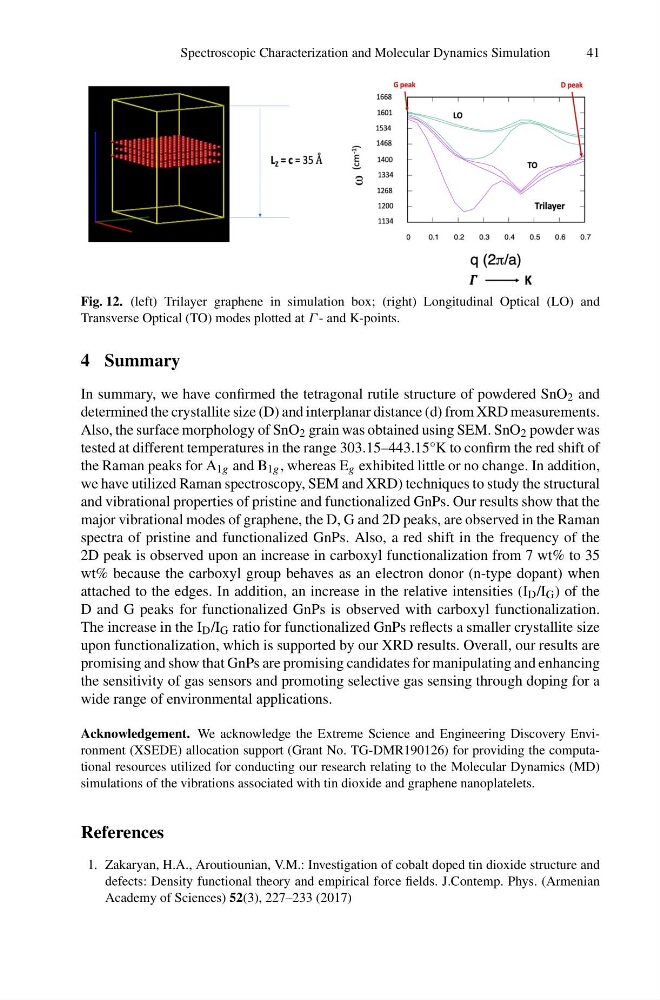
Fig. 12. (left) Trilayer graphene in simulation box; (right) Longitudinal Optical (LO) and
Transverse Optical (TO) modes plotted at Γ - and K-points.
4 Summary
In summary, we have confirmed the tetragonal rutile structure of powdered SnO 2 and
determined the crystallite size (D) and interplanar distance (d) from XRD measurements.
Also, the surface morphology of SnO 2 grain was obtained using SEM. SnO 2 powder was
tested at different temperatures in the range 303.15–443.15°K to confirm the red shift of
the Raman peaks for A 1g and B 1g , whereas E g exhibited little or no change. In addition,
we have utilized Raman spectroscopy, SEM and XRD) techniques to study the structural
and vibrational properties of pristine and functionalized GnPs. Our results show that the
major vibrational modes of graphene, the D, G and 2D peaks, are observed in the Raman
spectra of pristine and functionalized GnPs. Also, a red shift in the frequency of the
2D peak is observed upon an increase in carboxyl functionalization from 7 wt% to 35
wt% because the carboxyl group behaves as an electron donor (n-type dopant) when
attached to the edges. In addition, an increase in the relative intensities (I D /I G ) of the
D and G peaks for functionalized GnPs is observed with carboxyl functionalization.
The increase in the I D /I G ratio for functionalized GnPs reflects a smaller crystallite size
upon functionalization, which is supported by our XRD results. Overall, our results are
promising and show that GnPs are promising candidates for manipulating and enhancing
the sensitivity of gas sensors and promoting selective gas sensing through doping for a
wide range of environmental applications.
Acknowledgement. We acknowledge the Extreme Science and Engineering Discovery Environment (XSEDE) allocation support (Grant No. TG-DMR190126) for providing the computational resources utilized for conducting our research relating to the Molecular Dynamics (MD)
simulations of the vibrations associated with tin dioxide and graphene nanoplatelets.
References
1. Zakaryan, H.A., Aroutiounian, V.M.: Investigation of cobalt doped tin dioxide structure and
defects: Density functional theory and empirical force fields. J.Contemp. Phys. (Armenian
Academy of Sciences) 52(3), 227–233 (2017)
41
Fig. 12. (left) Trilayer graphene in simulation box; (right) Longitudinal Optical (LO) and
Transverse Optical (TO) modes plotted at Γ - and K-points.
4 Summary
In summary, we have confirmed the tetragonal rutile structure of powdered SnO 2 and
determined the crystallite size (D) and interplanar distance (d) from XRD measurements.
Also, the surface morphology of SnO 2 grain was obtained using SEM. SnO 2 powder was
tested at different temperatures in the range 303.15–443.15°K to confirm the red shift of
the Raman peaks for A 1g and B 1g , whereas E g exhibited little or no change. In addition,
we have utilized Raman spectroscopy, SEM and XRD) techniques to study the structural
and vibrational properties of pristine and functionalized GnPs. Our results show that the
major vibrational modes of graphene, the D, G and 2D peaks, are observed in the Raman
spectra of pristine and functionalized GnPs. Also, a red shift in the frequency of the
2D peak is observed upon an increase in carboxyl functionalization from 7 wt% to 35
wt% because the carboxyl group behaves as an electron donor (n-type dopant) when
attached to the edges. In addition, an increase in the relative intensities (I D /I G ) of the
D and G peaks for functionalized GnPs is observed with carboxyl functionalization.
The increase in the I D /I G ratio for functionalized GnPs reflects a smaller crystallite size
upon functionalization, which is supported by our XRD results. Overall, our results are
promising and show that GnPs are promising candidates for manipulating and enhancing
the sensitivity of gas sensors and promoting selective gas sensing through doping for a
wide range of environmental applications.
Acknowledgement. We acknowledge the Extreme Science and Engineering Discovery Environment (XSEDE) allocation support (Grant No. TG-DMR190126) for providing the computational resources utilized for conducting our research relating to the Molecular Dynamics (MD)
simulations of the vibrations associated with tin dioxide and graphene nanoplatelets.
References
1. Zakaryan, H.A., Aroutiounian, V.M.: Investigation of cobalt doped tin dioxide structure and
defects: Density functional theory and empirical force fields. J.Contemp. Phys. (Armenian
Academy of Sciences) 52(3), 227–233 (2017)