

24
M. Tabatabaei and S. N. Atluri
here, d λ k is a positive scalar, and f (σ , σ Y ) = 0 is the plastic potential explaining the
plasticity condition in terms of the stress components at the location of the plastic hinge
and the Yield stress, σ Y .
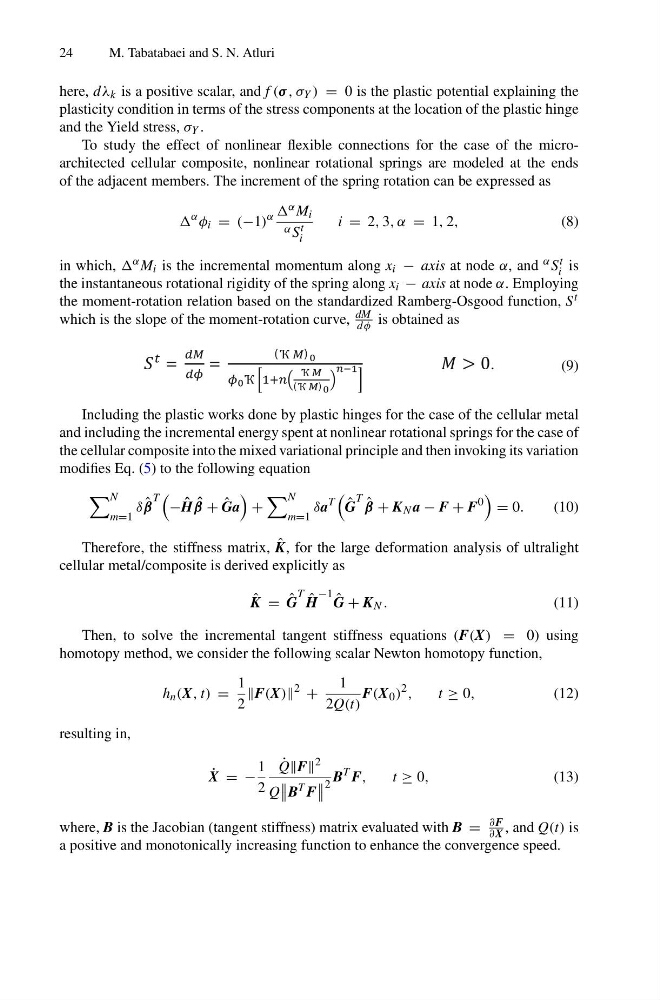
To study the effect of nonlinear flexible connections for the case of the microarchitected cellular composite, nonlinear rotational springs are modeled at the ends
of the adjacent members. The increment of the spring rotation can be expressed as
α
φ i = (−1)
α α M i
α S t
i
i = 2, 3, α = 1, 2,
(8)
in which, α M i is the incremental momentum along x i − axis at node α, and α S t
i is
the instantaneous rotational rigidity of the spring along x i − axis at node α. Employing
the moment-rotation relation based on the standardized Ramberg-Osgood function, S t
which is the slope of the moment-rotation curve,
dM
d φ is obtained as
(9)
Including the plastic works done by plastic hinges for the case of the cellular metal
and including the incremental energy spent at nonlinear rotational springs for the case of
the cellular composite into the mixed variational principle and then invoking its variation
modifies Eq. (5) to the following equation
N
m=1
δ ˆ
β
T
− ˆ
H ˆ
β + ˆ
Ga
+
N
m=1
δa
T
ˆ
G
T
ˆ
β + K N a − F + F
0
= 0.
(10)
Therefore, the stiffness matrix, ˆ
K, for the large deformation analysis of ultralight
cellular metal/composite is derived explicitly as
ˆ
K = ˆ
G
T ˆ
H
−1 ˆ
G + K N .
(11)
Then, to solve the incremental tangent stiffness equations (F(X) = 0) using
homotopy method, we consider the following scalar Newton homotopy function,
h n (X, t) =
1
2
F(X)
2
+
1
2Q(t)
F(X 0 )
2
,
t ≥ 0,
(12)
resulting in,
˙
X = −
1
2
˙
QF
2
Q
B T F
2 B
T F,
t ≥ 0,
(13)
where, B is the Jacobian (tangent stiffness) matrix evaluated with B =
∂F
∂X , and Q(t) is
a positive and monotonically increasing function to enhance the convergence speed.
M. Tabatabaei and S. N. Atluri
here, d λ k is a positive scalar, and f (σ , σ Y ) = 0 is the plastic potential explaining the
plasticity condition in terms of the stress components at the location of the plastic hinge
and the Yield stress, σ Y .
To study the effect of nonlinear flexible connections for the case of the microarchitected cellular composite, nonlinear rotational springs are modeled at the ends
of the adjacent members. The increment of the spring rotation can be expressed as
α
φ i = (−1)
α α M i
α S t
i
i = 2, 3, α = 1, 2,
(8)
in which, α M i is the incremental momentum along x i − axis at node α, and α S t
i is
the instantaneous rotational rigidity of the spring along x i − axis at node α. Employing
the moment-rotation relation based on the standardized Ramberg-Osgood function, S t
which is the slope of the moment-rotation curve,
dM
d φ is obtained as
(9)
Including the plastic works done by plastic hinges for the case of the cellular metal
and including the incremental energy spent at nonlinear rotational springs for the case of
the cellular composite into the mixed variational principle and then invoking its variation
modifies Eq. (5) to the following equation
N
m=1
δ ˆ
β
T
− ˆ
H ˆ
β + ˆ
Ga
+
N
m=1
δa
T
ˆ
G
T
ˆ
β + K N a − F + F
0
= 0.
(10)
Therefore, the stiffness matrix, ˆ
K, for the large deformation analysis of ultralight
cellular metal/composite is derived explicitly as
ˆ
K = ˆ
G
T ˆ
H
−1 ˆ
G + K N .
(11)
Then, to solve the incremental tangent stiffness equations (F(X) = 0) using
homotopy method, we consider the following scalar Newton homotopy function,
h n (X, t) =
1
2
F(X)
2
+
1
2Q(t)
F(X 0 )
2
,
t ≥ 0,
(12)
resulting in,
˙
X = −
1
2
˙
QF
2
Q
B T F
2 B
T F,
t ≥ 0,
(13)
where, B is the Jacobian (tangent stiffness) matrix evaluated with B =
∂F
∂X , and Q(t) is
a positive and monotonically increasing function to enhance the convergence speed.