

Preliminary Study on Integrated Simulation
295
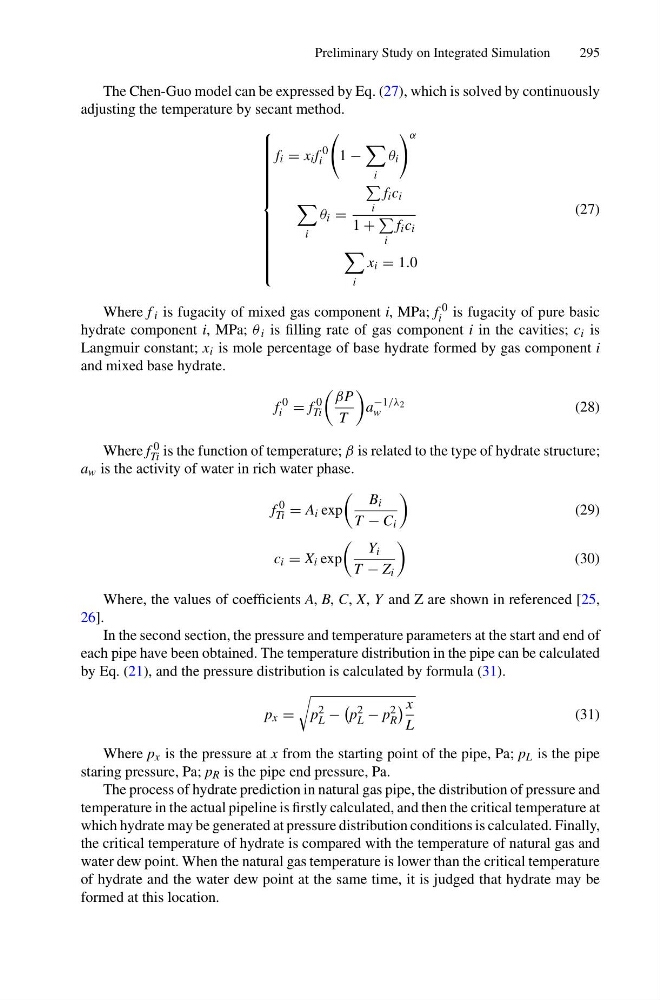
The Chen-Guo model can be expressed by Eq. (27), which is solved by continuously
adjusting the temperature by secant method.
⎧
⎪ ⎪ ⎪ ⎪ ⎪ ⎪ ⎪ ⎪ ⎪ ⎪ ⎪ ⎨
⎪ ⎪ ⎪ ⎪ ⎪ ⎪ ⎪ ⎪ ⎪ ⎪ ⎪ ⎩
f i = x i f
0
i
1 −
i
θ i
α
i
θ i =
i
f i c i
1 +
i
f i c i
i
x i = 1.0
(27)
Where f i is fugacity of mixed gas component i, MPa; f 0
i is fugacity of pure basic
hydrate component i, MPa; θ i is filling rate of gas component i in the cavities; c i is
Langmuir constant; x i is mole percentage of base hydrate formed by gas component i
and mixed base hydrate.
f
0
i = f
0
Ti
βP
T
a
−1/λ 2
w
(28)
Where f 0
Ti is the function of temperature; β is related to the type of hydrate structure;
a w is the activity of water in rich water phase.
f
0
Ti = A i exp
B i
T − C i
(29)
c i = X i exp
Y i
T − Z i
(30)
Where, the values of coefficients A, B, C, X, Y and Z are shown in referenced [25,
26].
In the second section, the pressure and temperature parameters at the start and end of
each pipe have been obtained. The temperature distribution in the pipe can be calculated
by Eq. (21), and the pressure distribution is calculated by formula (31).
p x =
p 2
L −
p 2
L − p 2
R
x
L
(31)
Where p x is the pressure at x from the starting point of the pipe, Pa; p L is the pipe
staring pressure, Pa; p R is the pipe end pressure, Pa.
The process of hydrate prediction in natural gas pipe, the distribution of pressure and
temperature in the actual pipeline is firstly calculated, and then the critical temperature at
which hydrate may be generated at pressure distribution conditions is calculated. Finally,
the critical temperature of hydrate is compared with the temperature of natural gas and
water dew point. When the natural gas temperature is lower than the critical temperature
of hydrate and the water dew point at the same time, it is judged that hydrate may be
formed at this location.
295
The Chen-Guo model can be expressed by Eq. (27), which is solved by continuously
adjusting the temperature by secant method.
⎧
⎪ ⎪ ⎪ ⎪ ⎪ ⎪ ⎪ ⎪ ⎪ ⎪ ⎪ ⎨
⎪ ⎪ ⎪ ⎪ ⎪ ⎪ ⎪ ⎪ ⎪ ⎪ ⎪ ⎩
f i = x i f
0
i
1 −
i
θ i
α
i
θ i =
i
f i c i
1 +
i
f i c i
i
x i = 1.0
(27)
Where f i is fugacity of mixed gas component i, MPa; f 0
i is fugacity of pure basic
hydrate component i, MPa; θ i is filling rate of gas component i in the cavities; c i is
Langmuir constant; x i is mole percentage of base hydrate formed by gas component i
and mixed base hydrate.
f
0
i = f
0
Ti
βP
T
a
−1/λ 2
w
(28)
Where f 0
Ti is the function of temperature; β is related to the type of hydrate structure;
a w is the activity of water in rich water phase.
f
0
Ti = A i exp
B i
T − C i
(29)
c i = X i exp
Y i
T − Z i
(30)
Where, the values of coefficients A, B, C, X, Y and Z are shown in referenced [25,
26].
In the second section, the pressure and temperature parameters at the start and end of
each pipe have been obtained. The temperature distribution in the pipe can be calculated
by Eq. (21), and the pressure distribution is calculated by formula (31).
p x =
p 2
L −
p 2
L − p 2
R
x
L
(31)
Where p x is the pressure at x from the starting point of the pipe, Pa; p L is the pipe
staring pressure, Pa; p R is the pipe end pressure, Pa.
The process of hydrate prediction in natural gas pipe, the distribution of pressure and
temperature in the actual pipeline is firstly calculated, and then the critical temperature at
which hydrate may be generated at pressure distribution conditions is calculated. Finally,
the critical temperature of hydrate is compared with the temperature of natural gas and
water dew point. When the natural gas temperature is lower than the critical temperature
of hydrate and the water dew point at the same time, it is judged that hydrate may be
formed at this location.