

280
Y. Xu et al.
Initialization
In this algorithm, optimization parameters are treated as particles and initialized within
the range of reasonable operating parameters. Individual particles can only change within
a reasonable range. The population size is set as 20.
Evaluate Fitness
The EnPI is used as fitness function. The particles were transfer to the corresponding
operating parameters of the HYSYS model through the data object interface (Automation) technology. The new operating parameters and transmits data such as energy consumption and product gas quality were calculated by HYSYS. Through the interface,
the data is transferred from HYSYS to MATLAB and converted into the EnPI.
Conditional Judgment
After optimizing the operating parameters, the various indicators of the purification plant
must meet the standards. The H 2 S concentration, CO 2 concentration, and water dew point
of the product gas should be less than the specified values. The SO 2 concentration in
the exhaust gas should be less than 960 mg/Nm 3 and the H 2 S content should be less
than 10 ppm. If it meets the standard, read the data in the Aspen HYSYS model to
calculate the fitness function. Otherwise, the penalty value (maximum value) is assigned
to the fitness value of the individual in order to eliminate the individual in the evolution
process.
Update Velocity and Position
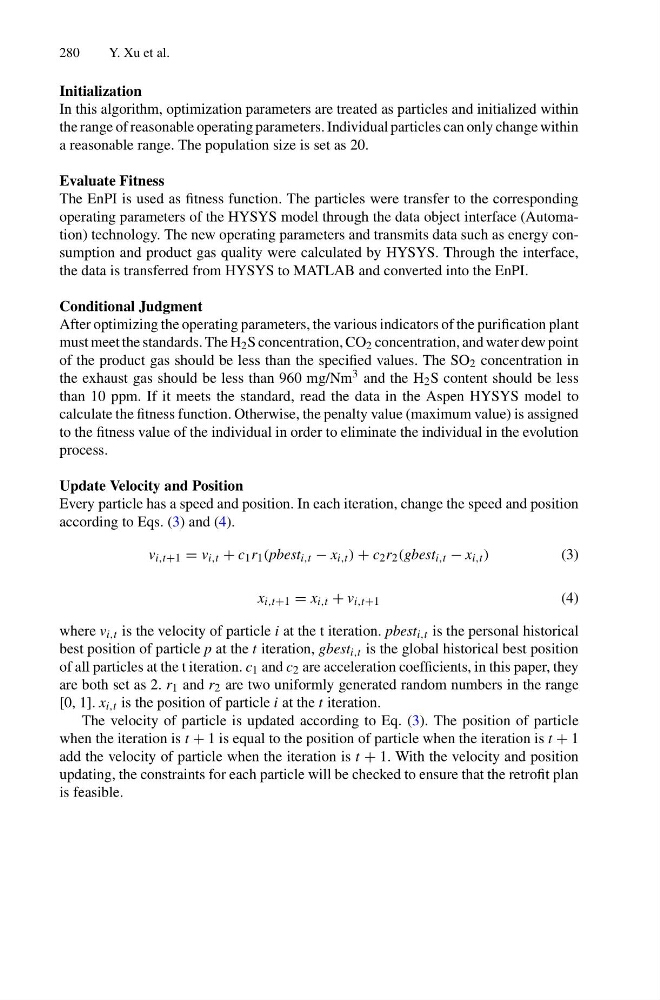
Every particle has a speed and position. In each iteration, change the speed and position
according to Eqs. (3) and (4).
v i,t+1 = v i,t + c 1 r 1 (pbest i,t − x i,t ) + c 2 r 2 (gbest i,t − x i,t )
(3)
x i,t+1 = x i,t + v i,t+1
(4)
where v i,t is the velocity of particle i at the t iteration. pbest i,t is the personal historical
best position of particle p at the t iteration, gbest i,t is the global historical best position
of all particles at the t iteration. c 1 and c 2 are acceleration coefficients, in this paper, they
are both set as 2. r 1 and r 2 are two uniformly generated random numbers in the range
[0, 1]. x i,t is the position of particle i at the t iteration.
The velocity of particle is updated according to Eq. (3). The position of particle
when the iteration is t + 1 is equal to the position of particle when the iteration is t + 1
add the velocity of particle when the iteration is t + 1. With the velocity and position
updating, the constraints for each particle will be checked to ensure that the retrofit plan
is feasible.
Y. Xu et al.
Initialization
In this algorithm, optimization parameters are treated as particles and initialized within
the range of reasonable operating parameters. Individual particles can only change within
a reasonable range. The population size is set as 20.
Evaluate Fitness
The EnPI is used as fitness function. The particles were transfer to the corresponding
operating parameters of the HYSYS model through the data object interface (Automation) technology. The new operating parameters and transmits data such as energy consumption and product gas quality were calculated by HYSYS. Through the interface,
the data is transferred from HYSYS to MATLAB and converted into the EnPI.
Conditional Judgment
After optimizing the operating parameters, the various indicators of the purification plant
must meet the standards. The H 2 S concentration, CO 2 concentration, and water dew point
of the product gas should be less than the specified values. The SO 2 concentration in
the exhaust gas should be less than 960 mg/Nm 3 and the H 2 S content should be less
than 10 ppm. If it meets the standard, read the data in the Aspen HYSYS model to
calculate the fitness function. Otherwise, the penalty value (maximum value) is assigned
to the fitness value of the individual in order to eliminate the individual in the evolution
process.
Update Velocity and Position
Every particle has a speed and position. In each iteration, change the speed and position
according to Eqs. (3) and (4).
v i,t+1 = v i,t + c 1 r 1 (pbest i,t − x i,t ) + c 2 r 2 (gbest i,t − x i,t )
(3)
x i,t+1 = x i,t + v i,t+1
(4)
where v i,t is the velocity of particle i at the t iteration. pbest i,t is the personal historical
best position of particle p at the t iteration, gbest i,t is the global historical best position
of all particles at the t iteration. c 1 and c 2 are acceleration coefficients, in this paper, they
are both set as 2. r 1 and r 2 are two uniformly generated random numbers in the range
[0, 1]. x i,t is the position of particle i at the t iteration.
The velocity of particle is updated according to Eq. (3). The position of particle
when the iteration is t + 1 is equal to the position of particle when the iteration is t + 1
add the velocity of particle when the iteration is t + 1. With the velocity and position
updating, the constraints for each particle will be checked to ensure that the retrofit plan
is feasible.