

242
Y. Zhu et al.
After adding the gradient penalty term, the loss function of the generator and the
discriminator can be determined. The first term of Formula (3) does not have G(X, Z),
and the loss function of the discriminator and the generator can be obtained as in Formula
(8), (9).
L D = −E Y [D(Y )] + E X ,Z [D(G(X , Z))] + L Di
(8)
L D = −E X ,Z [D(Y )] + E X ,Z [D(G(X , Z))] + L Di
(9)
4 Results and Discussion
4.1 Dataset and Parameters
The dataset used in this article is a collection of ThermalWorld datasets compiled by
Vladimir V. Kniaz. The dataset contains already registered visible and long-wave infrared
images. The ThermalWorld dataset has a total of 1568 images, and 10 categories. 100
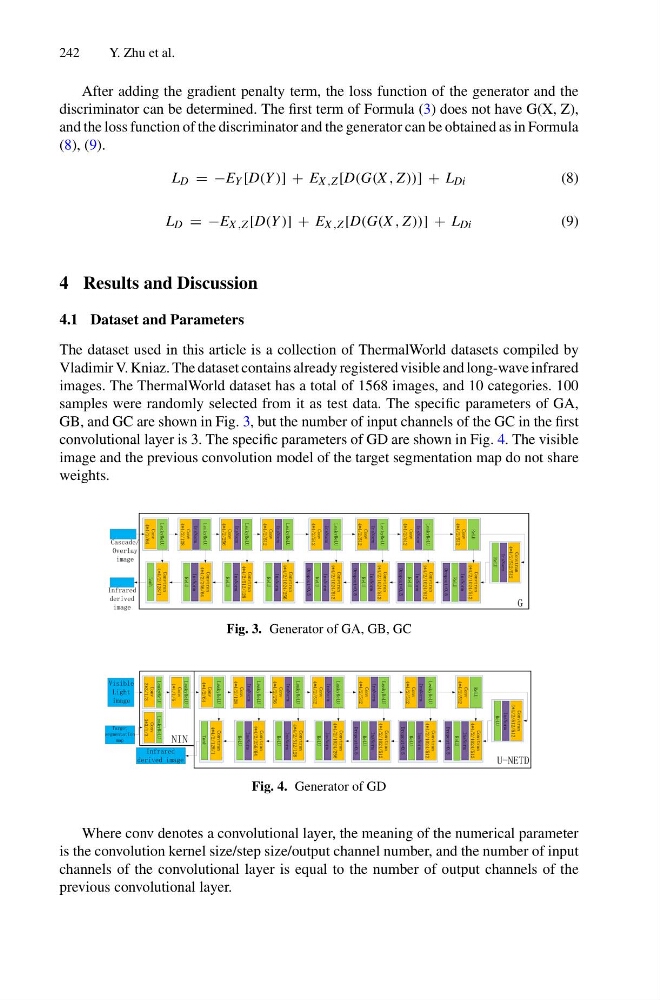
samples were randomly selected from it as test data. The specific parameters of GA,
GB, and GC are shown in Fig. 3, but the number of input channels of the GC in the first
convolutional layer is 3. The specific parameters of GD are shown in Fig. 4. The visible
image and the previous convolution model of the target segmentation map do not share
weights.
Fig. 3. Generator of GA, GB, GC
Fig. 4. Generator of GD
Where conv denotes a convolutional layer, the meaning of the numerical parameter
is the convolution kernel size/step size/output channel number, and the number of input
channels of the convolutional layer is equal to the number of output channels of the
previous convolutional layer.
Y. Zhu et al.
After adding the gradient penalty term, the loss function of the generator and the
discriminator can be determined. The first term of Formula (3) does not have G(X, Z),
and the loss function of the discriminator and the generator can be obtained as in Formula
(8), (9).
L D = −E Y [D(Y )] + E X ,Z [D(G(X , Z))] + L Di
(8)
L D = −E X ,Z [D(Y )] + E X ,Z [D(G(X , Z))] + L Di
(9)
4 Results and Discussion
4.1 Dataset and Parameters
The dataset used in this article is a collection of ThermalWorld datasets compiled by
Vladimir V. Kniaz. The dataset contains already registered visible and long-wave infrared
images. The ThermalWorld dataset has a total of 1568 images, and 10 categories. 100
samples were randomly selected from it as test data. The specific parameters of GA,
GB, and GC are shown in Fig. 3, but the number of input channels of the GC in the first
convolutional layer is 3. The specific parameters of GD are shown in Fig. 4. The visible
image and the previous convolution model of the target segmentation map do not share
weights.
Fig. 3. Generator of GA, GB, GC
Fig. 4. Generator of GD
Where conv denotes a convolutional layer, the meaning of the numerical parameter
is the convolution kernel size/step size/output channel number, and the number of input
channels of the convolutional layer is equal to the number of output channels of the
previous convolutional layer.