

Research on Wellbore Temperature Field in Deep-Water CML
215
(4) The annulus section below the seabed mud line, in which the external environment
is casing (or formation) and drill string;
(5) The riser annulus section below the static mud where the external environment is
the riser and the drill string;
(6) The annulus section in the static mud where the external environment is the riser
and drill string;
(7) mud return line, its external environment is sea water.
2.2 Mathematical Model
2.2.1 Fundamental Assumption
In order to simplify the calculation reasonably, the following assumptions were put
forward according to the heat transfer characteristics and flow law:
(1) The drilling fluid is one-dimensional transient heat transfer in the wellbore, axial
heat transfer of drilling fluid is ignored;
(2) The formation is unsteady heat transfer, and there is only heat conduction. The
ambient temperature and geothermal gradient of seawater are constant.
(3) The dissolution of gas is not considered, and the drilling fluid is single-phase fluid;
(4) Assume that the thermal conductivity and specific heat of rock and drilling fluid do
not change with temperature and pressure;
(5) Ignore the heat generated by viscous dissipation of the fluid;
(6) Assume that the drilling fluid follows the Heba rheological model, and other
rheological model calculation methods are similar.
2.2.2 Governing Equation
During the drilling fluid circulation, the wellbore - formation heat transfer system can
be regarded as a heat exchanger with certain boundary conditions, and the whole system
can be divided into seven control areas as shown in Fig. 2. According to the law of
conservation of energy, the governing equations are established for the seven divided
control regions.
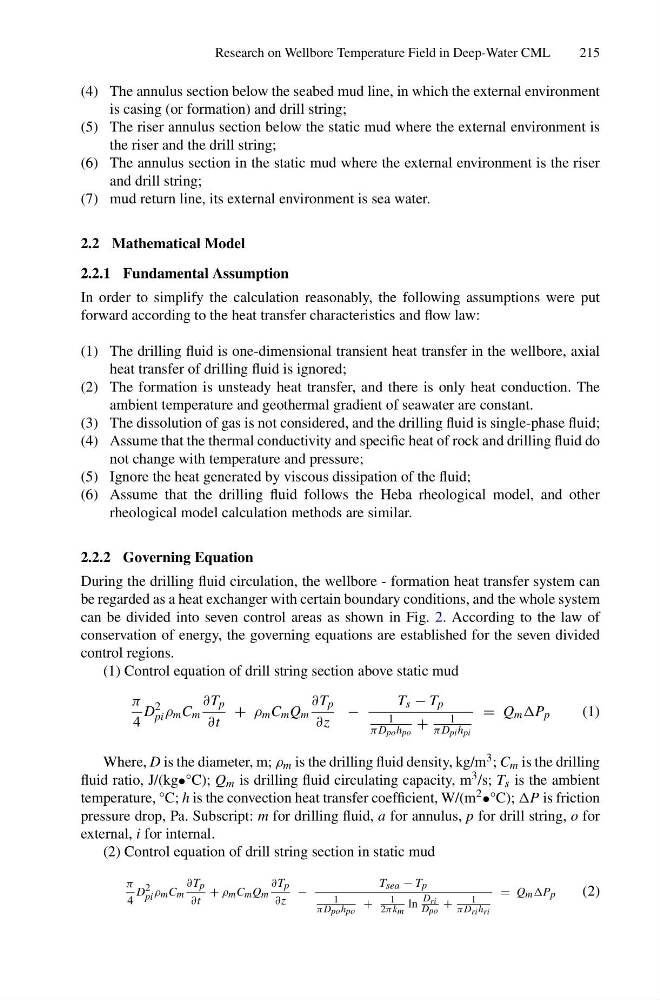
(1) Control equation of drill string section above static mud
π
4
D
2
pi ρ m C m
∂T p
∂t
+ ρ m C m Q m
∂T p
∂z
−
T s − T p
1
π D po h po
+
1
π D pi h pi
= Q m P p
(1)
Where, D is the diameter, m; ρ m is the drilling fluid density, kg/m 3 ; C m is the drilling
fluid ratio, J/(kg•°C); Q m is drilling fluid circulating capacity, m 3 /s; T s is the ambient
temperature, °C; h is the convection heat transfer coefficient, W/(m 2 •°C); P is friction
pressure drop, Pa. Subscript: m for drilling fluid, a for annulus, p for drill string, o for
external, i for internal.
(2) Control equation of drill string section in static mud
π
4
D 2
pi ρ m C m
∂T p
∂t
+ ρ m C m Q m
∂T p
∂z
−
T sea − T p
1
π D po h po
+ 1
2π k m
ln
D ri
D po
+
1
π D ri h ri
= Q m P p
(2)
215
(4) The annulus section below the seabed mud line, in which the external environment
is casing (or formation) and drill string;
(5) The riser annulus section below the static mud where the external environment is
the riser and the drill string;
(6) The annulus section in the static mud where the external environment is the riser
and drill string;
(7) mud return line, its external environment is sea water.
2.2 Mathematical Model
2.2.1 Fundamental Assumption
In order to simplify the calculation reasonably, the following assumptions were put
forward according to the heat transfer characteristics and flow law:
(1) The drilling fluid is one-dimensional transient heat transfer in the wellbore, axial
heat transfer of drilling fluid is ignored;
(2) The formation is unsteady heat transfer, and there is only heat conduction. The
ambient temperature and geothermal gradient of seawater are constant.
(3) The dissolution of gas is not considered, and the drilling fluid is single-phase fluid;
(4) Assume that the thermal conductivity and specific heat of rock and drilling fluid do
not change with temperature and pressure;
(5) Ignore the heat generated by viscous dissipation of the fluid;
(6) Assume that the drilling fluid follows the Heba rheological model, and other
rheological model calculation methods are similar.
2.2.2 Governing Equation
During the drilling fluid circulation, the wellbore - formation heat transfer system can
be regarded as a heat exchanger with certain boundary conditions, and the whole system
can be divided into seven control areas as shown in Fig. 2. According to the law of
conservation of energy, the governing equations are established for the seven divided
control regions.
(1) Control equation of drill string section above static mud
π
4
D
2
pi ρ m C m
∂T p
∂t
+ ρ m C m Q m
∂T p
∂z
−
T s − T p
1
π D po h po
+
1
π D pi h pi
= Q m P p
(1)
Where, D is the diameter, m; ρ m is the drilling fluid density, kg/m 3 ; C m is the drilling
fluid ratio, J/(kg•°C); Q m is drilling fluid circulating capacity, m 3 /s; T s is the ambient
temperature, °C; h is the convection heat transfer coefficient, W/(m 2 •°C); P is friction
pressure drop, Pa. Subscript: m for drilling fluid, a for annulus, p for drill string, o for
external, i for internal.
(2) Control equation of drill string section in static mud
π
4
D 2
pi ρ m C m
∂T p
∂t
+ ρ m C m Q m
∂T p
∂z
−
T sea − T p
1
π D po h po
+ 1
2π k m
ln
D ri
D po
+
1
π D ri h ri
= Q m P p
(2)