

214
G. Zhang et al.
2 CML Dual Gradient Wellbore Transient Heat Transfer Model
2.1 Physical Model
In the normal circulation drilling process, the drilling fluid flows downward along the
drill string. During the flow process, convection heat exchange occurs with the inner
wall of the drill string, and then the drilling fluid enters the annulus through the drill
hole. After entering the annulus, the drilling fluid flows upward from the annulus, during
which convection heat transfer occurs with the outer wall of the drill string and the inner
wall of the casing (or borehole wall), respectively. After the drilling fluid enters the
seawater section through the seabed mud line, it flows upward from the riser annulus.
During the flow, convection heat transfer occurs with the outer wall of the drill string
and the inner wall of the riser respectively. After that, the drilling fluid flows into the
drilling fluid back into the pipeline through the lift pump, and convection heat transfer
occurs between the drilling fluid and the inner wall of the pipeline during the flow. The
final drilling fluid is discharged through the return line.
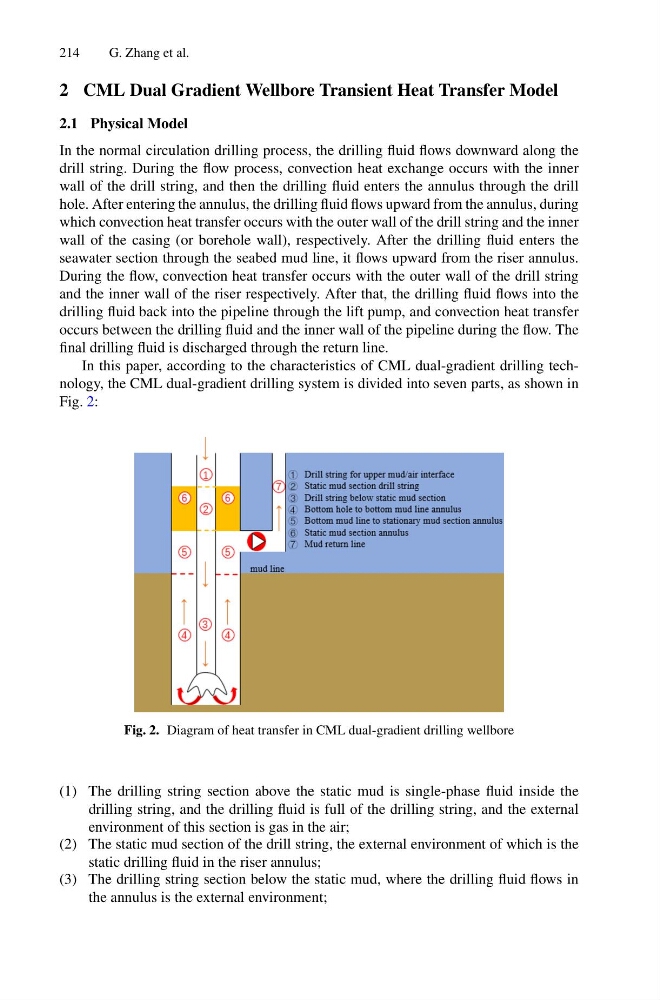
In this paper, according to the characteristics of CML dual-gradient drilling technology, the CML dual-gradient drilling system is divided into seven parts, as shown in
Fig. 2:
Fig. 2. Diagram of heat transfer in CML dual-gradient drilling wellbore
(1) The drilling string section above the static mud is single-phase fluid inside the
drilling string, and the drilling fluid is full of the drilling string, and the external
environment of this section is gas in the air;
(2) The static mud section of the drill string, the external environment of which is the
static drilling fluid in the riser annulus;
(3) The drilling string section below the static mud, where the drilling fluid flows in
the annulus is the external environment;
G. Zhang et al.
2 CML Dual Gradient Wellbore Transient Heat Transfer Model
2.1 Physical Model
In the normal circulation drilling process, the drilling fluid flows downward along the
drill string. During the flow process, convection heat exchange occurs with the inner
wall of the drill string, and then the drilling fluid enters the annulus through the drill
hole. After entering the annulus, the drilling fluid flows upward from the annulus, during
which convection heat transfer occurs with the outer wall of the drill string and the inner
wall of the casing (or borehole wall), respectively. After the drilling fluid enters the
seawater section through the seabed mud line, it flows upward from the riser annulus.
During the flow, convection heat transfer occurs with the outer wall of the drill string
and the inner wall of the riser respectively. After that, the drilling fluid flows into the
drilling fluid back into the pipeline through the lift pump, and convection heat transfer
occurs between the drilling fluid and the inner wall of the pipeline during the flow. The
final drilling fluid is discharged through the return line.
In this paper, according to the characteristics of CML dual-gradient drilling technology, the CML dual-gradient drilling system is divided into seven parts, as shown in
Fig. 2:
Fig. 2. Diagram of heat transfer in CML dual-gradient drilling wellbore
(1) The drilling string section above the static mud is single-phase fluid inside the
drilling string, and the drilling fluid is full of the drilling string, and the external
environment of this section is gas in the air;
(2) The static mud section of the drill string, the external environment of which is the
static drilling fluid in the riser annulus;
(3) The drilling string section below the static mud, where the drilling fluid flows in
the annulus is the external environment;