

Application of Functional Safety Analysis in Refined Oil Station
197
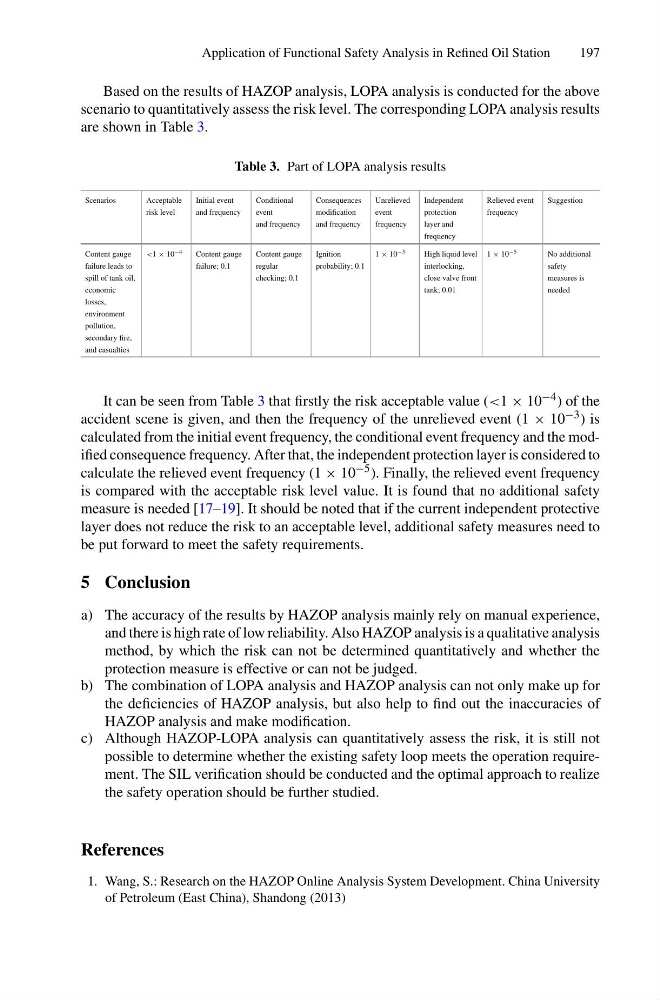
Based on the results of HAZOP analysis, LOPA analysis is conducted for the above
scenario to quantitatively assess the risk level. The corresponding LOPA analysis results
are shown in Table 3.
Table 3. Part of LOPA analysis results
Scenarios
Acceptable
risk level
Initial event
and frequency
Conditional
event
and frequency
Consequences
modification
and frequency
Unrelieved
event
frequency
Independent
protection
layer and
frequency
Relieved event
frequency
Suggestion
Content gauge
failure leads to
spill of tank oil,
economic
losses,
environment
pollution,
secondary fire,
and casualties
<1 × 10 −4
Content gauge
failure; 0.1
Content gauge
regular
checking; 0.1
Ignition
probability; 0.1
1 × 10 −3
High liquid level
interlocking,
close valve front
tank; 0.01
1 × 10 −5
No additional
safety
measures is
needed
It can be seen from Table 3 that firstly the risk acceptable value (<1 × 10 −4 ) of the
accident scene is given, and then the frequency of the unrelieved event (1 × 10 −3 ) is
calculated from the initial event frequency, the conditional event frequency and the modified consequence frequency. After that, the independent protection layer is considered to
calculate the relieved event frequency (1 × 10 −5 ). Finally, the relieved event frequency
is compared with the acceptable risk level value. It is found that no additional safety
measure is needed [17–19]. It should be noted that if the current independent protective
layer does not reduce the risk to an acceptable level, additional safety measures need to
be put forward to meet the safety requirements.
5 Conclusion
a) The accuracy of the results by HAZOP analysis mainly rely on manual experience,
and there is high rate of low reliability. Also HAZOP analysis is a qualitative analysis
method, by which the risk can not be determined quantitatively and whether the
protection measure is effective or can not be judged.
b) The combination of LOPA analysis and HAZOP analysis can not only make up for
the deficiencies of HAZOP analysis, but also help to find out the inaccuracies of
HAZOP analysis and make modification.
c) Although HAZOP-LOPA analysis can quantitatively assess the risk, it is still not
possible to determine whether the existing safety loop meets the operation requirement. The SIL verification should be conducted and the optimal approach to realize
the safety operation should be further studied.
References
1. Wang, S.: Research on the HAZOP Online Analysis System Development. China University
of Petroleum (East China), Shandong (2013)
197
Based on the results of HAZOP analysis, LOPA analysis is conducted for the above
scenario to quantitatively assess the risk level. The corresponding LOPA analysis results
are shown in Table 3.
Table 3. Part of LOPA analysis results
Scenarios
Acceptable
risk level
Initial event
and frequency
Conditional
event
and frequency
Consequences
modification
and frequency
Unrelieved
event
frequency
Independent
protection
layer and
frequency
Relieved event
frequency
Suggestion
Content gauge
failure leads to
spill of tank oil,
economic
losses,
environment
pollution,
secondary fire,
and casualties
<1 × 10 −4
Content gauge
failure; 0.1
Content gauge
regular
checking; 0.1
Ignition
probability; 0.1
1 × 10 −3
High liquid level
interlocking,
close valve front
tank; 0.01
1 × 10 −5
No additional
safety
measures is
needed
It can be seen from Table 3 that firstly the risk acceptable value (<1 × 10 −4 ) of the
accident scene is given, and then the frequency of the unrelieved event (1 × 10 −3 ) is
calculated from the initial event frequency, the conditional event frequency and the modified consequence frequency. After that, the independent protection layer is considered to
calculate the relieved event frequency (1 × 10 −5 ). Finally, the relieved event frequency
is compared with the acceptable risk level value. It is found that no additional safety
measure is needed [17–19]. It should be noted that if the current independent protective
layer does not reduce the risk to an acceptable level, additional safety measures need to
be put forward to meet the safety requirements.
5 Conclusion
a) The accuracy of the results by HAZOP analysis mainly rely on manual experience,
and there is high rate of low reliability. Also HAZOP analysis is a qualitative analysis
method, by which the risk can not be determined quantitatively and whether the
protection measure is effective or can not be judged.
b) The combination of LOPA analysis and HAZOP analysis can not only make up for
the deficiencies of HAZOP analysis, but also help to find out the inaccuracies of
HAZOP analysis and make modification.
c) Although HAZOP-LOPA analysis can quantitatively assess the risk, it is still not
possible to determine whether the existing safety loop meets the operation requirement. The SIL verification should be conducted and the optimal approach to realize
the safety operation should be further studied.
References
1. Wang, S.: Research on the HAZOP Online Analysis System Development. China University
of Petroleum (East China), Shandong (2013)