

Study on Commissioning Techniques for Oil Transportation Pipeline
189
Where, V—gas volume, m 3 ; v—the velocity difference, m/s; L—the length of
pipeline, m; a—water hammer wave speed, m/s.
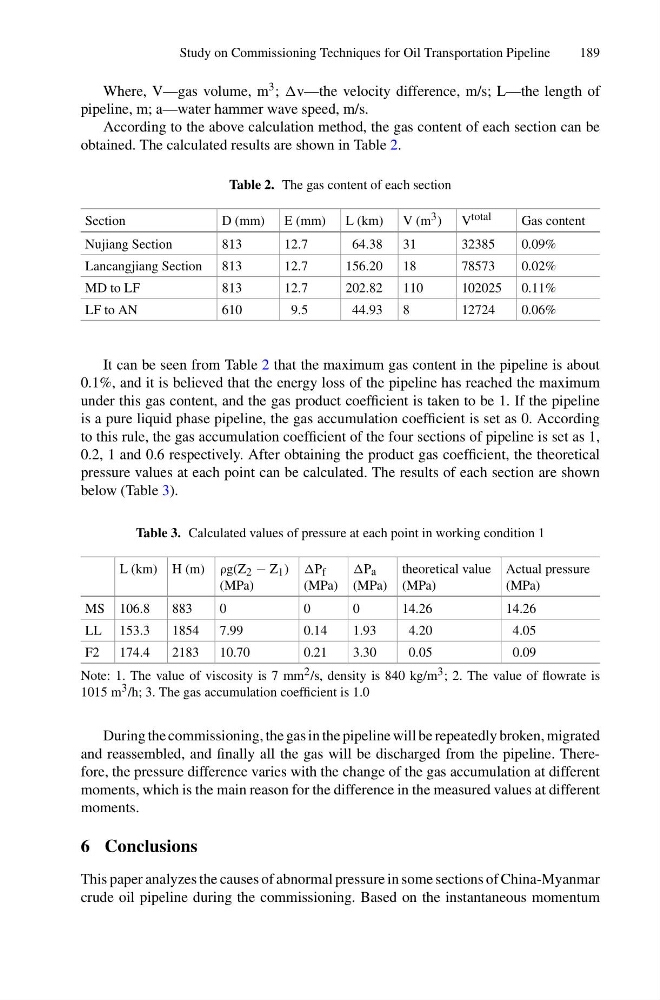
According to the above calculation method, the gas content of each section can be
obtained. The calculated results are shown in Table 2.
Table 2. The gas content of each section
Section
D (mm) E (mm) L (km) V (m 3 ) V total
Gas content
Nujiang Section
813
12.7
64.38
31
32385
0.09%
Lancangjiang Section 813
12.7
156.20
18
78573
0.02%
MD to LF
813
12.7
202.82
110
102025 0.11%
LF to AN
610
9.5
44.93
8
12724
0.06%
It can be seen from Table 2 that the maximum gas content in the pipeline is about
0.1%, and it is believed that the energy loss of the pipeline has reached the maximum
under this gas content, and the gas product coefficient is taken to be 1. If the pipeline
is a pure liquid phase pipeline, the gas accumulation coefficient is set as 0. According
to this rule, the gas accumulation coefficient of the four sections of pipeline is set as 1,
0.2, 1 and 0.6 respectively. After obtaining the product gas coefficient, the theoretical
pressure values at each point can be calculated. The results of each section are shown
below (Table 3).
Table 3. Calculated values of pressure at each point in working condition 1
L (km) H (m) ρg(Z 2 − Z 1 )
(MPa)
P f
(MPa)
P a
(MPa)
theoretical value
(MPa)
Actual pressure
(MPa)
MS 106.8
883
0
0
0
14.26
14.26
LL 153.3
1854
7.99
0.14
1.93
4.20
4.05
F2 174.4
2183
10.70
0.21
3.30
0.05
0.09
Note: 1. The value of viscosity is 7 mm 2 /s, density is 840 kg/m 3 ; 2. The value of flowrate is
1015 m 3 /h; 3. The gas accumulation coefficient is 1.0
During the commissioning, the gas in the pipeline will be repeatedly broken, migrated
and reassembled, and finally all the gas will be discharged from the pipeline. Therefore, the pressure difference varies with the change of the gas accumulation at different
moments, which is the main reason for the difference in the measured values at different
moments.
6 Conclusions
This paper analyzes the causes of abnormal pressure in some sections of China-Myanmar
crude oil pipeline during the commissioning. Based on the instantaneous momentum
189
Where, V—gas volume, m 3 ; v—the velocity difference, m/s; L—the length of
pipeline, m; a—water hammer wave speed, m/s.
According to the above calculation method, the gas content of each section can be
obtained. The calculated results are shown in Table 2.
Table 2. The gas content of each section
Section
D (mm) E (mm) L (km) V (m 3 ) V total
Gas content
Nujiang Section
813
12.7
64.38
31
32385
0.09%
Lancangjiang Section 813
12.7
156.20
18
78573
0.02%
MD to LF
813
12.7
202.82
110
102025 0.11%
LF to AN
610
9.5
44.93
8
12724
0.06%
It can be seen from Table 2 that the maximum gas content in the pipeline is about
0.1%, and it is believed that the energy loss of the pipeline has reached the maximum
under this gas content, and the gas product coefficient is taken to be 1. If the pipeline
is a pure liquid phase pipeline, the gas accumulation coefficient is set as 0. According
to this rule, the gas accumulation coefficient of the four sections of pipeline is set as 1,
0.2, 1 and 0.6 respectively. After obtaining the product gas coefficient, the theoretical
pressure values at each point can be calculated. The results of each section are shown
below (Table 3).
Table 3. Calculated values of pressure at each point in working condition 1
L (km) H (m) ρg(Z 2 − Z 1 )
(MPa)
P f
(MPa)
P a
(MPa)
theoretical value
(MPa)
Actual pressure
(MPa)
MS 106.8
883
0
0
0
14.26
14.26
LL 153.3
1854
7.99
0.14
1.93
4.20
4.05
F2 174.4
2183
10.70
0.21
3.30
0.05
0.09
Note: 1. The value of viscosity is 7 mm 2 /s, density is 840 kg/m 3 ; 2. The value of flowrate is
1015 m 3 /h; 3. The gas accumulation coefficient is 1.0
During the commissioning, the gas in the pipeline will be repeatedly broken, migrated
and reassembled, and finally all the gas will be discharged from the pipeline. Therefore, the pressure difference varies with the change of the gas accumulation at different
moments, which is the main reason for the difference in the measured values at different
moments.
6 Conclusions
This paper analyzes the causes of abnormal pressure in some sections of China-Myanmar
crude oil pipeline during the commissioning. Based on the instantaneous momentum