

Experimental Investigation of the Evolution of Permeability and Porosity
175
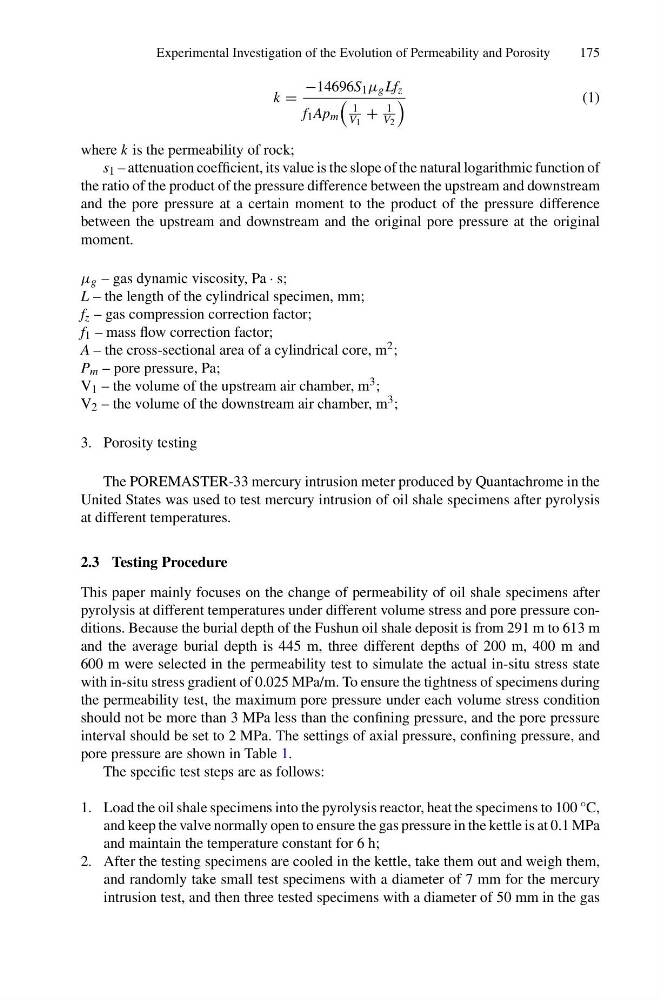
k =
−14696S 1 μ g Lf z
f 1 Ap m
1
V 1
+
1
V 2
(1)
where k is the permeability of rock;
s 1 – attenuation coefficient, its value is the slope of the natural logarithmic function of
the ratio of the product of the pressure difference between the upstream and downstream
and the pore pressure at a certain moment to the product of the pressure difference
between the upstream and downstream and the original pore pressure at the original
moment.
μ g – gas dynamic viscosity, Pa · s;
L – the length of the cylindrical specimen, mm;
f z – gas compression correction factor;
f 1 – mass flow correction factor;
A – the cross-sectional area of a cylindrical core, m 2 ;
P m – pore pressure, Pa;
V 1 – the volume of the upstream air chamber, m 3 ;
V 2 – the volume of the downstream air chamber, m 3 ;
3. Porosity testing
The POREMASTER-33 mercury intrusion meter produced by Quantachrome in the
United States was used to test mercury intrusion of oil shale specimens after pyrolysis
at different temperatures.
2.3 Testing Procedure
This paper mainly focuses on the change of permeability of oil shale specimens after
pyrolysis at different temperatures under different volume stress and pore pressure conditions. Because the burial depth of the Fushun oil shale deposit is from 291 m to 613 m
and the average burial depth is 445 m, three different depths of 200 m, 400 m and
600 m were selected in the permeability test to simulate the actual in-situ stress state
with in-situ stress gradient of 0.025 MPa/m. To ensure the tightness of specimens during
the permeability test, the maximum pore pressure under each volume stress condition
should not be more than 3 MPa less than the confining pressure, and the pore pressure
interval should be set to 2 MPa. The settings of axial pressure, confining pressure, and
pore pressure are shown in Table 1.
The specific test steps are as follows:
1. Load the oil shale specimens into the pyrolysis reactor, heat the specimens to 100 °C,
and keep the valve normally open to ensure the gas pressure in the kettle is at 0.1 MPa
and maintain the temperature constant for 6 h;
2. After the testing specimens are cooled in the kettle, take them out and weigh them,
and randomly take small test specimens with a diameter of 7 mm for the mercury
intrusion test, and then three tested specimens with a diameter of 50 mm in the gas
175
k =
−14696S 1 μ g Lf z
f 1 Ap m
1
V 1
+
1
V 2
(1)
where k is the permeability of rock;
s 1 – attenuation coefficient, its value is the slope of the natural logarithmic function of
the ratio of the product of the pressure difference between the upstream and downstream
and the pore pressure at a certain moment to the product of the pressure difference
between the upstream and downstream and the original pore pressure at the original
moment.
μ g – gas dynamic viscosity, Pa · s;
L – the length of the cylindrical specimen, mm;
f z – gas compression correction factor;
f 1 – mass flow correction factor;
A – the cross-sectional area of a cylindrical core, m 2 ;
P m – pore pressure, Pa;
V 1 – the volume of the upstream air chamber, m 3 ;
V 2 – the volume of the downstream air chamber, m 3 ;
3. Porosity testing
The POREMASTER-33 mercury intrusion meter produced by Quantachrome in the
United States was used to test mercury intrusion of oil shale specimens after pyrolysis
at different temperatures.
2.3 Testing Procedure
This paper mainly focuses on the change of permeability of oil shale specimens after
pyrolysis at different temperatures under different volume stress and pore pressure conditions. Because the burial depth of the Fushun oil shale deposit is from 291 m to 613 m
and the average burial depth is 445 m, three different depths of 200 m, 400 m and
600 m were selected in the permeability test to simulate the actual in-situ stress state
with in-situ stress gradient of 0.025 MPa/m. To ensure the tightness of specimens during
the permeability test, the maximum pore pressure under each volume stress condition
should not be more than 3 MPa less than the confining pressure, and the pore pressure
interval should be set to 2 MPa. The settings of axial pressure, confining pressure, and
pore pressure are shown in Table 1.
The specific test steps are as follows:
1. Load the oil shale specimens into the pyrolysis reactor, heat the specimens to 100 °C,
and keep the valve normally open to ensure the gas pressure in the kettle is at 0.1 MPa
and maintain the temperature constant for 6 h;
2. After the testing specimens are cooled in the kettle, take them out and weigh them,
and randomly take small test specimens with a diameter of 7 mm for the mercury
intrusion test, and then three tested specimens with a diameter of 50 mm in the gas