

ALOHA Anti-collision Algorithm
169
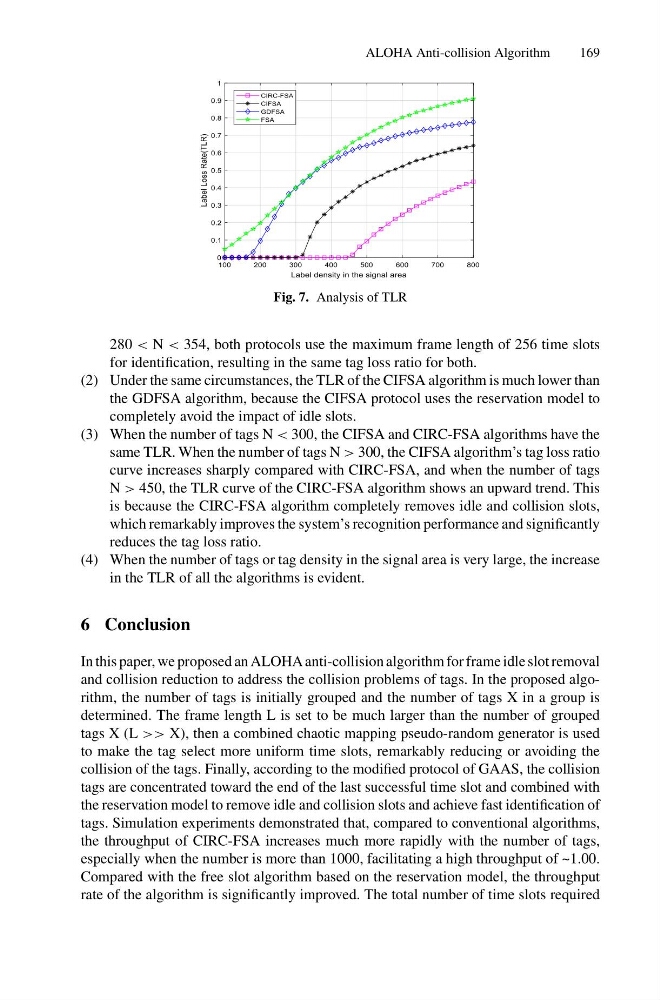
Fig. 7. Analysis of TLR
280 < N < 354, both protocols use the maximum frame length of 256 time slots
for identification, resulting in the same tag loss ratio for both.
(2) Under the same circumstances, the TLR of the CIFSA algorithm is much lower than
the GDFSA algorithm, because the CIFSA protocol uses the reservation model to
completely avoid the impact of idle slots.
(3) When the number of tags N < 300, the CIFSA and CIRC-FSA algorithms have the
same TLR. When the number of tags N > 300, the CIFSA algorithm’s tag loss ratio
curve increases sharply compared with CIRC-FSA, and when the number of tags
N > 450, the TLR curve of the CIRC-FSA algorithm shows an upward trend. This
is because the CIRC-FSA algorithm completely removes idle and collision slots,
which remarkably improves the system’s recognition performance and significantly
reduces the tag loss ratio.
(4) When the number of tags or tag density in the signal area is very large, the increase
in the TLR of all the algorithms is evident.
6 Conclusion
In this paper, we proposed an ALOHA anti-collision algorithm for frame idle slot removal
and collision reduction to address the collision problems of tags. In the proposed algorithm, the number of tags is initially grouped and the number of tags X in a group is
determined. The frame length L is set to be much larger than the number of grouped
tags X (L >> X), then a combined chaotic mapping pseudo-random generator is used
to make the tag select more uniform time slots, remarkably reducing or avoiding the
collision of the tags. Finally, according to the modified protocol of GAAS, the collision
tags are concentrated toward the end of the last successful time slot and combined with
the reservation model to remove idle and collision slots and achieve fast identification of
tags. Simulation experiments demonstrated that, compared to conventional algorithms,
the throughput of CIRC-FSA increases much more rapidly with the number of tags,
especially when the number is more than 1000, facilitating a high throughput of ~1.00.
Compared with the free slot algorithm based on the reservation model, the throughput
rate of the algorithm is significantly improved. The total number of time slots required
169
Fig. 7. Analysis of TLR
280 < N < 354, both protocols use the maximum frame length of 256 time slots
for identification, resulting in the same tag loss ratio for both.
(2) Under the same circumstances, the TLR of the CIFSA algorithm is much lower than
the GDFSA algorithm, because the CIFSA protocol uses the reservation model to
completely avoid the impact of idle slots.
(3) When the number of tags N < 300, the CIFSA and CIRC-FSA algorithms have the
same TLR. When the number of tags N > 300, the CIFSA algorithm’s tag loss ratio
curve increases sharply compared with CIRC-FSA, and when the number of tags
N > 450, the TLR curve of the CIRC-FSA algorithm shows an upward trend. This
is because the CIRC-FSA algorithm completely removes idle and collision slots,
which remarkably improves the system’s recognition performance and significantly
reduces the tag loss ratio.
(4) When the number of tags or tag density in the signal area is very large, the increase
in the TLR of all the algorithms is evident.
6 Conclusion
In this paper, we proposed an ALOHA anti-collision algorithm for frame idle slot removal
and collision reduction to address the collision problems of tags. In the proposed algorithm, the number of tags is initially grouped and the number of tags X in a group is
determined. The frame length L is set to be much larger than the number of grouped
tags X (L >> X), then a combined chaotic mapping pseudo-random generator is used
to make the tag select more uniform time slots, remarkably reducing or avoiding the
collision of the tags. Finally, according to the modified protocol of GAAS, the collision
tags are concentrated toward the end of the last successful time slot and combined with
the reservation model to remove idle and collision slots and achieve fast identification of
tags. Simulation experiments demonstrated that, compared to conventional algorithms,
the throughput of CIRC-FSA increases much more rapidly with the number of tags,
especially when the number is more than 1000, facilitating a high throughput of ~1.00.
Compared with the free slot algorithm based on the reservation model, the throughput
rate of the algorithm is significantly improved. The total number of time slots required