

162
H. Deng et al.
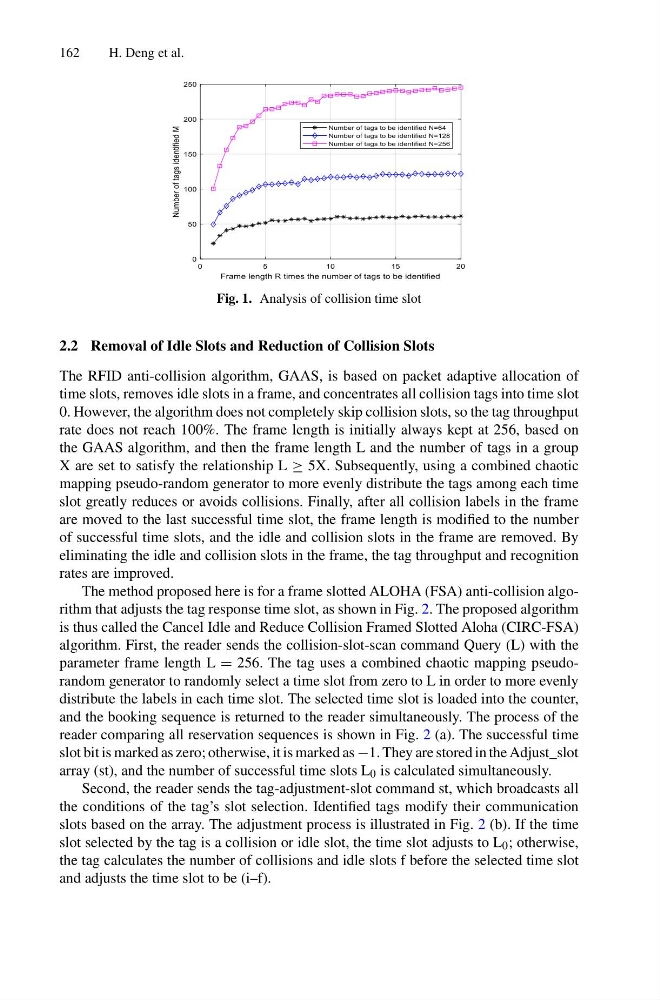
Fig. 1. Analysis of collision time slot
2.2 Removal of Idle Slots and Reduction of Collision Slots
The RFID anti-collision algorithm, GAAS, is based on packet adaptive allocation of
time slots, removes idle slots in a frame, and concentrates all collision tags into time slot
0. However, the algorithm does not completely skip collision slots, so the tag throughput
rate does not reach 100%. The frame length is initially always kept at 256, based on
the GAAS algorithm, and then the frame length L and the number of tags in a group
X are set to satisfy the relationship L ≥ 5X. Subsequently, using a combined chaotic
mapping pseudo-random generator to more evenly distribute the tags among each time
slot greatly reduces or avoids collisions. Finally, after all collision labels in the frame
are moved to the last successful time slot, the frame length is modified to the number
of successful time slots, and the idle and collision slots in the frame are removed. By
eliminating the idle and collision slots in the frame, the tag throughput and recognition
rates are improved.
The method proposed here is for a frame slotted ALOHA (FSA) anti-collision algorithm that adjusts the tag response time slot, as shown in Fig. 2. The proposed algorithm
is thus called the Cancel Idle and Reduce Collision Framed Slotted Aloha (CIRC-FSA)
algorithm. First, the reader sends the collision-slot-scan command Query (L) with the
parameter frame length L = 256. The tag uses a combined chaotic mapping pseudorandom generator to randomly select a time slot from zero to L in order to more evenly
distribute the labels in each time slot. The selected time slot is loaded into the counter,
and the booking sequence is returned to the reader simultaneously. The process of the
reader comparing all reservation sequences is shown in Fig. 2 (a). The successful time
slot bit is marked as zero; otherwise, it is marked as −1. They are stored in the Adjust_slot
array (st), and the number of successful time slots L 0 is calculated simultaneously.
Second, the reader sends the tag-adjustment-slot command st, which broadcasts all
the conditions of the tag’s slot selection. Identified tags modify their communication
slots based on the array. The adjustment process is illustrated in Fig. 2 (b). If the time
slot selected by the tag is a collision or idle slot, the time slot adjusts to L 0 ; otherwise,
the tag calculates the number of collisions and idle slots f before the selected time slot
and adjusts the time slot to be (i–f).
H. Deng et al.
Fig. 1. Analysis of collision time slot
2.2 Removal of Idle Slots and Reduction of Collision Slots
The RFID anti-collision algorithm, GAAS, is based on packet adaptive allocation of
time slots, removes idle slots in a frame, and concentrates all collision tags into time slot
0. However, the algorithm does not completely skip collision slots, so the tag throughput
rate does not reach 100%. The frame length is initially always kept at 256, based on
the GAAS algorithm, and then the frame length L and the number of tags in a group
X are set to satisfy the relationship L ≥ 5X. Subsequently, using a combined chaotic
mapping pseudo-random generator to more evenly distribute the tags among each time
slot greatly reduces or avoids collisions. Finally, after all collision labels in the frame
are moved to the last successful time slot, the frame length is modified to the number
of successful time slots, and the idle and collision slots in the frame are removed. By
eliminating the idle and collision slots in the frame, the tag throughput and recognition
rates are improved.
The method proposed here is for a frame slotted ALOHA (FSA) anti-collision algorithm that adjusts the tag response time slot, as shown in Fig. 2. The proposed algorithm
is thus called the Cancel Idle and Reduce Collision Framed Slotted Aloha (CIRC-FSA)
algorithm. First, the reader sends the collision-slot-scan command Query (L) with the
parameter frame length L = 256. The tag uses a combined chaotic mapping pseudorandom generator to randomly select a time slot from zero to L in order to more evenly
distribute the labels in each time slot. The selected time slot is loaded into the counter,
and the booking sequence is returned to the reader simultaneously. The process of the
reader comparing all reservation sequences is shown in Fig. 2 (a). The successful time
slot bit is marked as zero; otherwise, it is marked as −1. They are stored in the Adjust_slot
array (st), and the number of successful time slots L 0 is calculated simultaneously.
Second, the reader sends the tag-adjustment-slot command st, which broadcasts all
the conditions of the tag’s slot selection. Identified tags modify their communication
slots based on the array. The adjustment process is illustrated in Fig. 2 (b). If the time
slot selected by the tag is a collision or idle slot, the time slot adjusts to L 0 ; otherwise,
the tag calculates the number of collisions and idle slots f before the selected time slot
and adjusts the time slot to be (i–f).