

Dynamic Simulation of Natural Gas Filter Separator Depressurization
129
issue with the depressurization system is the calculation of the effective throat area
of the orifice. The calculation of throat area depends on the temperature, pressure,
adiabatic coefficient, compression factor, heat capacity and other thermodynamic
parameters of the fluid. The manual calculation method cannot accurately obtain the
physical properties of the discharge process. Therefore, this work uses the dynamic
simulation method to obtain the physical properties of the fluid in the discharge
process, and then accurately calculates the throat diameter area of the restriction
orifice plate.
4.1 Calculation of Throat Area of Depressurization System
The period of emergency venting time is recommended by the standard. In case of
leakage, failure or fire, the emergency venting system should reduce the system pressure
to 690 kPaG within 15 min and this forms the basis of the calculation. For the natural gas
filter separator system shown in Table 1, the throat area of the flow limiting orifice plate of
the depressurization system is the main factor determining the natural gas vent flow and
vent pipeline design after the design pressure and depressurization time are determined.
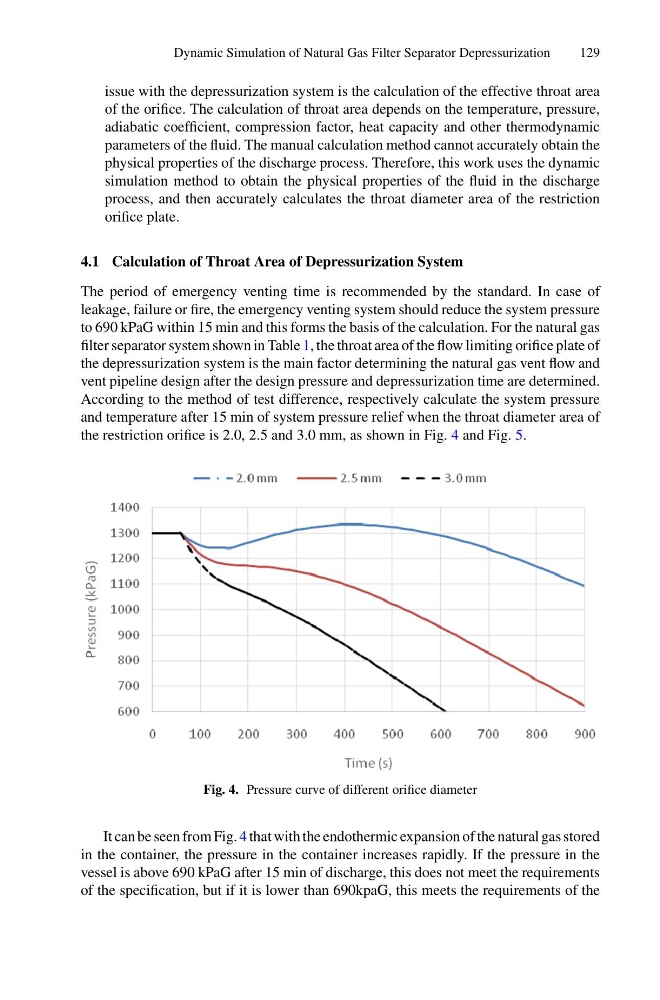
According to the method of test difference, respectively calculate the system pressure
and temperature after 15 min of system pressure relief when the throat diameter area of
the restriction orifice is 2.0, 2.5 and 3.0 mm, as shown in Fig. 4 and Fig. 5.
Fig. 4. Pressure curve of different orifice diameter
It can be seen from Fig. 4 that with the endothermic expansion of the natural gas stored
in the container, the pressure in the container increases rapidly. If the pressure in the
vessel is above 690 kPaG after 15 min of discharge, this does not meet the requirements
of the specification, but if it is lower than 690kpaG, this meets the requirements of the
129
issue with the depressurization system is the calculation of the effective throat area
of the orifice. The calculation of throat area depends on the temperature, pressure,
adiabatic coefficient, compression factor, heat capacity and other thermodynamic
parameters of the fluid. The manual calculation method cannot accurately obtain the
physical properties of the discharge process. Therefore, this work uses the dynamic
simulation method to obtain the physical properties of the fluid in the discharge
process, and then accurately calculates the throat diameter area of the restriction
orifice plate.
4.1 Calculation of Throat Area of Depressurization System
The period of emergency venting time is recommended by the standard. In case of
leakage, failure or fire, the emergency venting system should reduce the system pressure
to 690 kPaG within 15 min and this forms the basis of the calculation. For the natural gas
filter separator system shown in Table 1, the throat area of the flow limiting orifice plate of
the depressurization system is the main factor determining the natural gas vent flow and
vent pipeline design after the design pressure and depressurization time are determined.
According to the method of test difference, respectively calculate the system pressure
and temperature after 15 min of system pressure relief when the throat diameter area of
the restriction orifice is 2.0, 2.5 and 3.0 mm, as shown in Fig. 4 and Fig. 5.
Fig. 4. Pressure curve of different orifice diameter
It can be seen from Fig. 4 that with the endothermic expansion of the natural gas stored
in the container, the pressure in the container increases rapidly. If the pressure in the
vessel is above 690 kPaG after 15 min of discharge, this does not meet the requirements
of the specification, but if it is lower than 690kpaG, this meets the requirements of the