

100
J. Chen et al.
N e is the shape function of element e i where
N
e
=
⎡
⎣
P 0 −α 3 P 0 0
0 P 0 −α 3 P 0
0 0 0
0 P
⎤
⎦ .
(13)
In this work, P is taken as
P(α 1 , α 2 ) =
1 α 10 α 20 α 2
10 α 10 α 20 α 2
20 α 3
10 α 2
10 α 20 α 10 α 2
20 α 3
20
,
(14)
where α 10 = α 1 − α 1i ; α 20 = α 2 − α 2i ; (α 1i , α 2i ) is the curvilinear coordinate of the
central point of element e i .
As seen, the third order displacement approximation can be constructed without
difficulty in the SEIA, which is more convenient than that in the finite element method,
because a third-order finite shell element is usually constructed by including the highorder derivatives of displacement in the nodal DOFs, which often leads to the daunting
complexity in the formulation and numerical implementation.
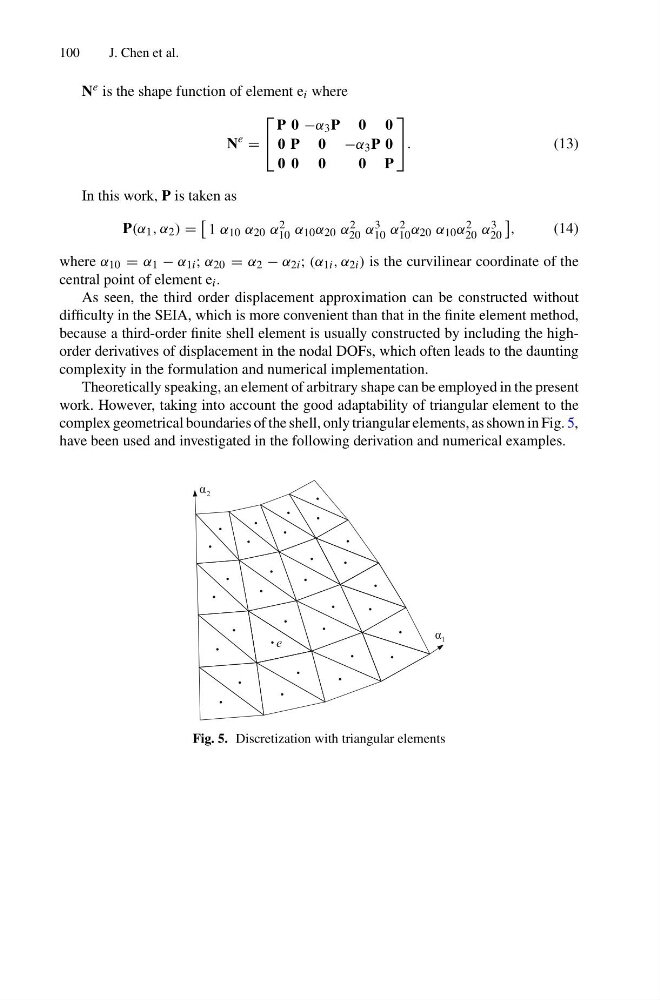
Theoretically speaking, an element of arbitrary shape can be employed in the present
work. However, taking into account the good adaptability of triangular element to the
complex geometrical boundaries of the shell, only triangular elements, as shown in Fig. 5,
have been used and investigated in the following derivation and numerical examples.
2
α
1
α
e
Fig. 5. Discretization with triangular elements
J. Chen et al.
N e is the shape function of element e i where
N
e
=
⎡
⎣
P 0 −α 3 P 0 0
0 P 0 −α 3 P 0
0 0 0
0 P
⎤
⎦ .
(13)
In this work, P is taken as
P(α 1 , α 2 ) =
1 α 10 α 20 α 2
10 α 10 α 20 α 2
20 α 3
10 α 2
10 α 20 α 10 α 2
20 α 3
20
,
(14)
where α 10 = α 1 − α 1i ; α 20 = α 2 − α 2i ; (α 1i , α 2i ) is the curvilinear coordinate of the
central point of element e i .
As seen, the third order displacement approximation can be constructed without
difficulty in the SEIA, which is more convenient than that in the finite element method,
because a third-order finite shell element is usually constructed by including the highorder derivatives of displacement in the nodal DOFs, which often leads to the daunting
complexity in the formulation and numerical implementation.
Theoretically speaking, an element of arbitrary shape can be employed in the present
work. However, taking into account the good adaptability of triangular element to the
complex geometrical boundaries of the shell, only triangular elements, as shown in Fig. 5,
have been used and investigated in the following derivation and numerical examples.
2
α
1
α
e
Fig. 5. Discretization with triangular elements