

A New Locking-Free Thick/Thin Shell Element
99
1
α
2
α
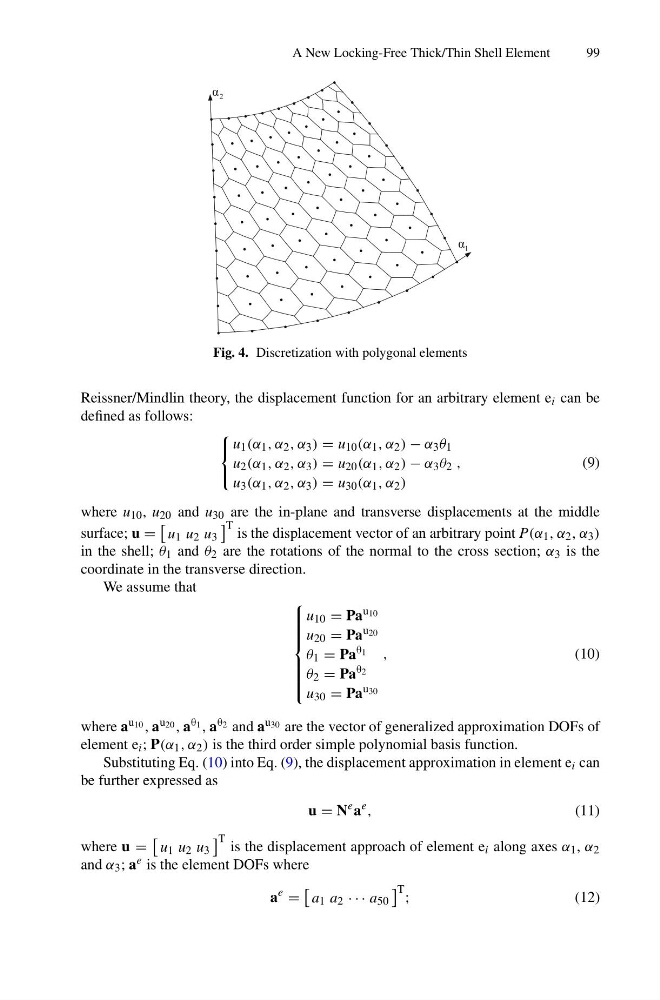
Fig. 4. Discretization with polygonal elements
Reissner/Mindlin theory, the displacement function for an arbitrary element e i can be
defined as follows:
⎧
⎨
⎩
u 1 (α 1 , α 2 , α 3 ) = u 10 (α 1 , α 2 ) − α 3 θ 1
u 2 (α 1 , α 2 , α 3 ) = u 20 (α 1 , α 2 ) − α 3 θ 2
u 3 (α 1 , α 2 , α 3 ) = u 30 (α 1 , α 2 )
,
(9)
where u 10 , u 20 and u 30 are the in-plane and transverse displacements at the middle
surface; u =
u 1 u 2 u 3
T is the displacement vector of an arbitrary point P(α 1 , α 2 , α 3 )
in the shell; θ 1 and θ 2 are the rotations of the normal to the cross section; α 3 is the
coordinate in the transverse direction.
We assume that
⎧
⎪ ⎪ ⎪ ⎪ ⎪ ⎨
⎪ ⎪ ⎪ ⎪ ⎪ ⎩
u 10 = Pa
u 10
u 20 = Pa
u 20
θ 1 = Pa
θ 1
θ 2 = Pa
θ 2
u 30 = Pa
u 30
,
(10)
where a u 10 , a u 20 , a θ 1 , a θ 2 and a u 30 are the vector of generalized approximation DOFs of
element e i ; P(α 1 , α 2 ) is the third order simple polynomial basis function.
Substituting Eq. (10) into Eq. (9), the displacement approximation in element e i can
be further expressed as
u = N
e a
e
,
(11)
where u =
u 1 u 2 u 3
T is the displacement approach of element e i along axes α 1 , α 2
and α 3 ; a e is the element DOFs where
a
e
=
a 1 a 2 · · · a 50
T ;
(12)
99
1
α
2
α
Fig. 4. Discretization with polygonal elements
Reissner/Mindlin theory, the displacement function for an arbitrary element e i can be
defined as follows:
⎧
⎨
⎩
u 1 (α 1 , α 2 , α 3 ) = u 10 (α 1 , α 2 ) − α 3 θ 1
u 2 (α 1 , α 2 , α 3 ) = u 20 (α 1 , α 2 ) − α 3 θ 2
u 3 (α 1 , α 2 , α 3 ) = u 30 (α 1 , α 2 )
,
(9)
where u 10 , u 20 and u 30 are the in-plane and transverse displacements at the middle
surface; u =
u 1 u 2 u 3
T is the displacement vector of an arbitrary point P(α 1 , α 2 , α 3 )
in the shell; θ 1 and θ 2 are the rotations of the normal to the cross section; α 3 is the
coordinate in the transverse direction.
We assume that
⎧
⎪ ⎪ ⎪ ⎪ ⎪ ⎨
⎪ ⎪ ⎪ ⎪ ⎪ ⎩
u 10 = Pa
u 10
u 20 = Pa
u 20
θ 1 = Pa
θ 1
θ 2 = Pa
θ 2
u 30 = Pa
u 30
,
(10)
where a u 10 , a u 20 , a θ 1 , a θ 2 and a u 30 are the vector of generalized approximation DOFs of
element e i ; P(α 1 , α 2 ) is the third order simple polynomial basis function.
Substituting Eq. (10) into Eq. (9), the displacement approximation in element e i can
be further expressed as
u = N
e a
e
,
(11)
where u =
u 1 u 2 u 3
T is the displacement approach of element e i along axes α 1 , α 2
and α 3 ; a e is the element DOFs where
a
e
=
a 1 a 2 · · · a 50
T ;
(12)