

cross-linked using diacrylates [2]. The method is straightforward for a single network, gives precise control over the cross-link density and can be adapted for multigeneration networks using an iterative procedure that we detail below. The result of
the network generation procedure is a coarse-grained bead-spring network model for
elastomers, with a controllable number of generations, and a well-defined density of
cross-links within each generation, as well as between generations. The coarsegraining scale is set by the rest length b of the springs, which typically will be
chosen to be the Kuhn length of the polymer. By using random walkers as the basis,
the method aims to provide physically sound statistical network properties, such as
bridge lengths and entanglements.
3.4.1 Modified Random Walk Networks
Within each generation, the network preparation method can be visualized as a cubic
lattice with lattice constant b. A fraction p of the sites is marked as cross-linking
sites. The method to generate polymer networks amounts to modified self-avoiding
random walk on this lattice that can be interpreted as a free radical polymerization
path. Normal sites can be visited exactly once by a random walker, as in a standard
self-avoiding walk. Cross-linking sites can be visited twice, mimicking the fact that
they contain two polymerizable moieties. In essence, we have made a lattice version
of the chain generation method of [84] and have expanded it to include the possibility of generating cross-links. We will refer to this procedure as our modified selfavoiding random walk (m-SARW). Note that p ¼ 0 represents the case in which
there are no cross-links and the process is reduced to a standard SARW [85].
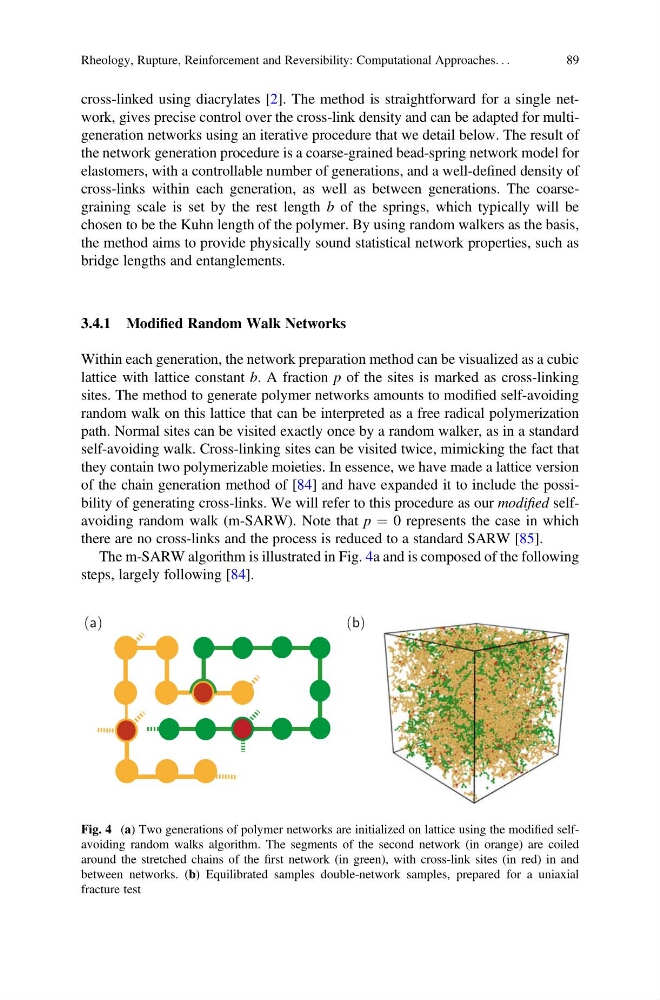
The m-SARW algorithm is illustrated in Fig. 4a and is composed of the following
steps, largely following [84].
(a)
( b)
Fig. 4 (a) Two generations of polymer networks are initialized on lattice using the modified selfavoiding random walks algorithm. The segments of the second network (in orange) are coiled
around the stretched chains of the first network (in green), with cross-link sites (in red) in and
between networks. (b) Equilibrated samples double-network samples, prepared for a uniaxial
fracture test
Rheology, Rupture, Reinforcement and Reversibility: Computational Approaches. . .
89
the network generation procedure is a coarse-grained bead-spring network model for
elastomers, with a controllable number of generations, and a well-defined density of
cross-links within each generation, as well as between generations. The coarsegraining scale is set by the rest length b of the springs, which typically will be
chosen to be the Kuhn length of the polymer. By using random walkers as the basis,
the method aims to provide physically sound statistical network properties, such as
bridge lengths and entanglements.
3.4.1 Modified Random Walk Networks
Within each generation, the network preparation method can be visualized as a cubic
lattice with lattice constant b. A fraction p of the sites is marked as cross-linking
sites. The method to generate polymer networks amounts to modified self-avoiding
random walk on this lattice that can be interpreted as a free radical polymerization
path. Normal sites can be visited exactly once by a random walker, as in a standard
self-avoiding walk. Cross-linking sites can be visited twice, mimicking the fact that
they contain two polymerizable moieties. In essence, we have made a lattice version
of the chain generation method of [84] and have expanded it to include the possibility of generating cross-links. We will refer to this procedure as our modified selfavoiding random walk (m-SARW). Note that p ¼ 0 represents the case in which
there are no cross-links and the process is reduced to a standard SARW [85].
The m-SARW algorithm is illustrated in Fig. 4a and is composed of the following
steps, largely following [84].
(a)
( b)
Fig. 4 (a) Two generations of polymer networks are initialized on lattice using the modified selfavoiding random walks algorithm. The segments of the second network (in orange) are coiled
around the stretched chains of the first network (in green), with cross-link sites (in red) in and
between networks. (b) Equilibrated samples double-network samples, prepared for a uniaxial
fracture test
Rheology, Rupture, Reinforcement and Reversibility: Computational Approaches. . .
89