

r
!
a bonded to monomer b at r
!
b , while monomer c at r
!
c approaches the interaction
range:
U
3
ð Þ
abc ¼ λε b
U
2
ð Þ
E2 r ac
ð Þ
ð46Þ
¼ ÀλU
2
ð Þ
GLJ r ac
ð Þ
ð47Þ
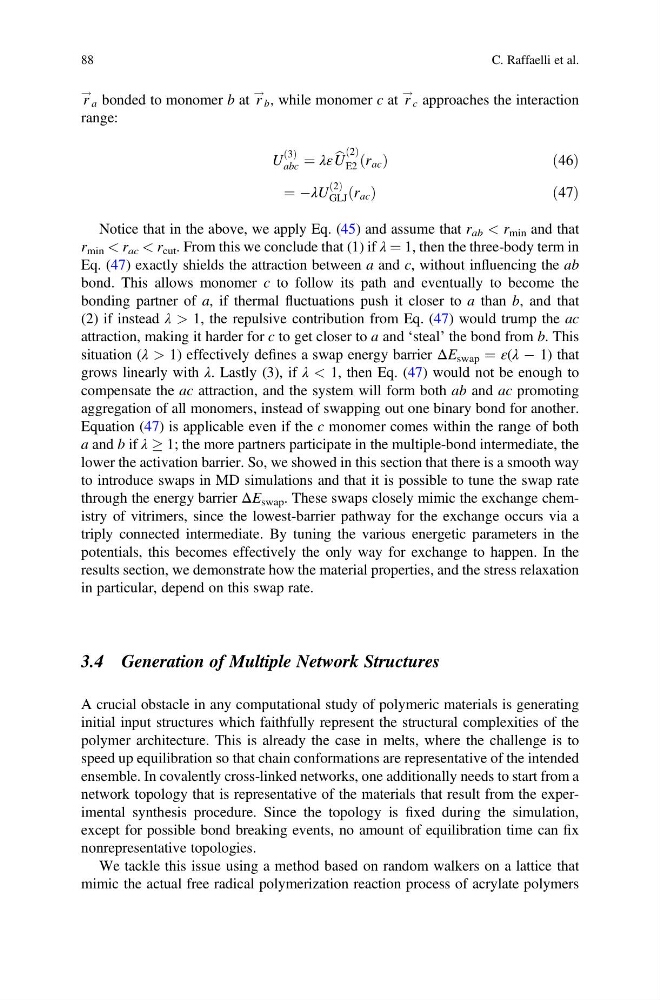
Notice that in the above, we apply Eq. (45) and assume that r ab < r min and that
r min < r ac < r cut . From this we conclude that (1) if λ ¼ 1, then the three-body term in
Eq. (47) exactly shields the attraction between a and c, without influencing the ab
bond. This allows monomer c to follow its path and eventually to become the
bonding partner of a, if thermal fluctuations push it closer to a than b, and that
(2) if instead λ > 1, the repulsive contribution from Eq. (47) would trump the ac
attraction, making it harder for c to get closer to a and ‘steal’ the bond from b. This
situation (λ > 1) effectively defines a swap energy barrier ΔE swap ¼ ε(λ À 1) that
grows linearly with λ. Lastly (3), if λ < 1, then Eq. (47) would not be enough to
compensate the ac attraction, and the system will form both ab and ac promoting
aggregation of all monomers, instead of swapping out one binary bond for another.
Equation (47) is applicable even if the c monomer comes within the range of both
a and b if λ ! 1; the more partners participate in the multiple-bond intermediate, the
lower the activation barrier. So, we showed in this section that there is a smooth way
to introduce swaps in MD simulations and that it is possible to tune the swap rate
through the energy barrier ΔE swap . These swaps closely mimic the exchange chemistry of vitrimers, since the lowest-barrier pathway for the exchange occurs via a
triply connected intermediate. By tuning the various energetic parameters in the
potentials, this becomes effectively the only way for exchange to happen. In the
results section, we demonstrate how the material properties, and the stress relaxation
in particular, depend on this swap rate.
3.4 Generation of Multiple Network Structures
A crucial obstacle in any computational study of polymeric materials is generating
initial input structures which faithfully represent the structural complexities of the
polymer architecture. This is already the case in melts, where the challenge is to
speed up equilibration so that chain conformations are representative of the intended
ensemble. In covalently cross-linked networks, one additionally needs to start from a
network topology that is representative of the materials that result from the experimental synthesis procedure. Since the topology is fixed during the simulation,
except for possible bond breaking events, no amount of equilibration time can fix
nonrepresentative topologies.
We tackle this issue using a method based on random walkers on a lattice that
mimic the actual free radical polymerization reaction process of acrylate polymers
88
C. Raffaelli et al.
!
a bonded to monomer b at r
!
b , while monomer c at r
!
c approaches the interaction
range:
U
3
ð Þ
abc ¼ λε b
U
2
ð Þ
E2 r ac
ð Þ
ð46Þ
¼ ÀλU
2
ð Þ
GLJ r ac
ð Þ
ð47Þ
Notice that in the above, we apply Eq. (45) and assume that r ab < r min and that
r min < r ac < r cut . From this we conclude that (1) if λ ¼ 1, then the three-body term in
Eq. (47) exactly shields the attraction between a and c, without influencing the ab
bond. This allows monomer c to follow its path and eventually to become the
bonding partner of a, if thermal fluctuations push it closer to a than b, and that
(2) if instead λ > 1, the repulsive contribution from Eq. (47) would trump the ac
attraction, making it harder for c to get closer to a and ‘steal’ the bond from b. This
situation (λ > 1) effectively defines a swap energy barrier ΔE swap ¼ ε(λ À 1) that
grows linearly with λ. Lastly (3), if λ < 1, then Eq. (47) would not be enough to
compensate the ac attraction, and the system will form both ab and ac promoting
aggregation of all monomers, instead of swapping out one binary bond for another.
Equation (47) is applicable even if the c monomer comes within the range of both
a and b if λ ! 1; the more partners participate in the multiple-bond intermediate, the
lower the activation barrier. So, we showed in this section that there is a smooth way
to introduce swaps in MD simulations and that it is possible to tune the swap rate
through the energy barrier ΔE swap . These swaps closely mimic the exchange chemistry of vitrimers, since the lowest-barrier pathway for the exchange occurs via a
triply connected intermediate. By tuning the various energetic parameters in the
potentials, this becomes effectively the only way for exchange to happen. In the
results section, we demonstrate how the material properties, and the stress relaxation
in particular, depend on this swap rate.
3.4 Generation of Multiple Network Structures
A crucial obstacle in any computational study of polymeric materials is generating
initial input structures which faithfully represent the structural complexities of the
polymer architecture. This is already the case in melts, where the challenge is to
speed up equilibration so that chain conformations are representative of the intended
ensemble. In covalently cross-linked networks, one additionally needs to start from a
network topology that is representative of the materials that result from the experimental synthesis procedure. Since the topology is fixed during the simulation,
except for possible bond breaking events, no amount of equilibration time can fix
nonrepresentative topologies.
We tackle this issue using a method based on random walkers on a lattice that
mimic the actual free radical polymerization reaction process of acrylate polymers
88
C. Raffaelli et al.