

Reinforcement and the Payne effect are challenging issues in computational soft
matter science: Complex interactions between constituent phases at the atomic level
ultimately manifest themselves in macroscopic properties, and for this reason a large
range of length and timescales must be, in principle, addressed in such simulations.
Typically, a combination of modelling techniques is required to meaningfully
simulate the bulk-level behaviour of nanocomposites.
Raos et al. [10] were among the first who studied the effect of the interactions
between stiff colloidal filler particles and polymer networks using large-scale,
coarse-grained dissipative particle dynamics (DPD) models. The nonlinear viscoelastic results of these simulations, however, were rather different from the experimentally observed Payne effect. The authors conclude that the origin of the Payne
effect is not solely related to the particle-particle interactions. The reasons of the
observed discrepancies could also be in the specificity of the soft DPD potentials
used in these simulations. At the same time, recent DPD simulations of [11]
reproduced nicely the experimental reinforcement in elastomer nanocomposites.
Evidence that in elastomer-based nanocomposites the filler nanoparticles play the
role of temporal cross-links in a supranetwork was presented by [12, 13]. They
investigate the formation of temporal networks and the role of polymer-nanoparticle
interactions in coarse-grained molecular dynamics (MD) simulations, with filler
particles represented as Lennard-Jones spheres. The authors find that the observed
reinforcement is correlated with the minimization of the relative mobility of the filler
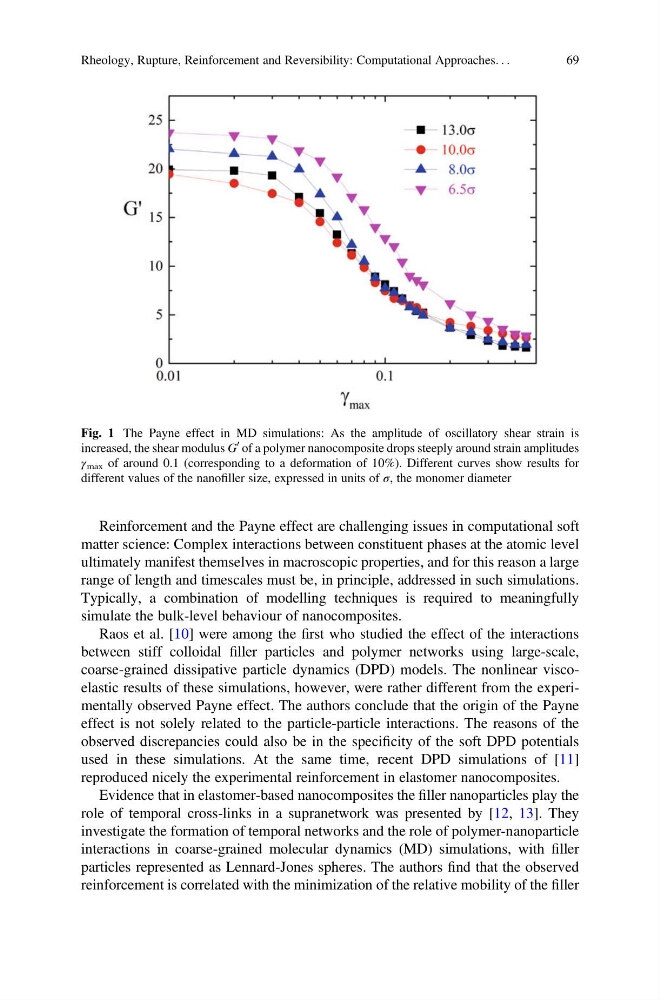
Fig. 1 The Payne effect in MD simulations: As the amplitude of oscillatory shear strain is
increased, the shear modulus G
0 of a polymer nanocomposite drops steeply around strain amplitudes
γ max of around 0.1 (corresponding to a deformation of 10%). Different curves show results for
different values of the nanofiller size, expressed in units of σ, the monomer diameter
Rheology, Rupture, Reinforcement and Reversibility: Computational Approaches. . .
69
matter science: Complex interactions between constituent phases at the atomic level
ultimately manifest themselves in macroscopic properties, and for this reason a large
range of length and timescales must be, in principle, addressed in such simulations.
Typically, a combination of modelling techniques is required to meaningfully
simulate the bulk-level behaviour of nanocomposites.
Raos et al. [10] were among the first who studied the effect of the interactions
between stiff colloidal filler particles and polymer networks using large-scale,
coarse-grained dissipative particle dynamics (DPD) models. The nonlinear viscoelastic results of these simulations, however, were rather different from the experimentally observed Payne effect. The authors conclude that the origin of the Payne
effect is not solely related to the particle-particle interactions. The reasons of the
observed discrepancies could also be in the specificity of the soft DPD potentials
used in these simulations. At the same time, recent DPD simulations of [11]
reproduced nicely the experimental reinforcement in elastomer nanocomposites.
Evidence that in elastomer-based nanocomposites the filler nanoparticles play the
role of temporal cross-links in a supranetwork was presented by [12, 13]. They
investigate the formation of temporal networks and the role of polymer-nanoparticle
interactions in coarse-grained molecular dynamics (MD) simulations, with filler
particles represented as Lennard-Jones spheres. The authors find that the observed
reinforcement is correlated with the minimization of the relative mobility of the filler
Fig. 1 The Payne effect in MD simulations: As the amplitude of oscillatory shear strain is
increased, the shear modulus G
0 of a polymer nanocomposite drops steeply around strain amplitudes
γ max of around 0.1 (corresponding to a deformation of 10%). Different curves show results for
different values of the nanofiller size, expressed in units of σ, the monomer diameter
Rheology, Rupture, Reinforcement and Reversibility: Computational Approaches. . .
69