

automotive propulsion, and even modest improvements can entail significant impact
on global emissions. An important drawback of the use of carbon black in tires is that
as the tire wears, these compounds enter the atmosphere and the environment as
micro- and nanopollutants. Considering that over the course of its useful lifetime, a
typical car tire will shed about 1.5 kg of material and that carbon black may be linked
to human health and environmental issues, it is no surprise that the industry is
looking for cleaner alternatives; tires may be made less of an environmental burden
either by reducing the rolling resistance, leading to less shedding, or by replacing the
harmful and pollutant carbon black with less noxious alternatives. In order to
effectively screen for sustainable alternatives for carbon black, it is imperative that
the basic physics underlying the enhanced performance of nanocomposite rubbers be
understood. The essence of this enhanced performance may be summarized by two,
potentially related, effects: mechanical reinforcement (or stiffening) and the Payne
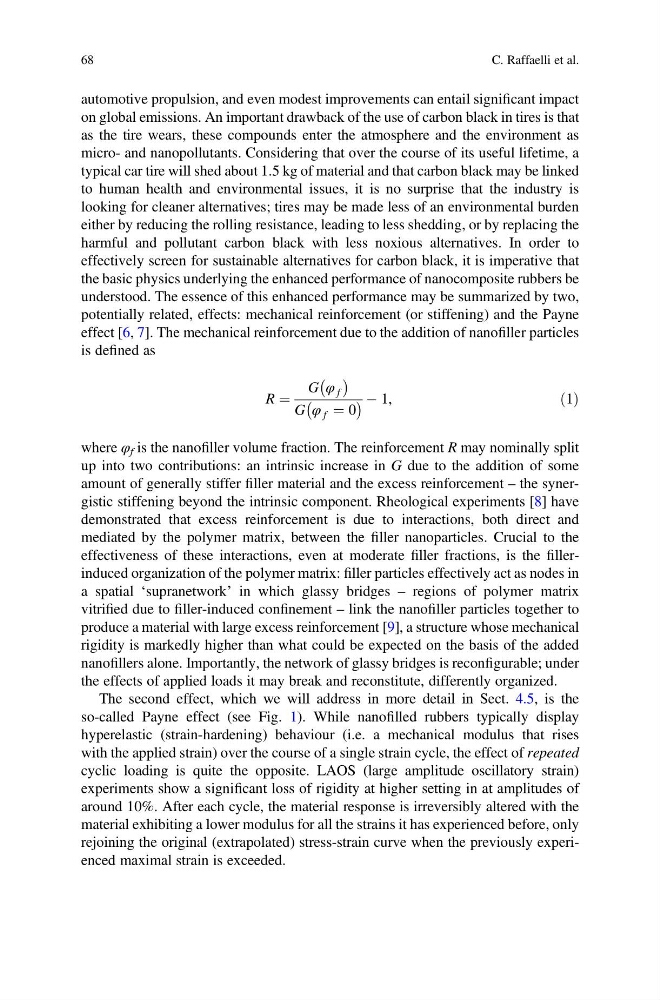
effect [6, 7]. The mechanical reinforcement due to the addition of nanofiller particles
is defined as
R ¼
G φ f
À Á
G φ f ¼ 0
À
ÁÀ 1,
ð1Þ
where φ f is the nanofiller volume fraction. The reinforcement R may nominally split
up into two contributions: an intrinsic increase in G due to the addition of some
amount of generally stiffer filler material and the excess reinforcement – the synergistic stiffening beyond the intrinsic component. Rheological experiments [8] have
demonstrated that excess reinforcement is due to interactions, both direct and
mediated by the polymer matrix, between the filler nanoparticles. Crucial to the
effectiveness of these interactions, even at moderate filler fractions, is the fillerinduced organization of the polymer matrix: filler particles effectively act as nodes in
a spatial ‘supranetwork’ in which glassy bridges – regions of polymer matrix
vitrified due to filler-induced confinement – link the nanofiller particles together to
produce a material with large excess reinforcement [9], a structure whose mechanical
rigidity is markedly higher than what could be expected on the basis of the added
nanofillers alone. Importantly, the network of glassy bridges is reconfigurable; under
the effects of applied loads it may break and reconstitute, differently organized.
The second effect, which we will address in more detail in Sect. 4.5, is the
so-called Payne effect (see Fig. 1). While nanofilled rubbers typically display
hyperelastic (strain-hardening) behaviour (i.e. a mechanical modulus that rises
with the applied strain) over the course of a single strain cycle, the effect of repeated
cyclic loading is quite the opposite. LAOS (large amplitude oscillatory strain)
experiments show a significant loss of rigidity at higher setting in at amplitudes of
around 10%. After each cycle, the material response is irreversibly altered with the
material exhibiting a lower modulus for all the strains it has experienced before, only
rejoining the original (extrapolated) stress-strain curve when the previously experienced maximal strain is exceeded.
68
C. Raffaelli et al.
on global emissions. An important drawback of the use of carbon black in tires is that
as the tire wears, these compounds enter the atmosphere and the environment as
micro- and nanopollutants. Considering that over the course of its useful lifetime, a
typical car tire will shed about 1.5 kg of material and that carbon black may be linked
to human health and environmental issues, it is no surprise that the industry is
looking for cleaner alternatives; tires may be made less of an environmental burden
either by reducing the rolling resistance, leading to less shedding, or by replacing the
harmful and pollutant carbon black with less noxious alternatives. In order to
effectively screen for sustainable alternatives for carbon black, it is imperative that
the basic physics underlying the enhanced performance of nanocomposite rubbers be
understood. The essence of this enhanced performance may be summarized by two,
potentially related, effects: mechanical reinforcement (or stiffening) and the Payne
effect [6, 7]. The mechanical reinforcement due to the addition of nanofiller particles
is defined as
R ¼
G φ f
À Á
G φ f ¼ 0
À
ÁÀ 1,
ð1Þ
where φ f is the nanofiller volume fraction. The reinforcement R may nominally split
up into two contributions: an intrinsic increase in G due to the addition of some
amount of generally stiffer filler material and the excess reinforcement – the synergistic stiffening beyond the intrinsic component. Rheological experiments [8] have
demonstrated that excess reinforcement is due to interactions, both direct and
mediated by the polymer matrix, between the filler nanoparticles. Crucial to the
effectiveness of these interactions, even at moderate filler fractions, is the fillerinduced organization of the polymer matrix: filler particles effectively act as nodes in
a spatial ‘supranetwork’ in which glassy bridges – regions of polymer matrix
vitrified due to filler-induced confinement – link the nanofiller particles together to
produce a material with large excess reinforcement [9], a structure whose mechanical
rigidity is markedly higher than what could be expected on the basis of the added
nanofillers alone. Importantly, the network of glassy bridges is reconfigurable; under
the effects of applied loads it may break and reconstitute, differently organized.
The second effect, which we will address in more detail in Sect. 4.5, is the
so-called Payne effect (see Fig. 1). While nanofilled rubbers typically display
hyperelastic (strain-hardening) behaviour (i.e. a mechanical modulus that rises
with the applied strain) over the course of a single strain cycle, the effect of repeated
cyclic loading is quite the opposite. LAOS (large amplitude oscillatory strain)
experiments show a significant loss of rigidity at higher setting in at amplitudes of
around 10%. After each cycle, the material response is irreversibly altered with the
material exhibiting a lower modulus for all the strains it has experienced before, only
rejoining the original (extrapolated) stress-strain curve when the previously experienced maximal strain is exceeded.
68
C. Raffaelli et al.