

transplanted into the brain has been a critical problem associated with stem cellbased therapy for Parkinson’s disease. To overcome this problem, a collagen
hydrogel incorporating an integrin-binding protein complex was prepared and
used as a carrier for neural stem cells. The protein complex consisted of two polypeptides containing the G3 domain of a laminin α1 chain and the C-terminal
oligopeptide of a laminin γ1 chain. These polypeptides were fused with α-helical
segments, which spontaneously formed a coiled-coil heterodimer and with the
collagen-binding peptide that facilitated the binding of the heterodimer to collagen
networks. Through in vivo studies, the authors demonstrated that infiltration of
microglial cells was physically blocked by the collagen hydrogel and the apoptotic
cell death could be minimized by ligating integrins with the collagen-binding LG3
(CLG3)/histidine-tagged LP (HLP) complex incorporated in the collagen hydrogel.
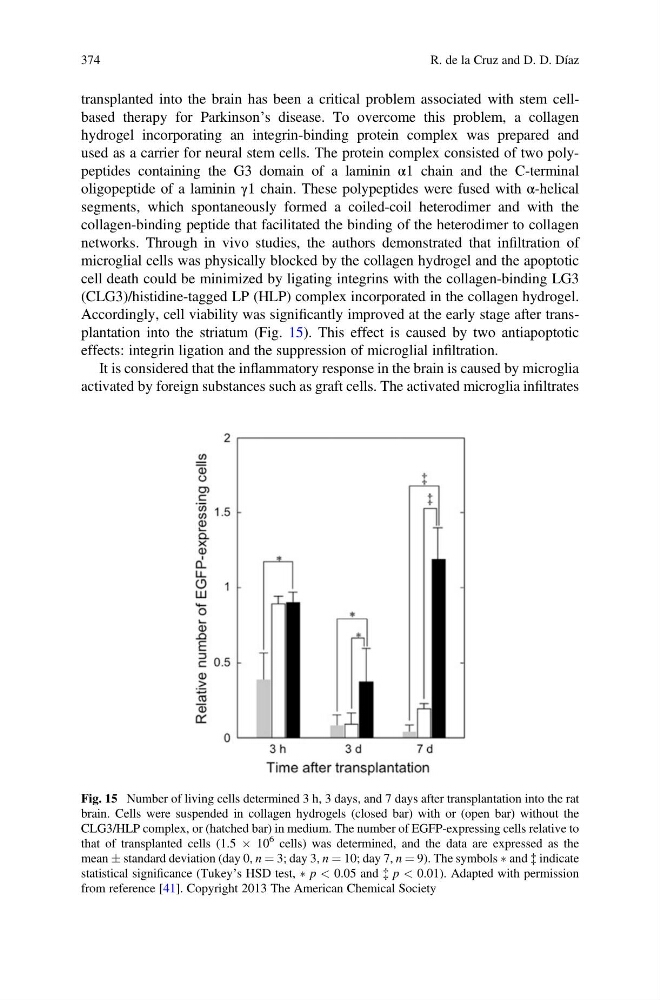
Accordingly, cell viability was significantly improved at the early stage after transplantation into the striatum (Fig. 15). This effect is caused by two antiapoptotic
effects: integrin ligation and the suppression of microglial infiltration.
It is considered that the inflammatory response in the brain is caused by microglia
activated by foreign substances such as graft cells. The activated microglia infiltrates
Fig. 15 Number of living cells determined 3 h, 3 days, and 7 days after transplantation into the rat
brain. Cells were suspended in collagen hydrogels (closed bar) with or (open bar) without the
CLG3/HLP complex, or (hatched bar) in medium. The number of EGFP-expressing cells relative to
that of transplanted cells (1.5 Â 10
6 cells) was determined, and the data are expressed as the
mean Æ standard deviation (day 0, n ¼ 3; day 3, n ¼ 10; day 7, n ¼ 9). The symbols à and { indicate
statistical significance (Tukey’s HSD test, Ã p < 0.05 and { p < 0.01). Adapted with permission
from reference [41]. Copyright 2013 The American Chemical Society
374
R. de la Cruz and D. D. Díaz
hydrogel incorporating an integrin-binding protein complex was prepared and
used as a carrier for neural stem cells. The protein complex consisted of two polypeptides containing the G3 domain of a laminin α1 chain and the C-terminal
oligopeptide of a laminin γ1 chain. These polypeptides were fused with α-helical
segments, which spontaneously formed a coiled-coil heterodimer and with the
collagen-binding peptide that facilitated the binding of the heterodimer to collagen
networks. Through in vivo studies, the authors demonstrated that infiltration of
microglial cells was physically blocked by the collagen hydrogel and the apoptotic
cell death could be minimized by ligating integrins with the collagen-binding LG3
(CLG3)/histidine-tagged LP (HLP) complex incorporated in the collagen hydrogel.
Accordingly, cell viability was significantly improved at the early stage after transplantation into the striatum (Fig. 15). This effect is caused by two antiapoptotic
effects: integrin ligation and the suppression of microglial infiltration.
It is considered that the inflammatory response in the brain is caused by microglia
activated by foreign substances such as graft cells. The activated microglia infiltrates
Fig. 15 Number of living cells determined 3 h, 3 days, and 7 days after transplantation into the rat
brain. Cells were suspended in collagen hydrogels (closed bar) with or (open bar) without the
CLG3/HLP complex, or (hatched bar) in medium. The number of EGFP-expressing cells relative to
that of transplanted cells (1.5 Â 10
6 cells) was determined, and the data are expressed as the
mean Æ standard deviation (day 0, n ¼ 3; day 3, n ¼ 10; day 7, n ¼ 9). The symbols à and { indicate
statistical significance (Tukey’s HSD test, Ã p < 0.05 and { p < 0.01). Adapted with permission
from reference [41]. Copyright 2013 The American Chemical Society
374
R. de la Cruz and D. D. Díaz