

3.2.3 Metal-Ligand Coordination
Coordination chemistry is vital to biological systems because it provides the structural integrity for metalloproteins and structural support for many living tissues,
which generate the particular chelation interactions based on two or more separate
binding sites on the same ligand with one central atom [179]. Thus, incorporation of
metal components (metal ions, metal-organic molecules, and metal nanoparticles) is
an effective way to develop reversible soft materials with tunable properties like
optical activity, conductivity, magnetic response activity, self-healing activity, etc.
[180–182].
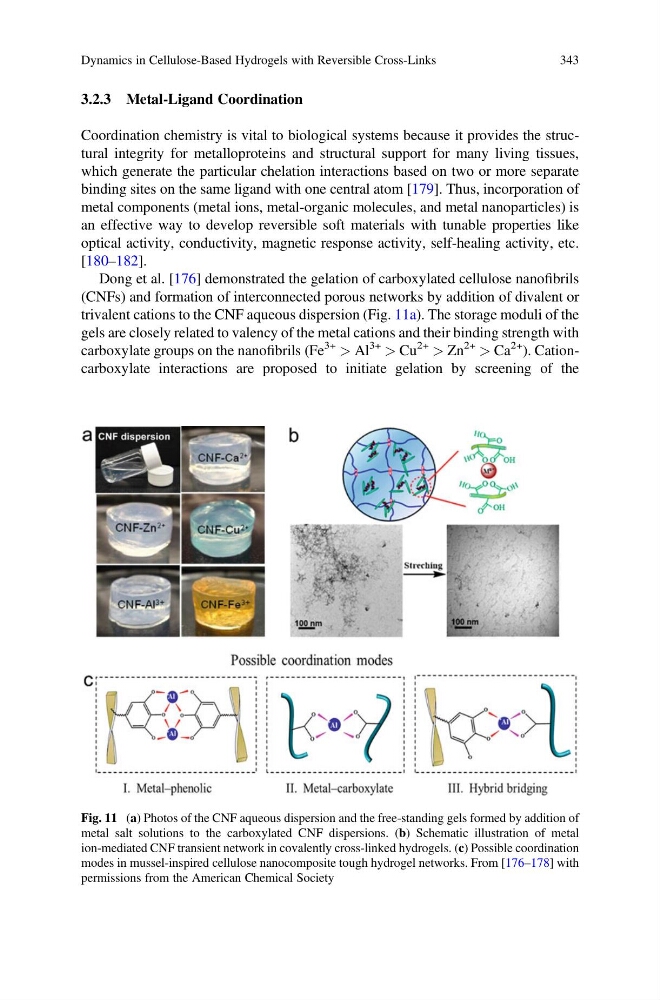
Dong et al. [176] demonstrated the gelation of carboxylated cellulose nanofibrils
(CNFs) and formation of interconnected porous networks by addition of divalent or
trivalent cations to the CNF aqueous dispersion (Fig. 11a). The storage moduli of the
gels are closely related to valency of the metal cations and their binding strength with
carboxylate groups on the nanofibrils (Fe
3+
> Al
3+
> Cu
2+
> Zn
2+
> Ca
2+ ). Cationcarboxylate interactions are proposed to initiate gelation by screening of the
Fig. 11 (a) Photos of the CNF aqueous dispersion and the free-standing gels formed by addition of
metal salt solutions to the carboxylated CNF dispersions. (b) Schematic illustration of metal
ion-mediated CNF transient network in covalently cross-linked hydrogels. (c) Possible coordination
modes in mussel-inspired cellulose nanocomposite tough hydrogel networks. From [176–178] with
permissions from the American Chemical Society
Dynamics in Cellulose-Based Hydrogels with Reversible Cross-Links
343
Coordination chemistry is vital to biological systems because it provides the structural integrity for metalloproteins and structural support for many living tissues,
which generate the particular chelation interactions based on two or more separate
binding sites on the same ligand with one central atom [179]. Thus, incorporation of
metal components (metal ions, metal-organic molecules, and metal nanoparticles) is
an effective way to develop reversible soft materials with tunable properties like
optical activity, conductivity, magnetic response activity, self-healing activity, etc.
[180–182].
Dong et al. [176] demonstrated the gelation of carboxylated cellulose nanofibrils
(CNFs) and formation of interconnected porous networks by addition of divalent or
trivalent cations to the CNF aqueous dispersion (Fig. 11a). The storage moduli of the
gels are closely related to valency of the metal cations and their binding strength with
carboxylate groups on the nanofibrils (Fe
3+
> Al
3+
> Cu
2+
> Zn
2+
> Ca
2+ ). Cationcarboxylate interactions are proposed to initiate gelation by screening of the
Fig. 11 (a) Photos of the CNF aqueous dispersion and the free-standing gels formed by addition of
metal salt solutions to the carboxylated CNF dispersions. (b) Schematic illustration of metal
ion-mediated CNF transient network in covalently cross-linked hydrogels. (c) Possible coordination
modes in mussel-inspired cellulose nanocomposite tough hydrogel networks. From [176–178] with
permissions from the American Chemical Society
Dynamics in Cellulose-Based Hydrogels with Reversible Cross-Links
343