

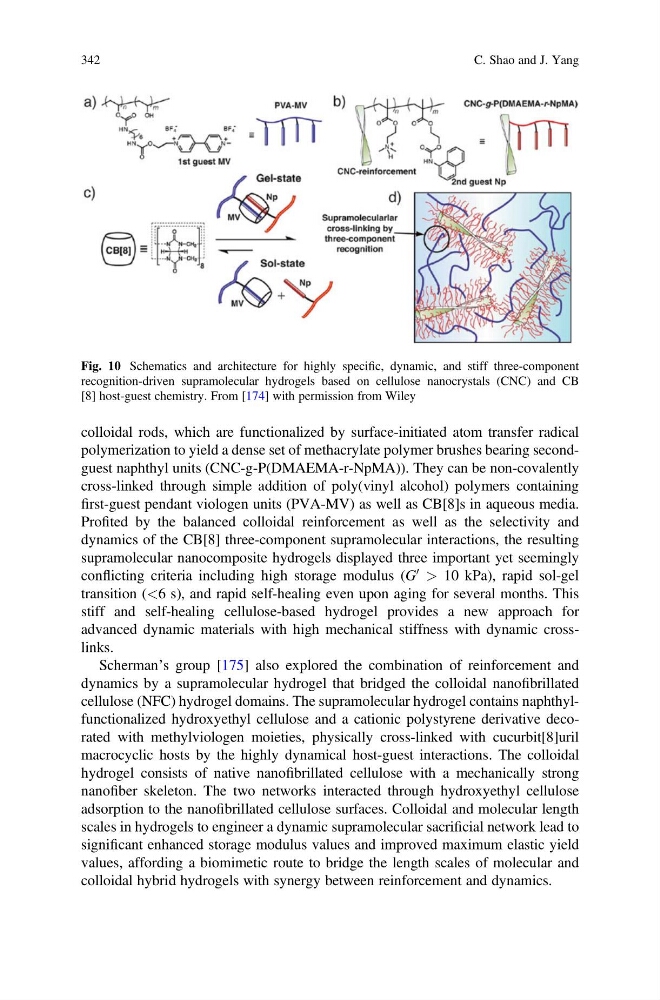
colloidal rods, which are functionalized by surface-initiated atom transfer radical
polymerization to yield a dense set of methacrylate polymer brushes bearing secondguest naphthyl units (CNC-g-P(DMAEMA-r-NpMA)). They can be non-covalently
cross-linked through simple addition of poly(vinyl alcohol) polymers containing
first-guest pendant viologen units (PVA-MV) as well as CB[8]s in aqueous media.
Profited by the balanced colloidal reinforcement as well as the selectivity and
dynamics of the CB[8] three-component supramolecular interactions, the resulting
supramolecular nanocomposite hydrogels displayed three important yet seemingly
conflicting criteria including high storage modulus (G
0
> 10 kPa), rapid sol-gel
transition (<6 s), and rapid self-healing even upon aging for several months. This
stiff and self-healing cellulose-based hydrogel provides a new approach for
advanced dynamic materials with high mechanical stiffness with dynamic crosslinks.
Scherman’s group [175] also explored the combination of reinforcement and
dynamics by a supramolecular hydrogel that bridged the colloidal nanofibrillated
cellulose (NFC) hydrogel domains. The supramolecular hydrogel contains naphthylfunctionalized hydroxyethyl cellulose and a cationic polystyrene derivative decorated with methylviologen moieties, physically cross-linked with cucurbit[8]uril
macrocyclic hosts by the highly dynamical host-guest interactions. The colloidal
hydrogel consists of native nanofibrillated cellulose with a mechanically strong
nanofiber skeleton. The two networks interacted through hydroxyethyl cellulose
adsorption to the nanofibrillated cellulose surfaces. Colloidal and molecular length
scales in hydrogels to engineer a dynamic supramolecular sacrificial network lead to
significant enhanced storage modulus values and improved maximum elastic yield
values, affording a biomimetic route to bridge the length scales of molecular and
colloidal hybrid hydrogels with synergy between reinforcement and dynamics.
Fig. 10 Schematics and architecture for highly specific, dynamic, and stiff three-component
recognition-driven supramolecular hydrogels based on cellulose nanocrystals (CNC) and CB
[8] host-guest chemistry. From [174] with permission from Wiley
342
C. Shao and J. Yang
polymerization to yield a dense set of methacrylate polymer brushes bearing secondguest naphthyl units (CNC-g-P(DMAEMA-r-NpMA)). They can be non-covalently
cross-linked through simple addition of poly(vinyl alcohol) polymers containing
first-guest pendant viologen units (PVA-MV) as well as CB[8]s in aqueous media.
Profited by the balanced colloidal reinforcement as well as the selectivity and
dynamics of the CB[8] three-component supramolecular interactions, the resulting
supramolecular nanocomposite hydrogels displayed three important yet seemingly
conflicting criteria including high storage modulus (G
0
> 10 kPa), rapid sol-gel
transition (<6 s), and rapid self-healing even upon aging for several months. This
stiff and self-healing cellulose-based hydrogel provides a new approach for
advanced dynamic materials with high mechanical stiffness with dynamic crosslinks.
Scherman’s group [175] also explored the combination of reinforcement and
dynamics by a supramolecular hydrogel that bridged the colloidal nanofibrillated
cellulose (NFC) hydrogel domains. The supramolecular hydrogel contains naphthylfunctionalized hydroxyethyl cellulose and a cationic polystyrene derivative decorated with methylviologen moieties, physically cross-linked with cucurbit[8]uril
macrocyclic hosts by the highly dynamical host-guest interactions. The colloidal
hydrogel consists of native nanofibrillated cellulose with a mechanically strong
nanofiber skeleton. The two networks interacted through hydroxyethyl cellulose
adsorption to the nanofibrillated cellulose surfaces. Colloidal and molecular length
scales in hydrogels to engineer a dynamic supramolecular sacrificial network lead to
significant enhanced storage modulus values and improved maximum elastic yield
values, affording a biomimetic route to bridge the length scales of molecular and
colloidal hybrid hydrogels with synergy between reinforcement and dynamics.
Fig. 10 Schematics and architecture for highly specific, dynamic, and stiff three-component
recognition-driven supramolecular hydrogels based on cellulose nanocrystals (CNC) and CB
[8] host-guest chemistry. From [174] with permission from Wiley
342
C. Shao and J. Yang