

3.2.1 Hydrogen-Bonding Interactions
Hydrogen bond (H-bond) is one of the most well-known and commonly used
physical interactions that is much weaker than dynamic covalent and ionic crosslinks. Different from the sharing of an electron pair in the formation of a covalent
bond, the H-bond is the electrostatic attraction between two polar groups when a
hydrogen atom bonded to a highly electronegative atom (e.g., O, N, or F) experiences the electrostatic field of another highly electronegative atom. Reversible crosslinks form between different polymer chains by electrostatic interactions that occur
between the hydrogens (hydrogen donors) and electronegative atoms (hydrogen
acceptors) of different moieties [158, 159].
2-Ureido-4[1H]-pyrimidone pendant groups (UPy) has a high dimerization constant due to the four hydrogen-bonding sites, which has been utilized for dynamical
cross-linked polymers, including self-healing materials [160] and shape-memory
polymers [161]. Attaching UPy moieties to the CNC surfaces using small-molecular
linkers was reported by Weder’s group [162]. By blending these UPy-modified
CNCs with a soft rubbery telechelic poly(ethylene-co-butylene) matrix, which was
decorated with UPy end groups, supramolecular UV-healable supramolecular
CNC-based nanocomposites were fabricated and displayed significantly improved
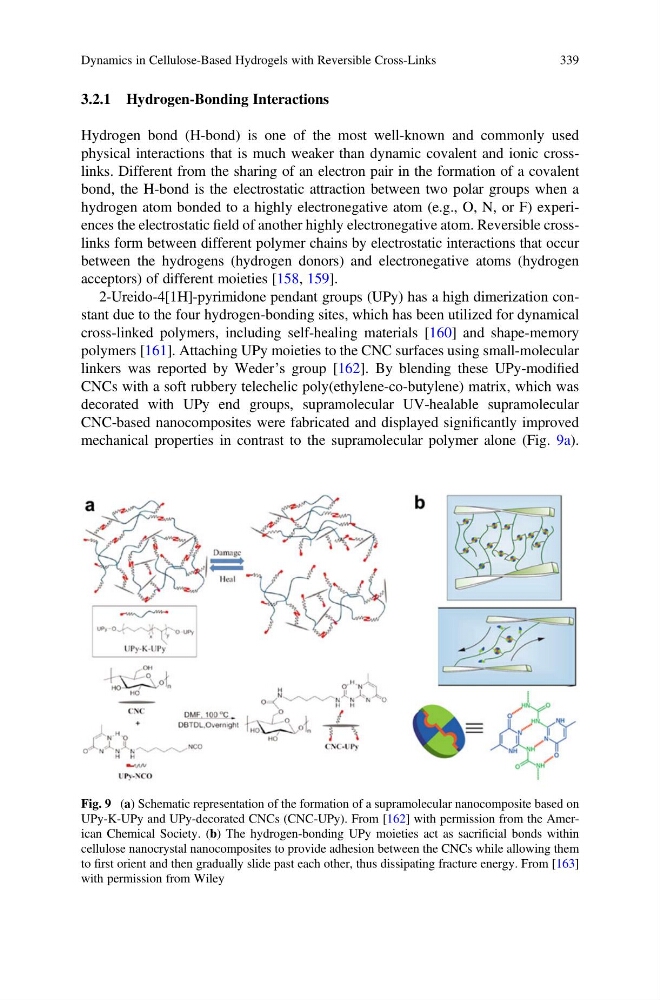
mechanical properties in contrast to the supramolecular polymer alone (Fig. 9a).
Fig. 9 (a) Schematic representation of the formation of a supramolecular nanocomposite based on
UPy-K-UPy and UPy-decorated CNCs (CNC-UPy). From [162] with permission from the American Chemical Society. (b) The hydrogen-bonding UPy moieties act as sacrificial bonds within
cellulose nanocrystal nanocomposites to provide adhesion between the CNCs while allowing them
to first orient and then gradually slide past each other, thus dissipating fracture energy. From [163]
with permission from Wiley
Dynamics in Cellulose-Based Hydrogels with Reversible Cross-Links
339
Hydrogen bond (H-bond) is one of the most well-known and commonly used
physical interactions that is much weaker than dynamic covalent and ionic crosslinks. Different from the sharing of an electron pair in the formation of a covalent
bond, the H-bond is the electrostatic attraction between two polar groups when a
hydrogen atom bonded to a highly electronegative atom (e.g., O, N, or F) experiences the electrostatic field of another highly electronegative atom. Reversible crosslinks form between different polymer chains by electrostatic interactions that occur
between the hydrogens (hydrogen donors) and electronegative atoms (hydrogen
acceptors) of different moieties [158, 159].
2-Ureido-4[1H]-pyrimidone pendant groups (UPy) has a high dimerization constant due to the four hydrogen-bonding sites, which has been utilized for dynamical
cross-linked polymers, including self-healing materials [160] and shape-memory
polymers [161]. Attaching UPy moieties to the CNC surfaces using small-molecular
linkers was reported by Weder’s group [162]. By blending these UPy-modified
CNCs with a soft rubbery telechelic poly(ethylene-co-butylene) matrix, which was
decorated with UPy end groups, supramolecular UV-healable supramolecular
CNC-based nanocomposites were fabricated and displayed significantly improved
mechanical properties in contrast to the supramolecular polymer alone (Fig. 9a).
Fig. 9 (a) Schematic representation of the formation of a supramolecular nanocomposite based on
UPy-K-UPy and UPy-decorated CNCs (CNC-UPy). From [162] with permission from the American Chemical Society. (b) The hydrogen-bonding UPy moieties act as sacrificial bonds within
cellulose nanocrystal nanocomposites to provide adhesion between the CNCs while allowing them
to first orient and then gradually slide past each other, thus dissipating fracture energy. From [163]
with permission from Wiley
Dynamics in Cellulose-Based Hydrogels with Reversible Cross-Links
339