

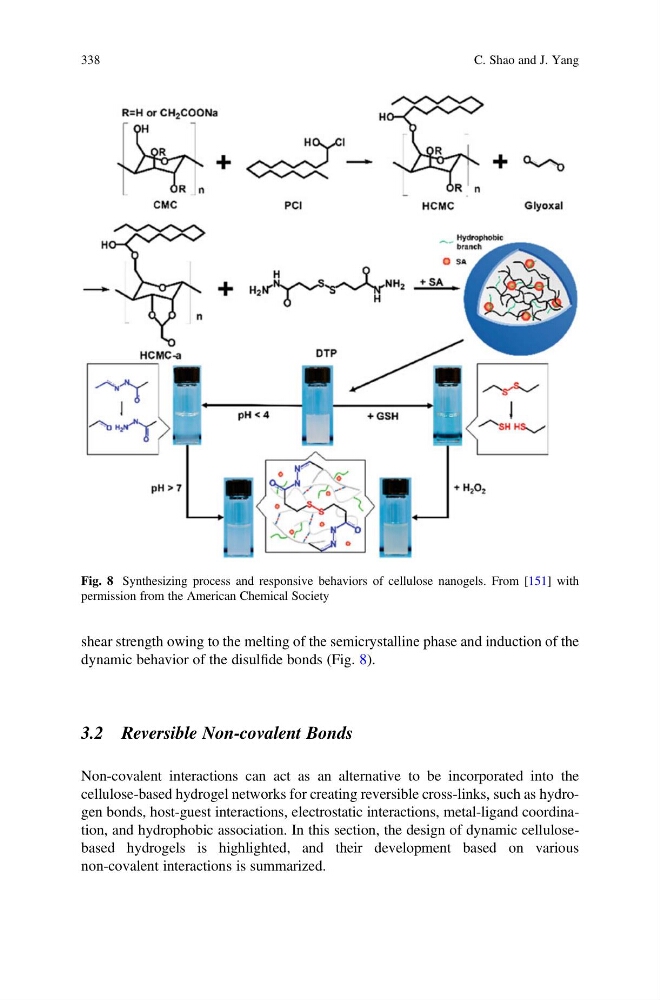
shear strength owing to the melting of the semicrystalline phase and induction of the
dynamic behavior of the disulfide bonds (Fig. 8).
3.2 Reversible Non-covalent Bonds
Non-covalent interactions can act as an alternative to be incorporated into the
cellulose-based hydrogel networks for creating reversible cross-links, such as hydrogen bonds, host-guest interactions, electrostatic interactions, metal-ligand coordination, and hydrophobic association. In this section, the design of dynamic cellulosebased hydrogels is highlighted, and their development based on various
non-covalent interactions is summarized.
Fig. 8 Synthesizing process and responsive behaviors of cellulose nanogels. From [151] with
permission from the American Chemical Society
338
C. Shao and J. Yang
dynamic behavior of the disulfide bonds (Fig. 8).
3.2 Reversible Non-covalent Bonds
Non-covalent interactions can act as an alternative to be incorporated into the
cellulose-based hydrogel networks for creating reversible cross-links, such as hydrogen bonds, host-guest interactions, electrostatic interactions, metal-ligand coordination, and hydrophobic association. In this section, the design of dynamic cellulosebased hydrogels is highlighted, and their development based on various
non-covalent interactions is summarized.
Fig. 8 Synthesizing process and responsive behaviors of cellulose nanogels. From [151] with
permission from the American Chemical Society
338
C. Shao and J. Yang