

networks is an effective way to develop cellulosic materials with high functionality.
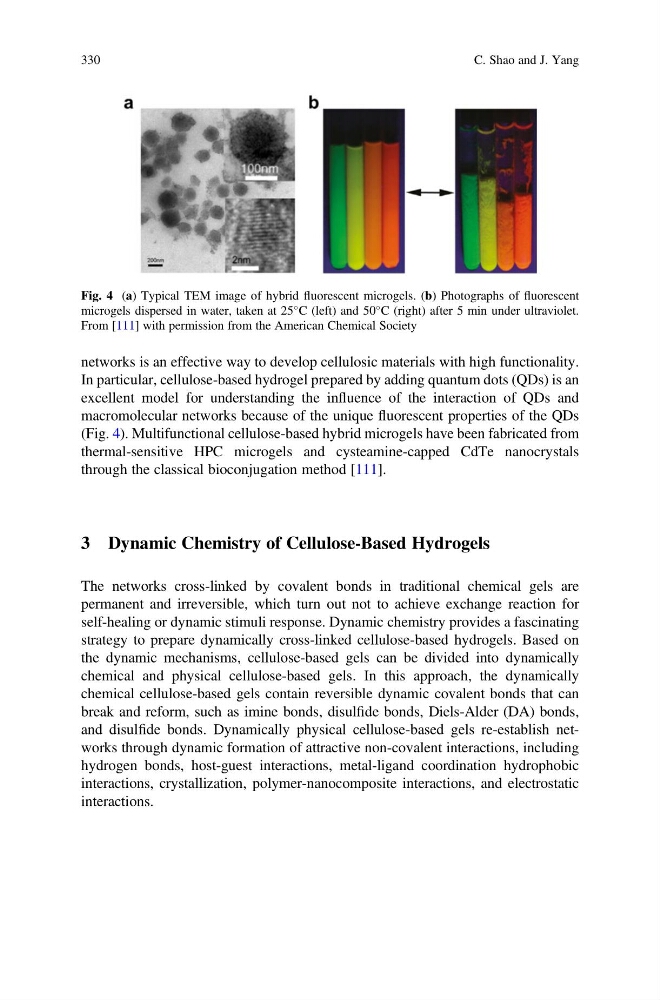
In particular, cellulose-based hydrogel prepared by adding quantum dots (QDs) is an
excellent model for understanding the influence of the interaction of QDs and
macromolecular networks because of the unique fluorescent properties of the QDs
(Fig. 4). Multifunctional cellulose-based hybrid microgels have been fabricated from
thermal-sensitive HPC microgels and cysteamine-capped CdTe nanocrystals
through the classical bioconjugation method [111].
3 Dynamic Chemistry of Cellulose-Based Hydrogels
The networks cross-linked by covalent bonds in traditional chemical gels are
permanent and irreversible, which turn out not to achieve exchange reaction for
self-healing or dynamic stimuli response. Dynamic chemistry provides a fascinating
strategy to prepare dynamically cross-linked cellulose-based hydrogels. Based on
the dynamic mechanisms, cellulose-based gels can be divided into dynamically
chemical and physical cellulose-based gels. In this approach, the dynamically
chemical cellulose-based gels contain reversible dynamic covalent bonds that can
break and reform, such as imine bonds, disulfide bonds, Diels-Alder (DA) bonds,
and disulfide bonds. Dynamically physical cellulose-based gels re-establish networks through dynamic formation of attractive non-covalent interactions, including
hydrogen bonds, host-guest interactions, metal-ligand coordination hydrophobic
interactions, crystallization, polymer-nanocomposite interactions, and electrostatic
interactions.
Fig. 4 (a) Typical TEM image of hybrid fluorescent microgels. (b) Photographs of fluorescent
microgels dispersed in water, taken at 25
C (left) and 50
C (right) after 5 min under ultraviolet.
From [111] with permission from the American Chemical Society
330
C. Shao and J. Yang
In particular, cellulose-based hydrogel prepared by adding quantum dots (QDs) is an
excellent model for understanding the influence of the interaction of QDs and
macromolecular networks because of the unique fluorescent properties of the QDs
(Fig. 4). Multifunctional cellulose-based hybrid microgels have been fabricated from
thermal-sensitive HPC microgels and cysteamine-capped CdTe nanocrystals
through the classical bioconjugation method [111].
3 Dynamic Chemistry of Cellulose-Based Hydrogels
The networks cross-linked by covalent bonds in traditional chemical gels are
permanent and irreversible, which turn out not to achieve exchange reaction for
self-healing or dynamic stimuli response. Dynamic chemistry provides a fascinating
strategy to prepare dynamically cross-linked cellulose-based hydrogels. Based on
the dynamic mechanisms, cellulose-based gels can be divided into dynamically
chemical and physical cellulose-based gels. In this approach, the dynamically
chemical cellulose-based gels contain reversible dynamic covalent bonds that can
break and reform, such as imine bonds, disulfide bonds, Diels-Alder (DA) bonds,
and disulfide bonds. Dynamically physical cellulose-based gels re-establish networks through dynamic formation of attractive non-covalent interactions, including
hydrogen bonds, host-guest interactions, metal-ligand coordination hydrophobic
interactions, crystallization, polymer-nanocomposite interactions, and electrostatic
interactions.
Fig. 4 (a) Typical TEM image of hybrid fluorescent microgels. (b) Photographs of fluorescent
microgels dispersed in water, taken at 25
C (left) and 50
C (right) after 5 min under ultraviolet.
From [111] with permission from the American Chemical Society
330
C. Shao and J. Yang