

microfibrils to produce hierarchical systems [34–36]. These microfibrils, which are
5–50 nm in diameter and several microns in length, contain highly ordered (crystalline) domains alternating with disordered (amorphous) regions (Fig. 1b) [39]. These
crystalline domains can be separated and extracted from a cellulose source through
the transverse deconstruction of cellulose fibers by mechanical, chemical, or combination of mechanical, chemical, and/or enzymatic treatments [40], resulting in
nanoscaled and highly crystalline rodlike fragments referred to as cellulose
nanocrystals (CNCs) (Fig. 1c) [39, 41]. Similarly, lateral disintegration by applying
high shear force on cellulose fibers can also obtain the nanofibrillated cellulose
(NFC) [42]. In addition, nanocellulose can also be isolated as bacterial nanocellulose
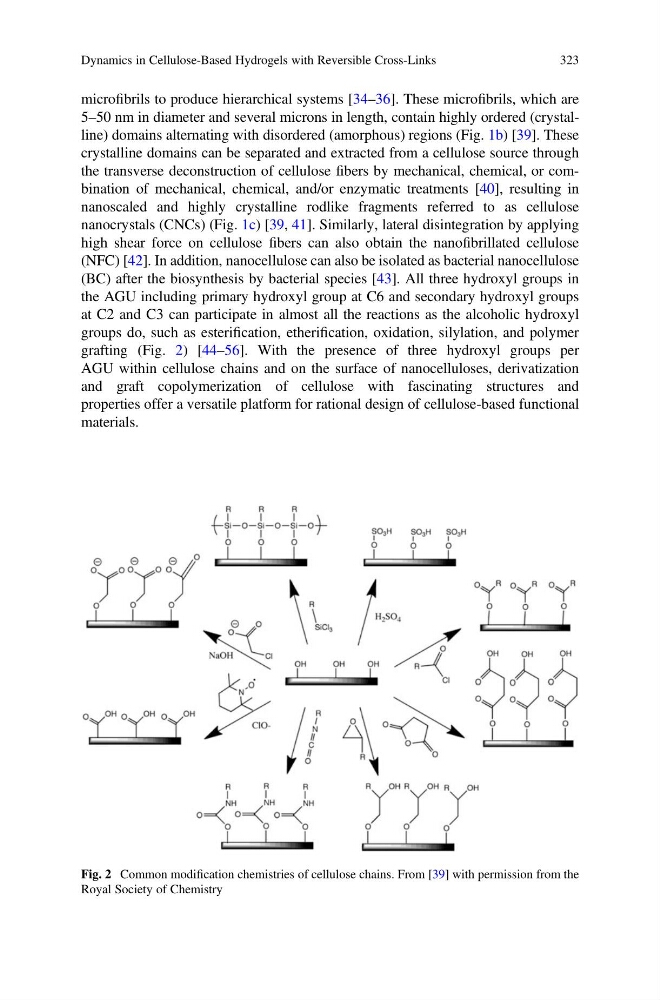
(BC) after the biosynthesis by bacterial species [43]. All three hydroxyl groups in
the AGU including primary hydroxyl group at C6 and secondary hydroxyl groups
at C2 and C3 can participate in almost all the reactions as the alcoholic hydroxyl
groups do, such as esterification, etherification, oxidation, silylation, and polymer
grafting (Fig. 2) [44–56]. With the presence of three hydroxyl groups per
AGU within cellulose chains and on the surface of nanocelluloses, derivatization
and graft copolymerization of cellulose with fascinating structures and
properties offer a versatile platform for rational design of cellulose-based functional
materials.
Fig. 2 Common modification chemistries of cellulose chains. From [39] with permission from the
Royal Society of Chemistry
Dynamics in Cellulose-Based Hydrogels with Reversible Cross-Links
323
5–50 nm in diameter and several microns in length, contain highly ordered (crystalline) domains alternating with disordered (amorphous) regions (Fig. 1b) [39]. These
crystalline domains can be separated and extracted from a cellulose source through
the transverse deconstruction of cellulose fibers by mechanical, chemical, or combination of mechanical, chemical, and/or enzymatic treatments [40], resulting in
nanoscaled and highly crystalline rodlike fragments referred to as cellulose
nanocrystals (CNCs) (Fig. 1c) [39, 41]. Similarly, lateral disintegration by applying
high shear force on cellulose fibers can also obtain the nanofibrillated cellulose
(NFC) [42]. In addition, nanocellulose can also be isolated as bacterial nanocellulose
(BC) after the biosynthesis by bacterial species [43]. All three hydroxyl groups in
the AGU including primary hydroxyl group at C6 and secondary hydroxyl groups
at C2 and C3 can participate in almost all the reactions as the alcoholic hydroxyl
groups do, such as esterification, etherification, oxidation, silylation, and polymer
grafting (Fig. 2) [44–56]. With the presence of three hydroxyl groups per
AGU within cellulose chains and on the surface of nanocelluloses, derivatization
and graft copolymerization of cellulose with fascinating structures and
properties offer a versatile platform for rational design of cellulose-based functional
materials.
Fig. 2 Common modification chemistries of cellulose chains. From [39] with permission from the
Royal Society of Chemistry
Dynamics in Cellulose-Based Hydrogels with Reversible Cross-Links
323