

[17], dyes [18, 19], and pesticides [20]), flexible electronic devices [21], etc. Various
natural polysaccharides such as chitosan [22, 23], dextran [24, 25], alginate [26],
starch [27], gelatin [28], hyaluronate [29], cellulose [30], chitin [31], and their
derivatives [32, 33] have been used to fabricate biopolymer-based hydrogels.
Cellulose, the most abundant and renewable biopolymer on earth, is an inexhaustible source of raw material from the form of wood, cotton, hemp, and other
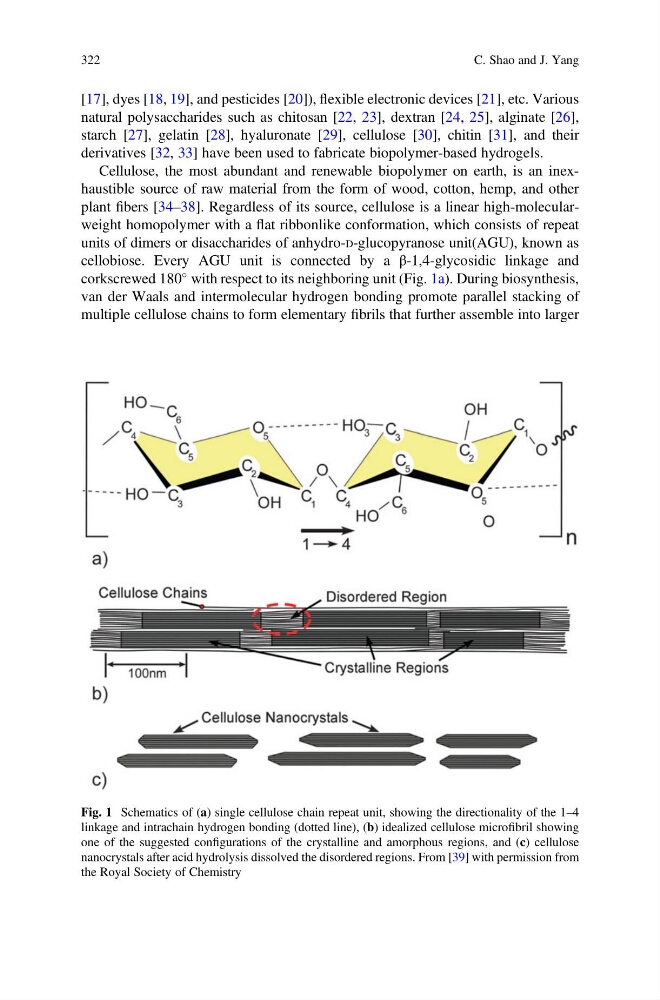
plant fibers [34–38]. Regardless of its source, cellulose is a linear high-molecularweight homopolymer with a flat ribbonlike conformation, which consists of repeat
units of dimers or disaccharides of anhydro-D-glucopyranose unit(AGU), known as
cellobiose. Every AGU unit is connected by a β-1,4-glycosidic linkage and
corkscrewed 180
with respect to its neighboring unit (Fig. 1a). During biosynthesis,
van der Waals and intermolecular hydrogen bonding promote parallel stacking of
multiple cellulose chains to form elementary fibrils that further assemble into larger
Fig. 1 Schematics of (a) single cellulose chain repeat unit, showing the directionality of the 1–4
linkage and intrachain hydrogen bonding (dotted line), (b) idealized cellulose microfibril showing
one of the suggested configurations of the crystalline and amorphous regions, and (c) cellulose
nanocrystals after acid hydrolysis dissolved the disordered regions. From [39] with permission from
the Royal Society of Chemistry
322
C. Shao and J. Yang
natural polysaccharides such as chitosan [22, 23], dextran [24, 25], alginate [26],
starch [27], gelatin [28], hyaluronate [29], cellulose [30], chitin [31], and their
derivatives [32, 33] have been used to fabricate biopolymer-based hydrogels.
Cellulose, the most abundant and renewable biopolymer on earth, is an inexhaustible source of raw material from the form of wood, cotton, hemp, and other
plant fibers [34–38]. Regardless of its source, cellulose is a linear high-molecularweight homopolymer with a flat ribbonlike conformation, which consists of repeat
units of dimers or disaccharides of anhydro-D-glucopyranose unit(AGU), known as
cellobiose. Every AGU unit is connected by a β-1,4-glycosidic linkage and
corkscrewed 180
with respect to its neighboring unit (Fig. 1a). During biosynthesis,
van der Waals and intermolecular hydrogen bonding promote parallel stacking of
multiple cellulose chains to form elementary fibrils that further assemble into larger
Fig. 1 Schematics of (a) single cellulose chain repeat unit, showing the directionality of the 1–4
linkage and intrachain hydrogen bonding (dotted line), (b) idealized cellulose microfibril showing
one of the suggested configurations of the crystalline and amorphous regions, and (c) cellulose
nanocrystals after acid hydrolysis dissolved the disordered regions. From [39] with permission from
the Royal Society of Chemistry
322
C. Shao and J. Yang