

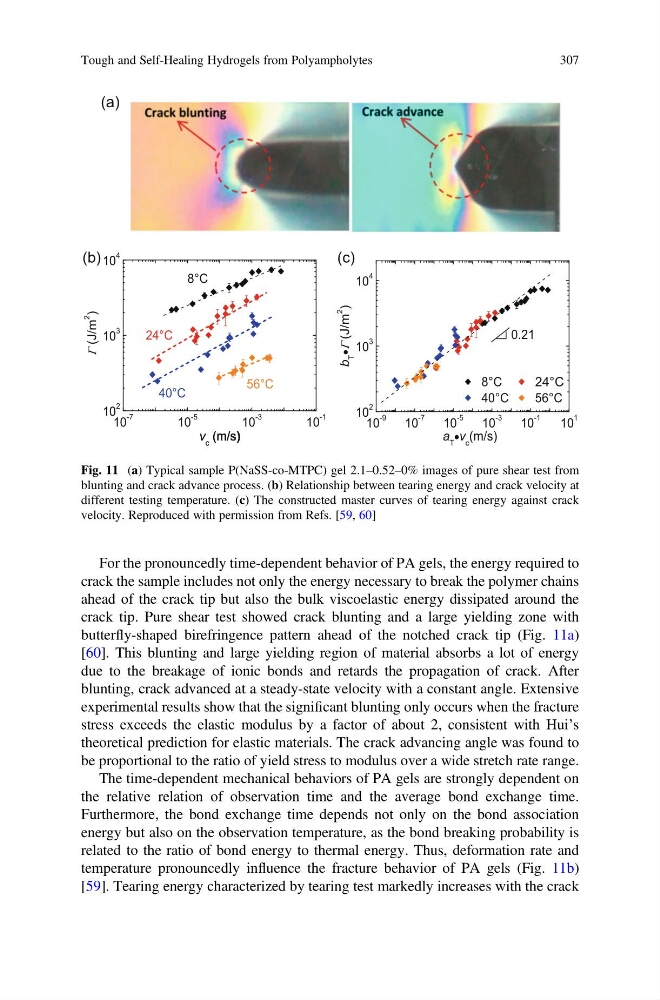
For the pronouncedly time-dependent behavior of PA gels, the energy required to
crack the sample includes not only the energy necessary to break the polymer chains
ahead of the crack tip but also the bulk viscoelastic energy dissipated around the
crack tip. Pure shear test showed crack blunting and a large yielding zone with
butterfly-shaped birefringence pattern ahead of the notched crack tip (Fig. 11a)
[60]. This blunting and large yielding region of material absorbs a lot of energy
due to the breakage of ionic bonds and retards the propagation of crack. After
blunting, crack advanced at a steady-state velocity with a constant angle. Extensive
experimental results show that the significant blunting only occurs when the fracture
stress exceeds the elastic modulus by a factor of about 2, consistent with Hui’s
theoretical prediction for elastic materials. The crack advancing angle was found to
be proportional to the ratio of yield stress to modulus over a wide stretch rate range.
The time-dependent mechanical behaviors of PA gels are strongly dependent on
the relative relation of observation time and the average bond exchange time.
Furthermore, the bond exchange time depends not only on the bond association
energy but also on the observation temperature, as the bond breaking probability is
related to the ratio of bond energy to thermal energy. Thus, deformation rate and
temperature pronouncedly influence the fracture behavior of PA gels (Fig. 11b)
[59]. Tearing energy characterized by tearing test markedly increases with the crack
10
-7
10
-5
10
-3
10
-1
10
2
10
3
10
4
56°C
40°C
24°C
8°C
(J/m
2
)
v c (m/s)
10
-9
10
-7
10
-5
10
-3
10
-1
10
1
10
2
10
3
10
4
8°C
24°C
40°C
56°C
0.21
(b)
(c)
(a)
Fig. 11 (a) Typical sample P(NaSS-co-MTPC) gel 2.1–0.52–0% images of pure shear test from
blunting and crack advance process. (b) Relationship between tearing energy and crack velocity at
different testing temperature. (c) The constructed master curves of tearing energy against crack
velocity. Reproduced with permission from Refs. [59, 60]
Tough and Self-Healing Hydrogels from Polyampholytes
307
crack the sample includes not only the energy necessary to break the polymer chains
ahead of the crack tip but also the bulk viscoelastic energy dissipated around the
crack tip. Pure shear test showed crack blunting and a large yielding zone with
butterfly-shaped birefringence pattern ahead of the notched crack tip (Fig. 11a)
[60]. This blunting and large yielding region of material absorbs a lot of energy
due to the breakage of ionic bonds and retards the propagation of crack. After
blunting, crack advanced at a steady-state velocity with a constant angle. Extensive
experimental results show that the significant blunting only occurs when the fracture
stress exceeds the elastic modulus by a factor of about 2, consistent with Hui’s
theoretical prediction for elastic materials. The crack advancing angle was found to
be proportional to the ratio of yield stress to modulus over a wide stretch rate range.
The time-dependent mechanical behaviors of PA gels are strongly dependent on
the relative relation of observation time and the average bond exchange time.
Furthermore, the bond exchange time depends not only on the bond association
energy but also on the observation temperature, as the bond breaking probability is
related to the ratio of bond energy to thermal energy. Thus, deformation rate and
temperature pronouncedly influence the fracture behavior of PA gels (Fig. 11b)
[59]. Tearing energy characterized by tearing test markedly increases with the crack
10
-7
10
-5
10
-3
10
-1
10
2
10
3
10
4
56°C
40°C
24°C
8°C
(J/m
2
)
v c (m/s)
10
-9
10
-7
10
-5
10
-3
10
-1
10
1
10
2
10
3
10
4
8°C
24°C
40°C
56°C
0.21
(b)
(c)
(a)
Fig. 11 (a) Typical sample P(NaSS-co-MTPC) gel 2.1–0.52–0% images of pure shear test from
blunting and crack advance process. (b) Relationship between tearing energy and crack velocity at
different testing temperature. (c) The constructed master curves of tearing energy against crack
velocity. Reproduced with permission from Refs. [59, 60]
Tough and Self-Healing Hydrogels from Polyampholytes
307