

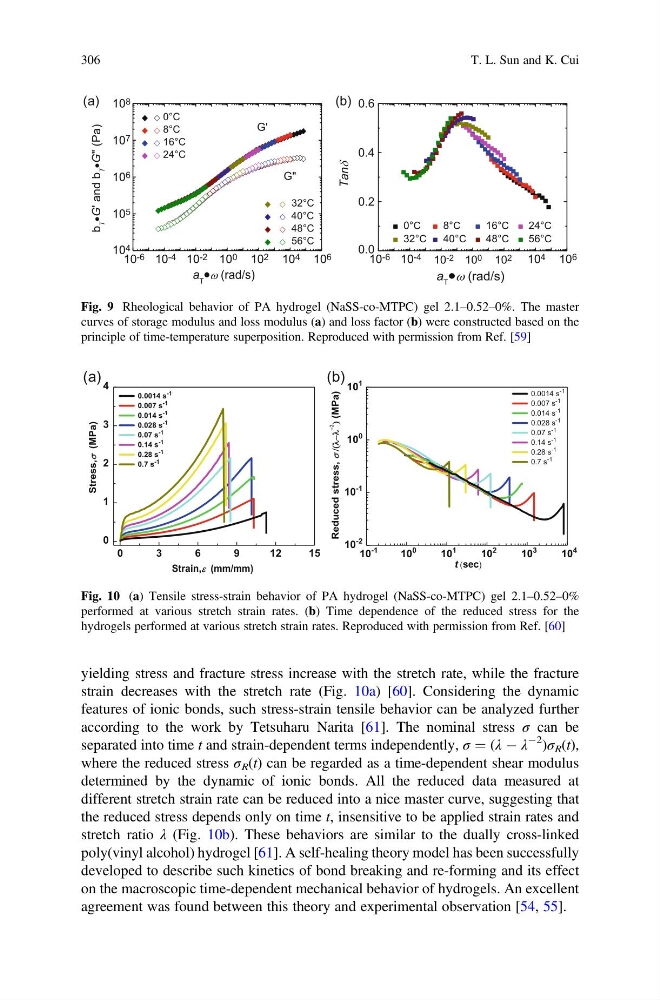
yielding stress and fracture stress increase with the stretch rate, while the fracture
strain decreases with the stretch rate (Fig. 10a) [60]. Considering the dynamic
features of ionic bonds, such stress-strain tensile behavior can be analyzed further
according to the work by Tetsuharu Narita [61]. The nominal stress σ can be
separated into time t and strain-dependent terms independently, σ ¼ (λ À λ
À2 )σ R (t),
where the reduced stress σ R (t) can be regarded as a time-dependent shear modulus
determined by the dynamic of ionic bonds. All the reduced data measured at
different stretch strain rate can be reduced into a nice master curve, suggesting that
the reduced stress depends only on time t, insensitive to be applied strain rates and
stretch ratio λ (Fig. 10b). These behaviors are similar to the dually cross-linked
poly(vinyl alcohol) hydrogel [61]. A self-healing theory model has been successfully
developed to describe such kinetics of bond breaking and re-forming and its effect
on the macroscopic time-dependent mechanical behavior of hydrogels. An excellent
agreement was found between this theory and experimental observation [54, 55].
(b)
(a)
0.0
0.2
0.4
0.6
0°C
8°C
16°C
24°C
32°C
40°C
48°C
56°C
10 -6 10 -4 10 -2 10 0 10 2 10 4 10 6
10 -6 10 -4
10 4 10 6
10 4
10 5
10 6
10 7
10 8
G"
G'
32°C
40°C
48°C
56°C
0°C
8°C
16°C
24°C
10 -2 10 0 10 2
Fig. 9 Rheological behavior of PA hydrogel (NaSS-co-MTPC) gel 2.1–0.52–0%. The master
curves of storage modulus and loss modulus (a) and loss factor (b) were constructed based on the
principle of time-temperature superposition. Reproduced with permission from Ref. [59]
0
3
6
9
1 2
1 5
0
1
2
3
4
0.0014 s -1
0.007 s -1
0.014 s -1
0.028 s -1
0.07 s -1
0.14 s -1
0.28 s -1
0.7 s -1
10
-1
10
0
10
1
10
2
10
3
10
4
10
-2
10
-1
10
0
10
1
0.0014 s -1
0.007 s -1
0.014 s -1
0.028 s -1
0.07 s -1
0.14 s -1
0.28 s -1
0.7 s -1
(b)
(a)
Fig. 10 (a) Tensile stress-strain behavior of PA hydrogel (NaSS-co-MTPC) gel 2.1–0.52–0%
performed at various stretch strain rates. (b) Time dependence of the reduced stress for the
hydrogels performed at various stretch strain rates. Reproduced with permission from Ref. [60]
306
T. L. Sun and K. Cui
strain decreases with the stretch rate (Fig. 10a) [60]. Considering the dynamic
features of ionic bonds, such stress-strain tensile behavior can be analyzed further
according to the work by Tetsuharu Narita [61]. The nominal stress σ can be
separated into time t and strain-dependent terms independently, σ ¼ (λ À λ
À2 )σ R (t),
where the reduced stress σ R (t) can be regarded as a time-dependent shear modulus
determined by the dynamic of ionic bonds. All the reduced data measured at
different stretch strain rate can be reduced into a nice master curve, suggesting that
the reduced stress depends only on time t, insensitive to be applied strain rates and
stretch ratio λ (Fig. 10b). These behaviors are similar to the dually cross-linked
poly(vinyl alcohol) hydrogel [61]. A self-healing theory model has been successfully
developed to describe such kinetics of bond breaking and re-forming and its effect
on the macroscopic time-dependent mechanical behavior of hydrogels. An excellent
agreement was found between this theory and experimental observation [54, 55].
(b)
(a)
0.0
0.2
0.4
0.6
0°C
8°C
16°C
24°C
32°C
40°C
48°C
56°C
10 -6 10 -4 10 -2 10 0 10 2 10 4 10 6
10 -6 10 -4
10 4 10 6
10 4
10 5
10 6
10 7
10 8
G"
G'
32°C
40°C
48°C
56°C
0°C
8°C
16°C
24°C
10 -2 10 0 10 2
Fig. 9 Rheological behavior of PA hydrogel (NaSS-co-MTPC) gel 2.1–0.52–0%. The master
curves of storage modulus and loss modulus (a) and loss factor (b) were constructed based on the
principle of time-temperature superposition. Reproduced with permission from Ref. [59]
0
3
6
9
1 2
1 5
0
1
2
3
4
0.0014 s -1
0.007 s -1
0.014 s -1
0.028 s -1
0.07 s -1
0.14 s -1
0.28 s -1
0.7 s -1
10
-1
10
0
10
1
10
2
10
3
10
4
10
-2
10
-1
10
0
10
1
0.0014 s -1
0.007 s -1
0.014 s -1
0.028 s -1
0.07 s -1
0.14 s -1
0.28 s -1
0.7 s -1
(b)
(a)
Fig. 10 (a) Tensile stress-strain behavior of PA hydrogel (NaSS-co-MTPC) gel 2.1–0.52–0%
performed at various stretch strain rates. (b) Time dependence of the reduced stress for the
hydrogels performed at various stretch strain rates. Reproduced with permission from Ref. [60]
306
T. L. Sun and K. Cui