

cross-linkers under UV irradiation for several hours. After polymerization, the
hydrogels at the equilibrated state are obtained by immersing the as-prepared gel
in a large amount of water to remove the excess mobile counterions and residual
chemical reagents from the as-prepared gel. This process will substantially stabilize
the formation of inter- and intra-chain ionic bonds [39].
The approach to synthesize PA hydrogels is quite general and has been
found effective to many kinds of ionic monomer combination, as shown in
Fig. 1b. Two typical examples, the one made from the polymerization of sodium
p-styrenesulfonate (NaSS) and 3-(methacryloylamino)propyl-trimethylammonium
chloride (MPTC) and the other made from the polymerization of NaSS and methyl
chloride quarternized N,N-dimethylamino ethyl acrylate (DMAEA-Q), are used to
discuss this review. Hereafter, we denote the samples using the code C m -f-x after
the names of the copolymers, where C m (mol/L) is total molar concentration of
monomers, f is the anion monomer molar fraction, and x (mol%) is the molar ratio of
the chemical cross-linker N,N
0 -methylenebisacrylamide (MBAA) relative to C m in
the precursor solution.
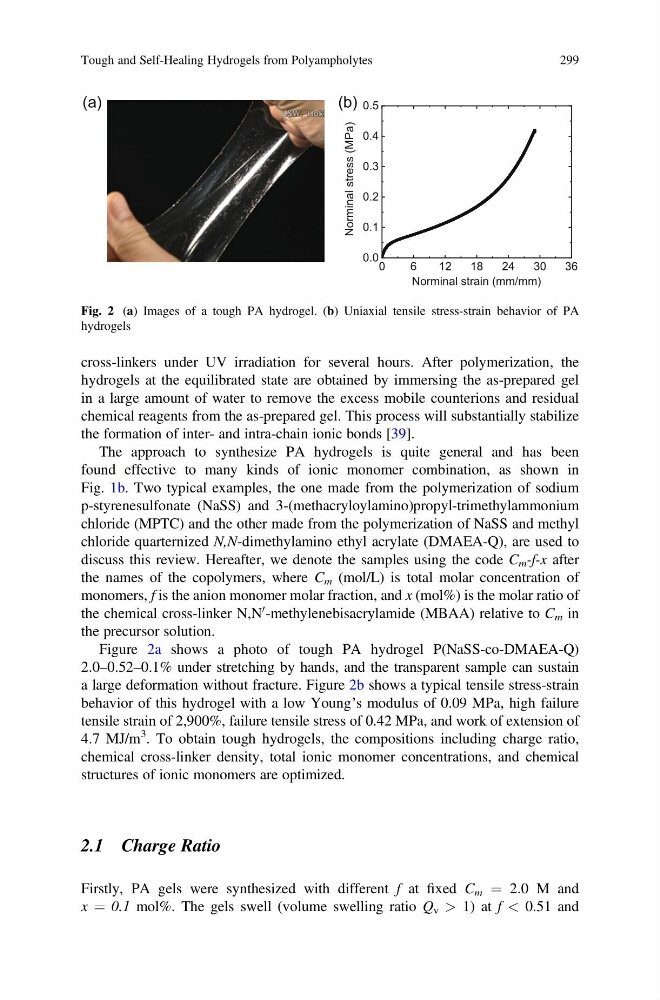
Figure 2a shows a photo of tough PA hydrogel P(NaSS-co-DMAEA-Q)
2.0–0.52–0.1% under stretching by hands, and the transparent sample can sustain
a large deformation without fracture. Figure 2b shows a typical tensile stress-strain
behavior of this hydrogel with a low Young’s modulus of 0.09 MPa, high failure
tensile strain of 2,900%, failure tensile stress of 0.42 MPa, and work of extension of
4.7 MJ/m
3 . To obtain tough hydrogels, the compositions including charge ratio,
chemical cross-linker density, total ionic monomer concentrations, and chemical
structures of ionic monomers are optimized.
2.1 Charge Ratio
Firstly, PA gels were synthesized with different f at fixed C m ¼ 2.0 M and
x ¼ 0.1 mol%. The gels swell (volume swelling ratio Q v > 1) at f < 0.51 and
0
6
12
18
24
30
36
0.0
0.1
0.2
0.3
0.4
0.5
Norminal strain (mm/mm)
(a)
(b)
Norminal stress (MPa)
Fig. 2 (a) Images of a tough PA hydrogel. (b) Uniaxial tensile stress-strain behavior of PA
hydrogels
Tough and Self-Healing Hydrogels from Polyampholytes
299
hydrogels at the equilibrated state are obtained by immersing the as-prepared gel
in a large amount of water to remove the excess mobile counterions and residual
chemical reagents from the as-prepared gel. This process will substantially stabilize
the formation of inter- and intra-chain ionic bonds [39].
The approach to synthesize PA hydrogels is quite general and has been
found effective to many kinds of ionic monomer combination, as shown in
Fig. 1b. Two typical examples, the one made from the polymerization of sodium
p-styrenesulfonate (NaSS) and 3-(methacryloylamino)propyl-trimethylammonium
chloride (MPTC) and the other made from the polymerization of NaSS and methyl
chloride quarternized N,N-dimethylamino ethyl acrylate (DMAEA-Q), are used to
discuss this review. Hereafter, we denote the samples using the code C m -f-x after
the names of the copolymers, where C m (mol/L) is total molar concentration of
monomers, f is the anion monomer molar fraction, and x (mol%) is the molar ratio of
the chemical cross-linker N,N
0 -methylenebisacrylamide (MBAA) relative to C m in
the precursor solution.
Figure 2a shows a photo of tough PA hydrogel P(NaSS-co-DMAEA-Q)
2.0–0.52–0.1% under stretching by hands, and the transparent sample can sustain
a large deformation without fracture. Figure 2b shows a typical tensile stress-strain
behavior of this hydrogel with a low Young’s modulus of 0.09 MPa, high failure
tensile strain of 2,900%, failure tensile stress of 0.42 MPa, and work of extension of
4.7 MJ/m
3 . To obtain tough hydrogels, the compositions including charge ratio,
chemical cross-linker density, total ionic monomer concentrations, and chemical
structures of ionic monomers are optimized.
2.1 Charge Ratio
Firstly, PA gels were synthesized with different f at fixed C m ¼ 2.0 M and
x ¼ 0.1 mol%. The gels swell (volume swelling ratio Q v > 1) at f < 0.51 and
0
6
12
18
24
30
36
0.0
0.1
0.2
0.3
0.4
0.5
Norminal strain (mm/mm)
(a)
(b)
Norminal stress (MPa)
Fig. 2 (a) Images of a tough PA hydrogel. (b) Uniaxial tensile stress-strain behavior of PA
hydrogels
Tough and Self-Healing Hydrogels from Polyampholytes
299