

0.1–2 MPa, failure tensile strain of 150–1,500%, work of extension of 0.1–7 MJ/m
3 ,
Young’s modulus of 0.01–8 MPa, 100% self-recovery behavior, and a high selfhealing efficiency. They have a fracture energy of 1,000–4,000 J/m
2 , comparable to
that of filled rubbers, tough double-network hydrogels, and soft tissues.
In this review paper, we firstly optimize the compositions of tough hydrogels,
including the charge ratio of cationic monomer and anionic monomer, monomer
concentration, cross-linker concentration, chemical structures, etc. Secondly, we
discuss the role of dynamical ionic bonds on the mechanical behavior of hydrogels,
including the self-healing, viscoelastic, and fracture behavior. Thirdly, we elucidate
the toughening mechanism of PA hydrogel. Fourthly, we simply summarize the
recent applications of PA hydrogel. Finally, conclusions are given in the last part.
2 Synthesis and Optimized Structure
PA hydrogels are synthesized from the one-step random copolymerization of
cationic monomer and anionic monomer with a described molar ratio, monomer
concentration, and initiator concentration in the presence of or without chemical
Cationic monomer
Anionic monomer
MPTC
DMAEA-Q
NaSS
AMPS
(a)
(b)
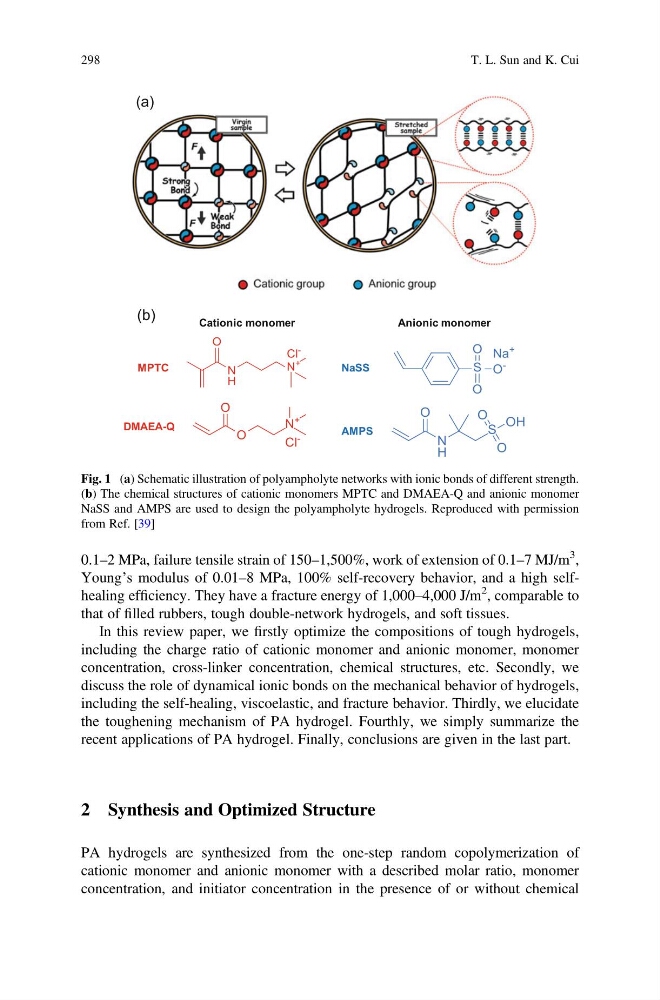
Fig. 1 (a) Schematic illustration of polyampholyte networks with ionic bonds of different strength.
(b) The chemical structures of cationic monomers MPTC and DMAEA-Q and anionic monomer
NaSS and AMPS are used to design the polyampholyte hydrogels. Reproduced with permission
from Ref. [39]
298
T. L. Sun and K. Cui
3 ,
Young’s modulus of 0.01–8 MPa, 100% self-recovery behavior, and a high selfhealing efficiency. They have a fracture energy of 1,000–4,000 J/m
2 , comparable to
that of filled rubbers, tough double-network hydrogels, and soft tissues.
In this review paper, we firstly optimize the compositions of tough hydrogels,
including the charge ratio of cationic monomer and anionic monomer, monomer
concentration, cross-linker concentration, chemical structures, etc. Secondly, we
discuss the role of dynamical ionic bonds on the mechanical behavior of hydrogels,
including the self-healing, viscoelastic, and fracture behavior. Thirdly, we elucidate
the toughening mechanism of PA hydrogel. Fourthly, we simply summarize the
recent applications of PA hydrogel. Finally, conclusions are given in the last part.
2 Synthesis and Optimized Structure
PA hydrogels are synthesized from the one-step random copolymerization of
cationic monomer and anionic monomer with a described molar ratio, monomer
concentration, and initiator concentration in the presence of or without chemical
Cationic monomer
Anionic monomer
MPTC
DMAEA-Q
NaSS
AMPS
(a)
(b)
Fig. 1 (a) Schematic illustration of polyampholyte networks with ionic bonds of different strength.
(b) The chemical structures of cationic monomers MPTC and DMAEA-Q and anionic monomer
NaSS and AMPS are used to design the polyampholyte hydrogels. Reproduced with permission
from Ref. [39]
298
T. L. Sun and K. Cui