

was cut into two, and immediate healing of two pieces was observed when they were
put together (Fig. 5d–f). Furthermore, to assess self-healing qualitatively, strain
amplitude sweep test was applied on hydrogel where strain was alternated between
1 and 300%. A drastic decrease in G
0 occurred under high strain (300%), and
immediate recovery to original G
0 was recorded upon reducing strain to 1%. This
biodegradable and intelligent hydrogel possesses a great potential to be used as a cell
therapy platform for cardiac tissue repair.
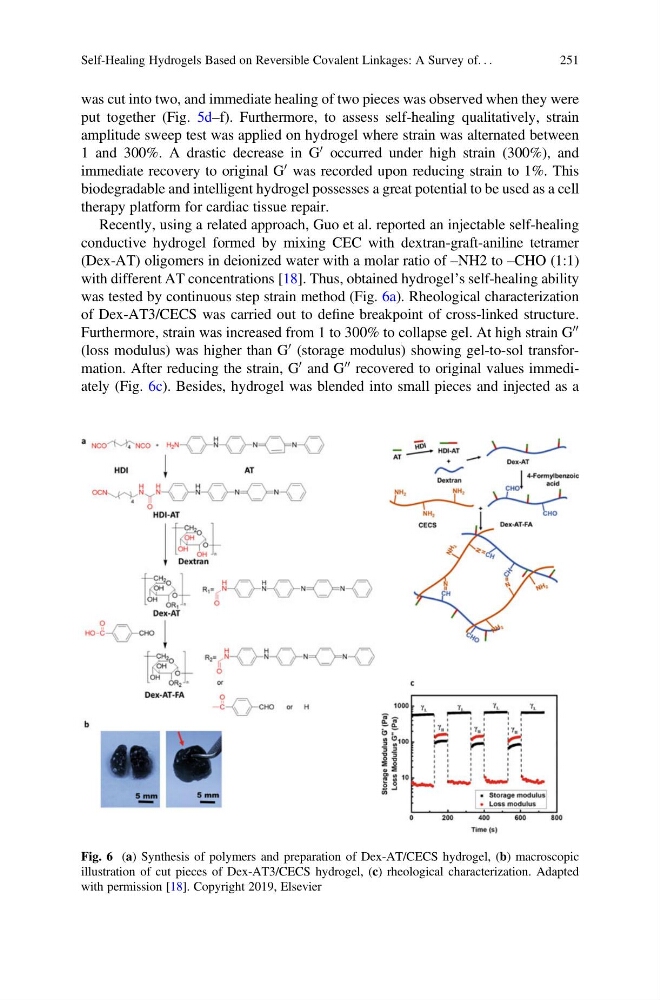
Recently, using a related approach, Guo et al. reported an injectable self-healing
conductive hydrogel formed by mixing CEC with dextran-graft-aniline tetramer
(Dex-AT) oligomers in deionized water with a molar ratio of –NH2 to –CHO (1:1)
with different AT concentrations [18]. Thus, obtained hydrogel’s self-healing ability
was tested by continuous step strain method (Fig. 6a). Rheological characterization
of Dex-AT3/CECS was carried out to define breakpoint of cross-linked structure.
Furthermore, strain was increased from 1 to 300% to collapse gel. At high strain G
00
(loss modulus) was higher than G
0 (storage modulus) showing gel-to-sol transformation. After reducing the strain, G
0 and G
00 recovered to original values immediately (Fig. 6c). Besides, hydrogel was blended into small pieces and injected as a
Fig. 6 (a) Synthesis of polymers and preparation of Dex-AT/CECS hydrogel, (b) macroscopic
illustration of cut pieces of Dex-AT3/CECS hydrogel, (c) rheological characterization. Adapted
with permission [18]. Copyright 2019, Elsevier
Self-Healing Hydrogels Based on Reversible Covalent Linkages: A Survey of. . .
251
put together (Fig. 5d–f). Furthermore, to assess self-healing qualitatively, strain
amplitude sweep test was applied on hydrogel where strain was alternated between
1 and 300%. A drastic decrease in G
0 occurred under high strain (300%), and
immediate recovery to original G
0 was recorded upon reducing strain to 1%. This
biodegradable and intelligent hydrogel possesses a great potential to be used as a cell
therapy platform for cardiac tissue repair.
Recently, using a related approach, Guo et al. reported an injectable self-healing
conductive hydrogel formed by mixing CEC with dextran-graft-aniline tetramer
(Dex-AT) oligomers in deionized water with a molar ratio of –NH2 to –CHO (1:1)
with different AT concentrations [18]. Thus, obtained hydrogel’s self-healing ability
was tested by continuous step strain method (Fig. 6a). Rheological characterization
of Dex-AT3/CECS was carried out to define breakpoint of cross-linked structure.
Furthermore, strain was increased from 1 to 300% to collapse gel. At high strain G
00
(loss modulus) was higher than G
0 (storage modulus) showing gel-to-sol transformation. After reducing the strain, G
0 and G
00 recovered to original values immediately (Fig. 6c). Besides, hydrogel was blended into small pieces and injected as a
Fig. 6 (a) Synthesis of polymers and preparation of Dex-AT/CECS hydrogel, (b) macroscopic
illustration of cut pieces of Dex-AT3/CECS hydrogel, (c) rheological characterization. Adapted
with permission [18]. Copyright 2019, Elsevier
Self-Healing Hydrogels Based on Reversible Covalent Linkages: A Survey of. . .
251