

natural brain tissue (100–1,000 Pa) to support neural stem cell (NSC) growth and
differentiation were obtained via the Schiff base reaction. The dynamic nature of the
imine bonds ensured self-healing, as demonstrated through alternate step strain
measurements. Strain was varied from 1 to 1,000% alternately and repeated several
times. Recovery of the storage modulus (G
0 ) to its initial value was observed when
strain was reduced to 1% (Fig. 4b). This polysaccharide-based self-healing hydrogel
was used as carrier for NSC transplantations.
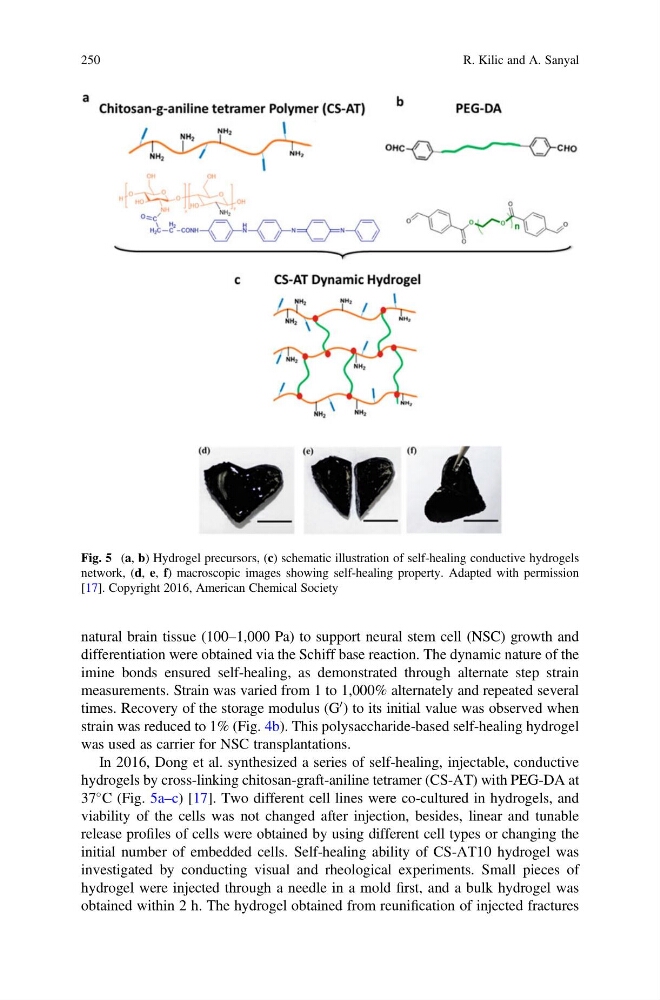
In 2016, Dong et al. synthesized a series of self-healing, injectable, conductive
hydrogels by cross-linking chitosan-graft-aniline tetramer (CS-AT) with PEG-DA at
37
C (Fig. 5a–c) [17]. Two different cell lines were co-cultured in hydrogels, and
viability of the cells was not changed after injection, besides, linear and tunable
release profiles of cells were obtained by using different cell types or changing the
initial number of embedded cells. Self-healing ability of CS-AT10 hydrogel was
investigated by conducting visual and rheological experiments. Small pieces of
hydrogel were injected through a needle in a mold first, and a bulk hydrogel was
obtained within 2 h. The hydrogel obtained from reunification of injected fractures
Fig. 5 (a, b) Hydrogel precursors, (c) schematic illustration of self-healing conductive hydrogels
network, (d, e, f) macroscopic images showing self-healing property. Adapted with permission
[17]. Copyright 2016, American Chemical Society
250
R. Kilic and A. Sanyal
differentiation were obtained via the Schiff base reaction. The dynamic nature of the
imine bonds ensured self-healing, as demonstrated through alternate step strain
measurements. Strain was varied from 1 to 1,000% alternately and repeated several
times. Recovery of the storage modulus (G
0 ) to its initial value was observed when
strain was reduced to 1% (Fig. 4b). This polysaccharide-based self-healing hydrogel
was used as carrier for NSC transplantations.
In 2016, Dong et al. synthesized a series of self-healing, injectable, conductive
hydrogels by cross-linking chitosan-graft-aniline tetramer (CS-AT) with PEG-DA at
37
C (Fig. 5a–c) [17]. Two different cell lines were co-cultured in hydrogels, and
viability of the cells was not changed after injection, besides, linear and tunable
release profiles of cells were obtained by using different cell types or changing the
initial number of embedded cells. Self-healing ability of CS-AT10 hydrogel was
investigated by conducting visual and rheological experiments. Small pieces of
hydrogel were injected through a needle in a mold first, and a bulk hydrogel was
obtained within 2 h. The hydrogel obtained from reunification of injected fractures
Fig. 5 (a, b) Hydrogel precursors, (c) schematic illustration of self-healing conductive hydrogels
network, (d, e, f) macroscopic images showing self-healing property. Adapted with permission
[17]. Copyright 2016, American Chemical Society
250
R. Kilic and A. Sanyal