

obtain hydrogels with stiffness suitable for the differentiation and growth of neural
stem cells (NSCs) (%1.5 kPa) [15]. Additionally, conventional alginate hydrogels
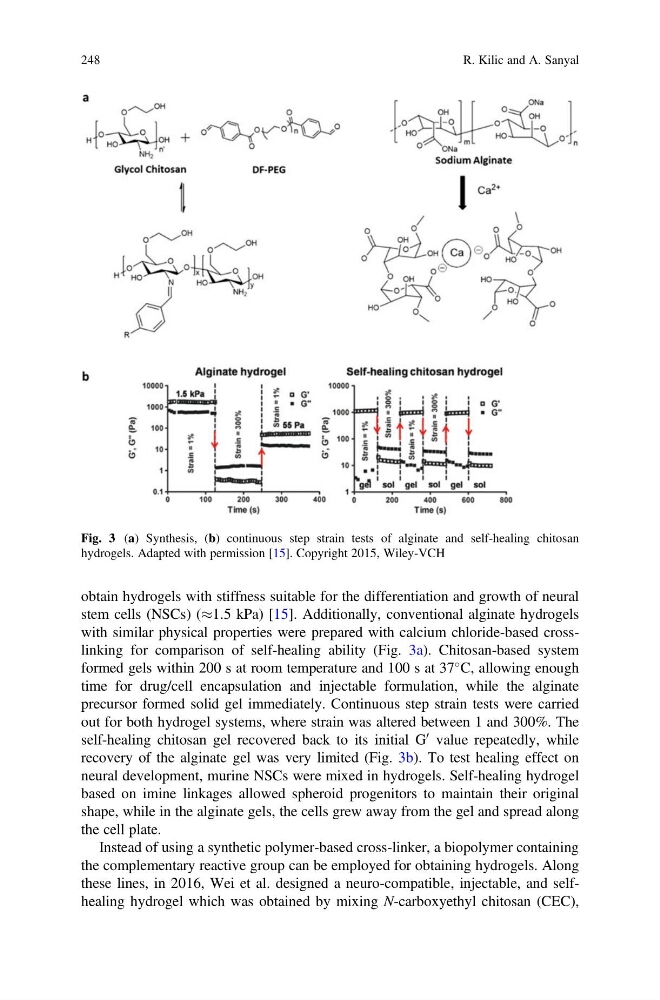
with similar physical properties were prepared with calcium chloride-based crosslinking for comparison of self-healing ability (Fig. 3a). Chitosan-based system
formed gels within 200 s at room temperature and 100 s at 37
C, allowing enough
time for drug/cell encapsulation and injectable formulation, while the alginate
precursor formed solid gel immediately. Continuous step strain tests were carried
out for both hydrogel systems, where strain was altered between 1 and 300%. The
self-healing chitosan gel recovered back to its initial G
0 value repeatedly, while
recovery of the alginate gel was very limited (Fig. 3b). To test healing effect on
neural development, murine NSCs were mixed in hydrogels. Self-healing hydrogel
based on imine linkages allowed spheroid progenitors to maintain their original
shape, while in the alginate gels, the cells grew away from the gel and spread along
the cell plate.
Instead of using a synthetic polymer-based cross-linker, a biopolymer containing
the complementary reactive group can be employed for obtaining hydrogels. Along
these lines, in 2016, Wei et al. designed a neuro-compatible, injectable, and selfhealing hydrogel which was obtained by mixing N-carboxyethyl chitosan (CEC),
Fig. 3 (a) Synthesis, (b) continuous step strain tests of alginate and self-healing chitosan
hydrogels. Adapted with permission [15]. Copyright 2015, Wiley-VCH
248
R. Kilic and A. Sanyal
stem cells (NSCs) (%1.5 kPa) [15]. Additionally, conventional alginate hydrogels
with similar physical properties were prepared with calcium chloride-based crosslinking for comparison of self-healing ability (Fig. 3a). Chitosan-based system
formed gels within 200 s at room temperature and 100 s at 37
C, allowing enough
time for drug/cell encapsulation and injectable formulation, while the alginate
precursor formed solid gel immediately. Continuous step strain tests were carried
out for both hydrogel systems, where strain was altered between 1 and 300%. The
self-healing chitosan gel recovered back to its initial G
0 value repeatedly, while
recovery of the alginate gel was very limited (Fig. 3b). To test healing effect on
neural development, murine NSCs were mixed in hydrogels. Self-healing hydrogel
based on imine linkages allowed spheroid progenitors to maintain their original
shape, while in the alginate gels, the cells grew away from the gel and spread along
the cell plate.
Instead of using a synthetic polymer-based cross-linker, a biopolymer containing
the complementary reactive group can be employed for obtaining hydrogels. Along
these lines, in 2016, Wei et al. designed a neuro-compatible, injectable, and selfhealing hydrogel which was obtained by mixing N-carboxyethyl chitosan (CEC),
Fig. 3 (a) Synthesis, (b) continuous step strain tests of alginate and self-healing chitosan
hydrogels. Adapted with permission [15]. Copyright 2015, Wiley-VCH
248
R. Kilic and A. Sanyal