

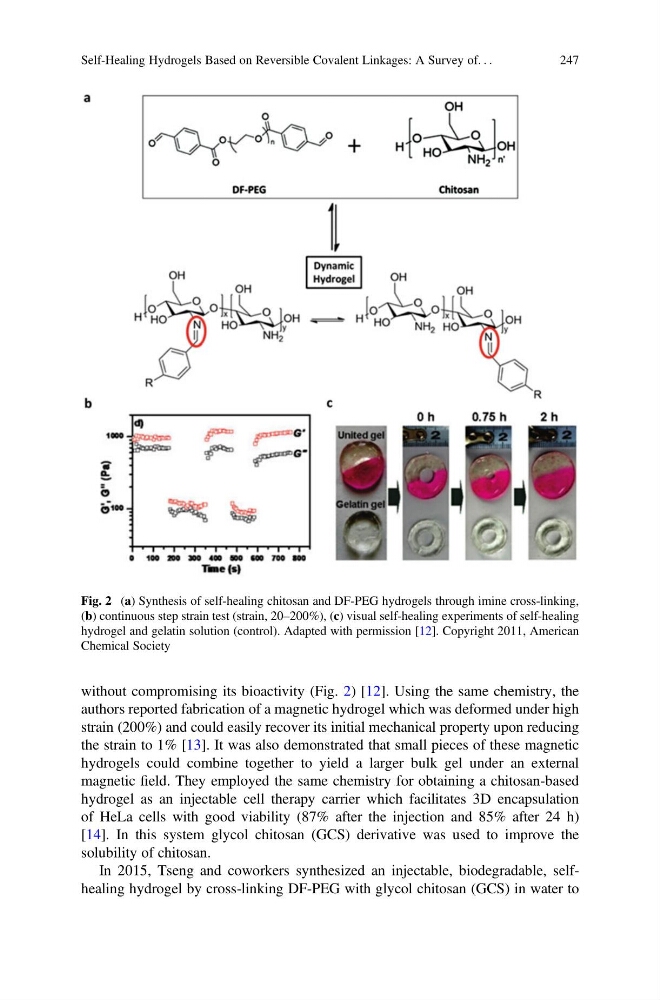
without compromising its bioactivity (Fig. 2) [12]. Using the same chemistry, the
authors reported fabrication of a magnetic hydrogel which was deformed under high
strain (200%) and could easily recover its initial mechanical property upon reducing
the strain to 1% [13]. It was also demonstrated that small pieces of these magnetic
hydrogels could combine together to yield a larger bulk gel under an external
magnetic field. They employed the same chemistry for obtaining a chitosan-based
hydrogel as an injectable cell therapy carrier which facilitates 3D encapsulation
of HeLa cells with good viability (87% after the injection and 85% after 24 h)
[14]. In this system glycol chitosan (GCS) derivative was used to improve the
solubility of chitosan.
In 2015, Tseng and coworkers synthesized an injectable, biodegradable, selfhealing hydrogel by cross-linking DF-PEG with glycol chitosan (GCS) in water to
Fig. 2 (a) Synthesis of self-healing chitosan and DF-PEG hydrogels through imine cross-linking,
(b) continuous step strain test (strain, 20–200%), (c) visual self-healing experiments of self-healing
hydrogel and gelatin solution (control). Adapted with permission [12]. Copyright 2011, American
Chemical Society
Self-Healing Hydrogels Based on Reversible Covalent Linkages: A Survey of. . .
247
authors reported fabrication of a magnetic hydrogel which was deformed under high
strain (200%) and could easily recover its initial mechanical property upon reducing
the strain to 1% [13]. It was also demonstrated that small pieces of these magnetic
hydrogels could combine together to yield a larger bulk gel under an external
magnetic field. They employed the same chemistry for obtaining a chitosan-based
hydrogel as an injectable cell therapy carrier which facilitates 3D encapsulation
of HeLa cells with good viability (87% after the injection and 85% after 24 h)
[14]. In this system glycol chitosan (GCS) derivative was used to improve the
solubility of chitosan.
In 2015, Tseng and coworkers synthesized an injectable, biodegradable, selfhealing hydrogel by cross-linking DF-PEG with glycol chitosan (GCS) in water to
Fig. 2 (a) Synthesis of self-healing chitosan and DF-PEG hydrogels through imine cross-linking,
(b) continuous step strain test (strain, 20–200%), (c) visual self-healing experiments of self-healing
hydrogel and gelatin solution (control). Adapted with permission [12]. Copyright 2011, American
Chemical Society
Self-Healing Hydrogels Based on Reversible Covalent Linkages: A Survey of. . .
247