

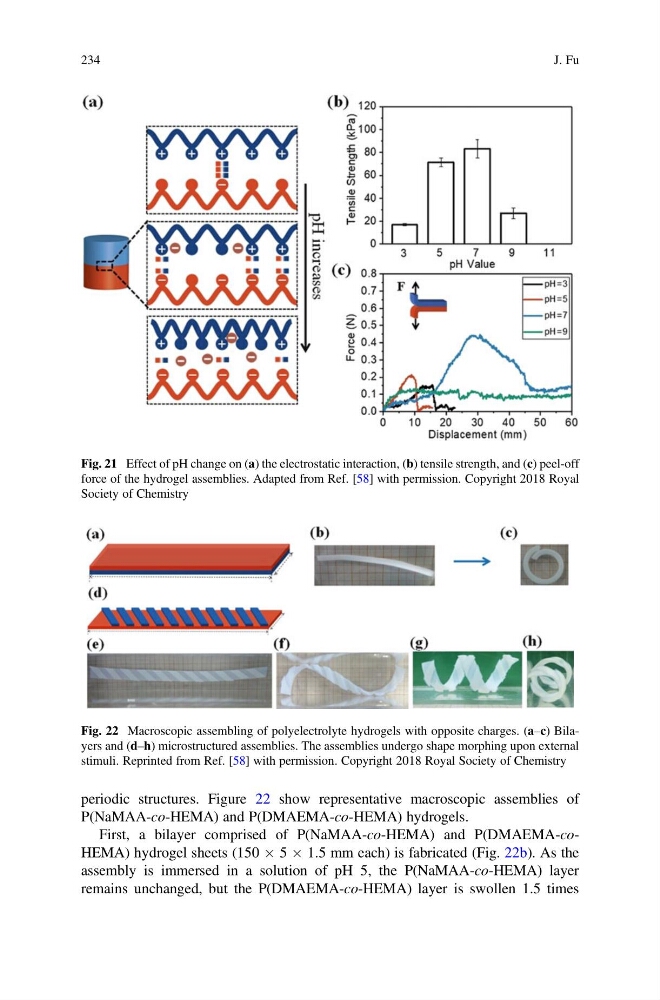
periodic structures. Figure 22 show representative macroscopic assemblies of
P(NaMAA-co-HEMA) and P(DMAEMA-co-HEMA) hydrogels.
First, a bilayer comprised of P(NaMAA-co-HEMA) and P(DMAEMA-coHEMA) hydrogel sheets (150 Â 5 Â 1.5 mm each) is fabricated (Fig. 22b). As the
assembly is immersed in a solution of pH 5, the P(NaMAA-co-HEMA) layer
remains unchanged, but the P(DMAEMA-co-HEMA) layer is swollen 1.5 times
Fig. 21 Effect of pH change on (a) the electrostatic interaction, (b) tensile strength, and (c) peel-off
force of the hydrogel assemblies. Adapted from Ref. [58] with permission. Copyright 2018 Royal
Society of Chemistry
Fig. 22 Macroscopic assembling of polyelectrolyte hydrogels with opposite charges. (a–c) Bilayers and (d–h) microstructured assemblies. The assemblies undergo shape morphing upon external
stimuli. Reprinted from Ref. [58] with permission. Copyright 2018 Royal Society of Chemistry
234
J. Fu
P(NaMAA-co-HEMA) and P(DMAEMA-co-HEMA) hydrogels.
First, a bilayer comprised of P(NaMAA-co-HEMA) and P(DMAEMA-coHEMA) hydrogel sheets (150 Â 5 Â 1.5 mm each) is fabricated (Fig. 22b). As the
assembly is immersed in a solution of pH 5, the P(NaMAA-co-HEMA) layer
remains unchanged, but the P(DMAEMA-co-HEMA) layer is swollen 1.5 times
Fig. 21 Effect of pH change on (a) the electrostatic interaction, (b) tensile strength, and (c) peel-off
force of the hydrogel assemblies. Adapted from Ref. [58] with permission. Copyright 2018 Royal
Society of Chemistry
Fig. 22 Macroscopic assembling of polyelectrolyte hydrogels with opposite charges. (a–c) Bilayers and (d–h) microstructured assemblies. The assemblies undergo shape morphing upon external
stimuli. Reprinted from Ref. [58] with permission. Copyright 2018 Royal Society of Chemistry
234
J. Fu