

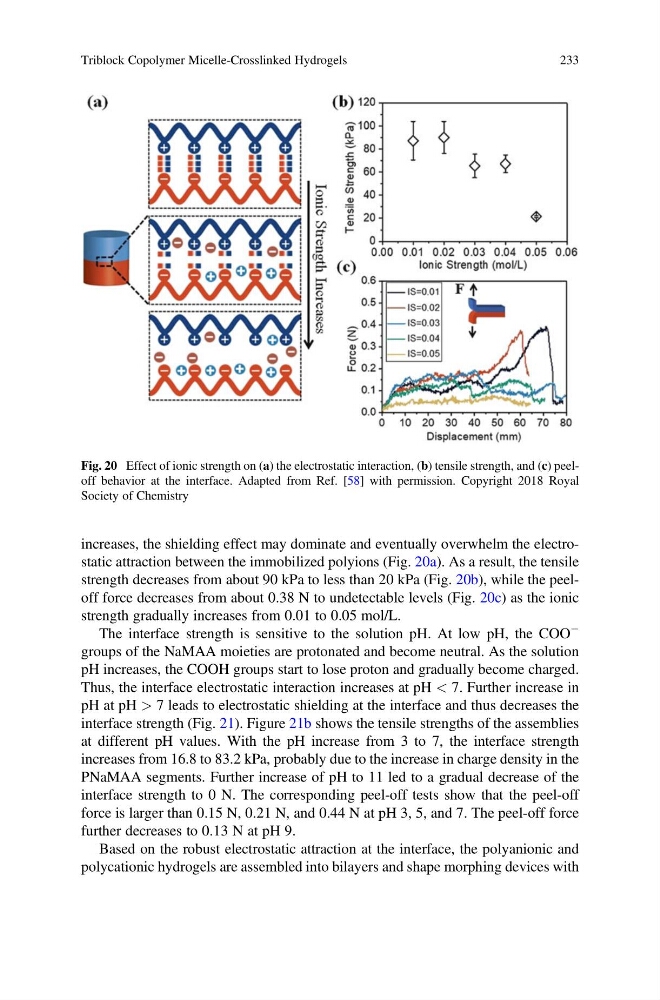
increases, the shielding effect may dominate and eventually overwhelm the electrostatic attraction between the immobilized polyions (Fig. 20a). As a result, the tensile
strength decreases from about 90 kPa to less than 20 kPa (Fig. 20b), while the peeloff force decreases from about 0.38 N to undetectable levels (Fig. 20c) as the ionic
strength gradually increases from 0.01 to 0.05 mol/L.
The interface strength is sensitive to the solution pH. At low pH, the COO
À
groups of the NaMAA moieties are protonated and become neutral. As the solution
pH increases, the COOH groups start to lose proton and gradually become charged.
Thus, the interface electrostatic interaction increases at pH < 7. Further increase in
pH at pH > 7 leads to electrostatic shielding at the interface and thus decreases the
interface strength (Fig. 21). Figure 21b shows the tensile strengths of the assemblies
at different pH values. With the pH increase from 3 to 7, the interface strength
increases from 16.8 to 83.2 kPa, probably due to the increase in charge density in the
PNaMAA segments. Further increase of pH to 11 led to a gradual decrease of the
interface strength to 0 N. The corresponding peel-off tests show that the peel-off
force is larger than 0.15 N, 0.21 N, and 0.44 N at pH 3, 5, and 7. The peel-off force
further decreases to 0.13 N at pH 9.
Based on the robust electrostatic attraction at the interface, the polyanionic and
polycationic hydrogels are assembled into bilayers and shape morphing devices with
Fig. 20 Effect of ionic strength on (a) the electrostatic interaction, (b) tensile strength, and (c) peeloff behavior at the interface. Adapted from Ref. [58] with permission. Copyright 2018 Royal
Society of Chemistry
Triblock Copolymer Micelle-Crosslinked Hydrogels
233
strength decreases from about 90 kPa to less than 20 kPa (Fig. 20b), while the peeloff force decreases from about 0.38 N to undetectable levels (Fig. 20c) as the ionic
strength gradually increases from 0.01 to 0.05 mol/L.
The interface strength is sensitive to the solution pH. At low pH, the COO
À
groups of the NaMAA moieties are protonated and become neutral. As the solution
pH increases, the COOH groups start to lose proton and gradually become charged.
Thus, the interface electrostatic interaction increases at pH < 7. Further increase in
pH at pH > 7 leads to electrostatic shielding at the interface and thus decreases the
interface strength (Fig. 21). Figure 21b shows the tensile strengths of the assemblies
at different pH values. With the pH increase from 3 to 7, the interface strength
increases from 16.8 to 83.2 kPa, probably due to the increase in charge density in the
PNaMAA segments. Further increase of pH to 11 led to a gradual decrease of the
interface strength to 0 N. The corresponding peel-off tests show that the peel-off
force is larger than 0.15 N, 0.21 N, and 0.44 N at pH 3, 5, and 7. The peel-off force
further decreases to 0.13 N at pH 9.
Based on the robust electrostatic attraction at the interface, the polyanionic and
polycationic hydrogels are assembled into bilayers and shape morphing devices with
Fig. 20 Effect of ionic strength on (a) the electrostatic interaction, (b) tensile strength, and (c) peeloff behavior at the interface. Adapted from Ref. [58] with permission. Copyright 2018 Royal
Society of Chemistry
Triblock Copolymer Micelle-Crosslinked Hydrogels
233