

chains in the gels. This is rational since the major deformation comes from polymer
chains.
In order to further examine the effect of solvent quality on the structures and
properties of the micelle-crosslinked gels, solvent exchange experiments are
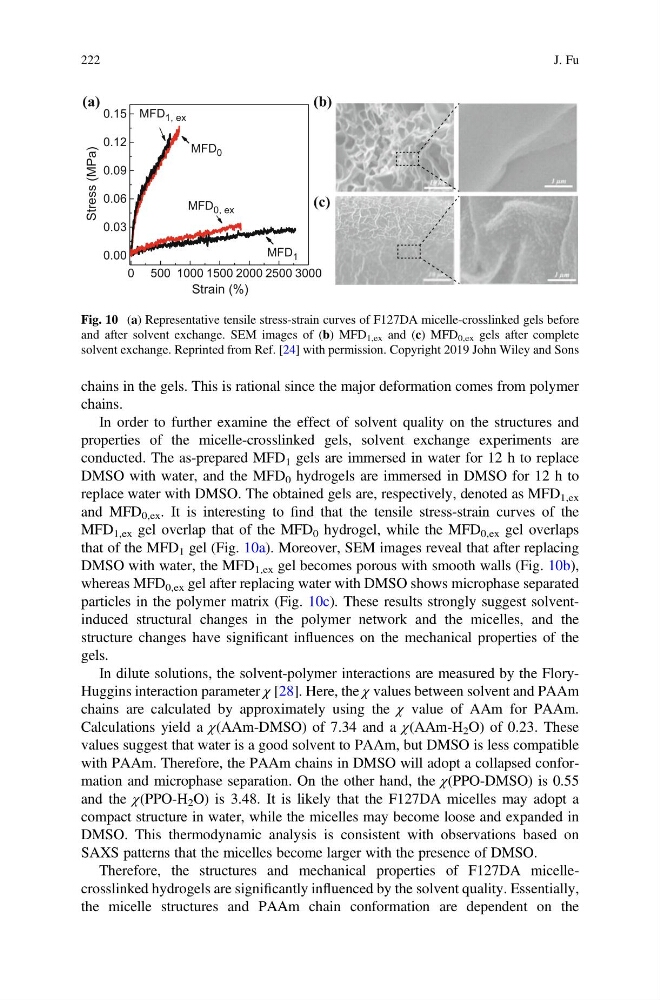
conducted. The as-prepared MFD 1 gels are immersed in water for 12 h to replace
DMSO with water, and the MFD 0 hydrogels are immersed in DMSO for 12 h to
replace water with DMSO. The obtained gels are, respectively, denoted as MFD 1,ex
and MFD 0,ex . It is interesting to find that the tensile stress-strain curves of the
MFD 1,ex gel overlap that of the MFD 0 hydrogel, while the MFD 0,ex gel overlaps
that of the MFD 1 gel (Fig. 10a). Moreover, SEM images reveal that after replacing
DMSO with water, the MFD 1,ex gel becomes porous with smooth walls (Fig. 10b),
whereas MFD 0,ex gel after replacing water with DMSO shows microphase separated
particles in the polymer matrix (Fig. 10c). These results strongly suggest solventinduced structural changes in the polymer network and the micelles, and the
structure changes have significant influences on the mechanical properties of the
gels.
In dilute solutions, the solvent-polymer interactions are measured by the FloryHuggins interaction parameter χ [28]. Here, the χ values between solvent and PAAm
chains are calculated by approximately using the χ value of AAm for PAAm.
Calculations yield a χ(AAm-DMSO) of 7.34 and a χ(AAm-H 2 O) of 0.23. These
values suggest that water is a good solvent to PAAm, but DMSO is less compatible
with PAAm. Therefore, the PAAm chains in DMSO will adopt a collapsed conformation and microphase separation. On the other hand, the χ(PPO-DMSO) is 0.55
and the χ(PPO-H 2 O) is 3.48. It is likely that the F127DA micelles may adopt a
compact structure in water, while the micelles may become loose and expanded in
DMSO. This thermodynamic analysis is consistent with observations based on
SAXS patterns that the micelles become larger with the presence of DMSO.
Therefore, the structures and mechanical properties of F127DA micellecrosslinked hydrogels are significantly influenced by the solvent quality. Essentially,
the micelle structures and PAAm chain conformation are dependent on the
(a)
(b)
(c)
0 500 1000 1500 2000 2500 3000
0.00
0.03
0.06
0.09
0.12
0.15
Strain (%)
)
a
P
M
(
s
s
e
r
t
S
MFD 1, ex
MFD 0, ex
MFD 0
MFD 1
Fig. 10 (a) Representative tensile stress-strain curves of F127DA micelle-crosslinked gels before
and after solvent exchange. SEM images of (b) MFD 1,ex and (c) MFD 0,ex gels after complete
solvent exchange. Reprinted from Ref. [24] with permission. Copyright 2019 John Wiley and Sons
222
J. Fu
chains.
In order to further examine the effect of solvent quality on the structures and
properties of the micelle-crosslinked gels, solvent exchange experiments are
conducted. The as-prepared MFD 1 gels are immersed in water for 12 h to replace
DMSO with water, and the MFD 0 hydrogels are immersed in DMSO for 12 h to
replace water with DMSO. The obtained gels are, respectively, denoted as MFD 1,ex
and MFD 0,ex . It is interesting to find that the tensile stress-strain curves of the
MFD 1,ex gel overlap that of the MFD 0 hydrogel, while the MFD 0,ex gel overlaps
that of the MFD 1 gel (Fig. 10a). Moreover, SEM images reveal that after replacing
DMSO with water, the MFD 1,ex gel becomes porous with smooth walls (Fig. 10b),
whereas MFD 0,ex gel after replacing water with DMSO shows microphase separated
particles in the polymer matrix (Fig. 10c). These results strongly suggest solventinduced structural changes in the polymer network and the micelles, and the
structure changes have significant influences on the mechanical properties of the
gels.
In dilute solutions, the solvent-polymer interactions are measured by the FloryHuggins interaction parameter χ [28]. Here, the χ values between solvent and PAAm
chains are calculated by approximately using the χ value of AAm for PAAm.
Calculations yield a χ(AAm-DMSO) of 7.34 and a χ(AAm-H 2 O) of 0.23. These
values suggest that water is a good solvent to PAAm, but DMSO is less compatible
with PAAm. Therefore, the PAAm chains in DMSO will adopt a collapsed conformation and microphase separation. On the other hand, the χ(PPO-DMSO) is 0.55
and the χ(PPO-H 2 O) is 3.48. It is likely that the F127DA micelles may adopt a
compact structure in water, while the micelles may become loose and expanded in
DMSO. This thermodynamic analysis is consistent with observations based on
SAXS patterns that the micelles become larger with the presence of DMSO.
Therefore, the structures and mechanical properties of F127DA micellecrosslinked hydrogels are significantly influenced by the solvent quality. Essentially,
the micelle structures and PAAm chain conformation are dependent on the
(a)
(b)
(c)
0 500 1000 1500 2000 2500 3000
0.00
0.03
0.06
0.09
0.12
0.15
Strain (%)
)
a
P
M
(
s
s
e
r
t
S
MFD 1, ex
MFD 0, ex
MFD 0
MFD 1
Fig. 10 (a) Representative tensile stress-strain curves of F127DA micelle-crosslinked gels before
and after solvent exchange. SEM images of (b) MFD 1,ex and (c) MFD 0,ex gels after complete
solvent exchange. Reprinted from Ref. [24] with permission. Copyright 2019 John Wiley and Sons
222
J. Fu