

R t
ð Þ ¼
l s À l r
l s À l o
ð7Þ
and l r is the length of the sample after the shape recovery step.
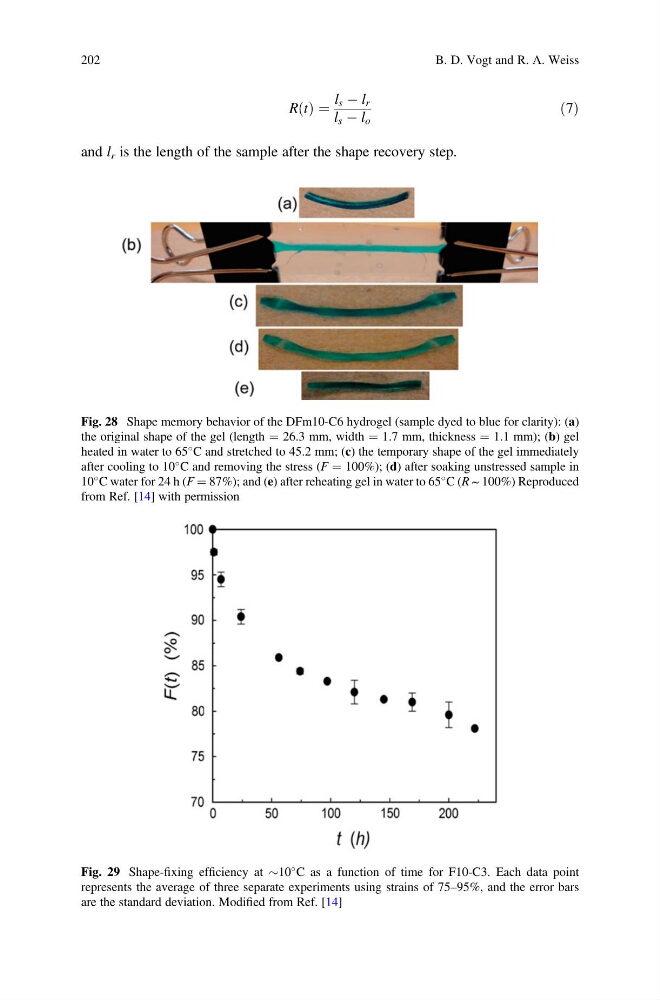
Fig. 28 Shape memory behavior of the DFm10-C6 hydrogel (sample dyed to blue for clarity): (a)
the original shape of the gel (length ¼ 26.3 mm, width ¼ 1.7 mm, thickness ¼ 1.1 mm); (b) gel
heated in water to 65
C and stretched to 45.2 mm; (c) the temporary shape of the gel immediately
after cooling to 10
C and removing the stress (F ¼ 100%); (d) after soaking unstressed sample in
10
C water for 24 h (F ¼ 87%); and (e) after reheating gel in water to 65
C (R ~ 100%) Reproduced
from Ref. [14] with permission
Fig. 29 Shape-fixing efficiency at $10
C as a function of time for F10-C3. Each data point
represents the average of three separate experiments using strains of 75–95%, and the error bars
are the standard deviation. Modified from Ref. [14]
202
B. D. Vogt and R. A. Weiss
ð Þ ¼
l s À l r
l s À l o
ð7Þ
and l r is the length of the sample after the shape recovery step.
Fig. 28 Shape memory behavior of the DFm10-C6 hydrogel (sample dyed to blue for clarity): (a)
the original shape of the gel (length ¼ 26.3 mm, width ¼ 1.7 mm, thickness ¼ 1.1 mm); (b) gel
heated in water to 65
C and stretched to 45.2 mm; (c) the temporary shape of the gel immediately
after cooling to 10
C and removing the stress (F ¼ 100%); (d) after soaking unstressed sample in
10
C water for 24 h (F ¼ 87%); and (e) after reheating gel in water to 65
C (R ~ 100%) Reproduced
from Ref. [14] with permission
Fig. 29 Shape-fixing efficiency at $10
C as a function of time for F10-C3. Each data point
represents the average of three separate experiments using strains of 75–95%, and the error bars
are the standard deviation. Modified from Ref. [14]
202
B. D. Vogt and R. A. Weiss