

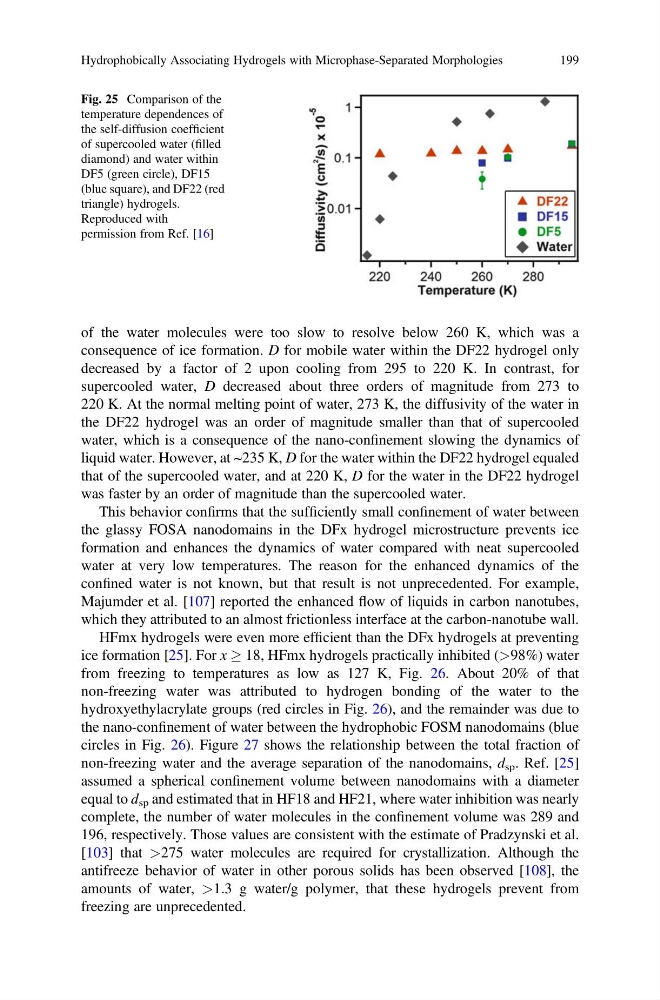
of the water molecules were too slow to resolve below 260 K, which was a
consequence of ice formation. D for mobile water within the DF22 hydrogel only
decreased by a factor of 2 upon cooling from 295 to 220 K. In contrast, for
supercooled water, D decreased about three orders of magnitude from 273 to
220 K. At the normal melting point of water, 273 K, the diffusivity of the water in
the DF22 hydrogel was an order of magnitude smaller than that of supercooled
water, which is a consequence of the nano-confinement slowing the dynamics of
liquid water. However, at ~235 K, D for the water within the DF22 hydrogel equaled
that of the supercooled water, and at 220 K, D for the water in the DF22 hydrogel
was faster by an order of magnitude than the supercooled water.
This behavior confirms that the sufficiently small confinement of water between
the glassy FOSA nanodomains in the DFx hydrogel microstructure prevents ice
formation and enhances the dynamics of water compared with neat supercooled
water at very low temperatures. The reason for the enhanced dynamics of the
confined water is not known, but that result is not unprecedented. For example,
Majumder et al. [107] reported the enhanced flow of liquids in carbon nanotubes,
which they attributed to an almost frictionless interface at the carbon-nanotube wall.
HFmx hydrogels were even more efficient than the DFx hydrogels at preventing
ice formation [25]. For x ! 18, HFmx hydrogels practically inhibited (>98%) water
from freezing to temperatures as low as 127 K, Fig. 26. About 20% of that
non-freezing water was attributed to hydrogen bonding of the water to the
hydroxyethylacrylate groups (red circles in Fig. 26), and the remainder was due to
the nano-confinement of water between the hydrophobic FOSM nanodomains (blue
circles in Fig. 26). Figure 27 shows the relationship between the total fraction of
non-freezing water and the average separation of the nanodomains, d sp . Ref. [25]
assumed a spherical confinement volume between nanodomains with a diameter
equal to d sp and estimated that in HF18 and HF21, where water inhibition was nearly
complete, the number of water molecules in the confinement volume was 289 and
196, respectively. Those values are consistent with the estimate of Pradzynski et al.
[103] that >275 water molecules are required for crystallization. Although the
antifreeze behavior of water in other porous solids has been observed [108], the
amounts of water, >1.3 g water/g polymer, that these hydrogels prevent from
freezing are unprecedented.
Fig. 25 Comparison of the
temperature dependences of
the self-diffusion coefficient
of supercooled water (filled
diamond) and water within
DF5 (green circle), DF15
(blue square), and DF22 (red
triangle) hydrogels.
Reproduced with
permission from Ref. [16]
Hydrophobically Associating Hydrogels with Microphase-Separated Morphologies
199
consequence of ice formation. D for mobile water within the DF22 hydrogel only
decreased by a factor of 2 upon cooling from 295 to 220 K. In contrast, for
supercooled water, D decreased about three orders of magnitude from 273 to
220 K. At the normal melting point of water, 273 K, the diffusivity of the water in
the DF22 hydrogel was an order of magnitude smaller than that of supercooled
water, which is a consequence of the nano-confinement slowing the dynamics of
liquid water. However, at ~235 K, D for the water within the DF22 hydrogel equaled
that of the supercooled water, and at 220 K, D for the water in the DF22 hydrogel
was faster by an order of magnitude than the supercooled water.
This behavior confirms that the sufficiently small confinement of water between
the glassy FOSA nanodomains in the DFx hydrogel microstructure prevents ice
formation and enhances the dynamics of water compared with neat supercooled
water at very low temperatures. The reason for the enhanced dynamics of the
confined water is not known, but that result is not unprecedented. For example,
Majumder et al. [107] reported the enhanced flow of liquids in carbon nanotubes,
which they attributed to an almost frictionless interface at the carbon-nanotube wall.
HFmx hydrogels were even more efficient than the DFx hydrogels at preventing
ice formation [25]. For x ! 18, HFmx hydrogels practically inhibited (>98%) water
from freezing to temperatures as low as 127 K, Fig. 26. About 20% of that
non-freezing water was attributed to hydrogen bonding of the water to the
hydroxyethylacrylate groups (red circles in Fig. 26), and the remainder was due to
the nano-confinement of water between the hydrophobic FOSM nanodomains (blue
circles in Fig. 26). Figure 27 shows the relationship between the total fraction of
non-freezing water and the average separation of the nanodomains, d sp . Ref. [25]
assumed a spherical confinement volume between nanodomains with a diameter
equal to d sp and estimated that in HF18 and HF21, where water inhibition was nearly
complete, the number of water molecules in the confinement volume was 289 and
196, respectively. Those values are consistent with the estimate of Pradzynski et al.
[103] that >275 water molecules are required for crystallization. Although the
antifreeze behavior of water in other porous solids has been observed [108], the
amounts of water, >1.3 g water/g polymer, that these hydrogels prevent from
freezing are unprecedented.
Fig. 25 Comparison of the
temperature dependences of
the self-diffusion coefficient
of supercooled water (filled
diamond) and water within
DF5 (green circle), DF15
(blue square), and DF22 (red
triangle) hydrogels.
Reproduced with
permission from Ref. [16]
Hydrophobically Associating Hydrogels with Microphase-Separated Morphologies
199